HomeTag

RF-35 PCB - KKPCB

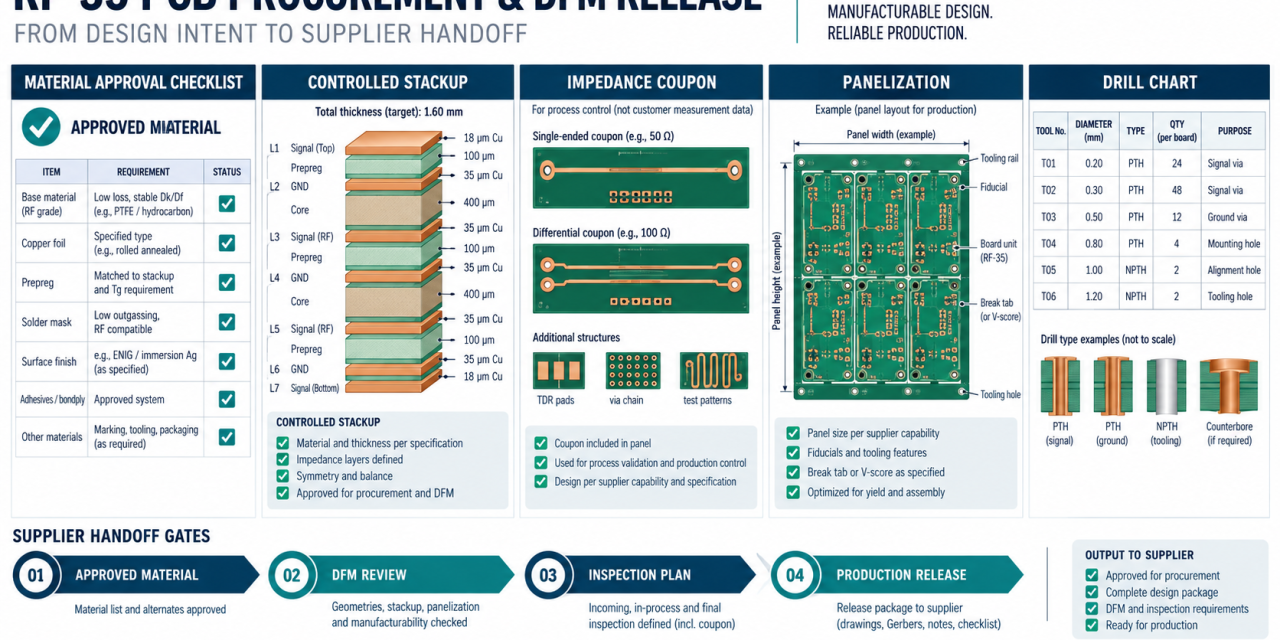
RF-35 PCB Procurement and DFM: A Supplier-Ready Release Checklist

Procurement teams often receive a microwave PCB package that looks complete but leaves the fabricator to guess the laminate grade, pressed dielectric, coupon method, or drill sequence. This supplier-ready checklist uses an RF-35 PCB example to turn design intent into controlled purchasing and DFM inputs without inventing customer results. RF-35 ceramic-filled PTFE/glass laminates are commonly...
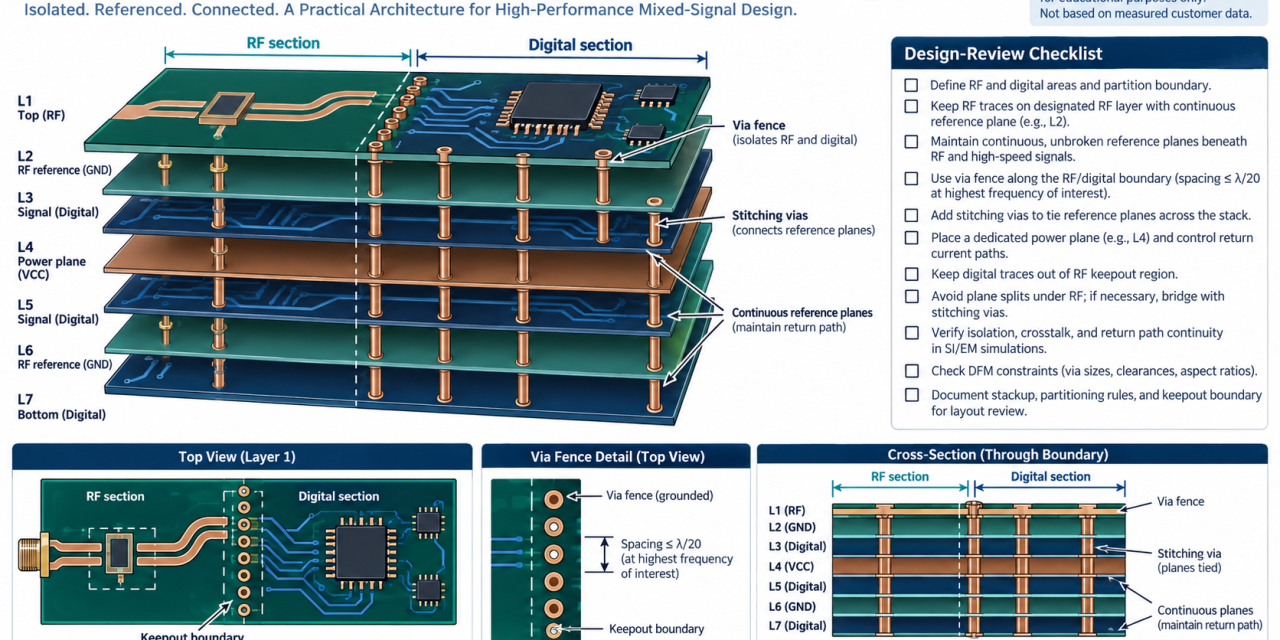
RF-35 PCB Mixed-Signal Stackup: Partitioning RF and Digital Return Paths

Mixed RF-and-digital boards rarely fail because the engineer forgot a trace-width rule. They fail when the stackup, plane strategy, and return path are treated as separate documents. This article uses an RF-35 PCB example to explain how a project team can partition RF and digital functions while keeping the board manufacturable. RF-35 ceramic-filled PTFE/glass materials...

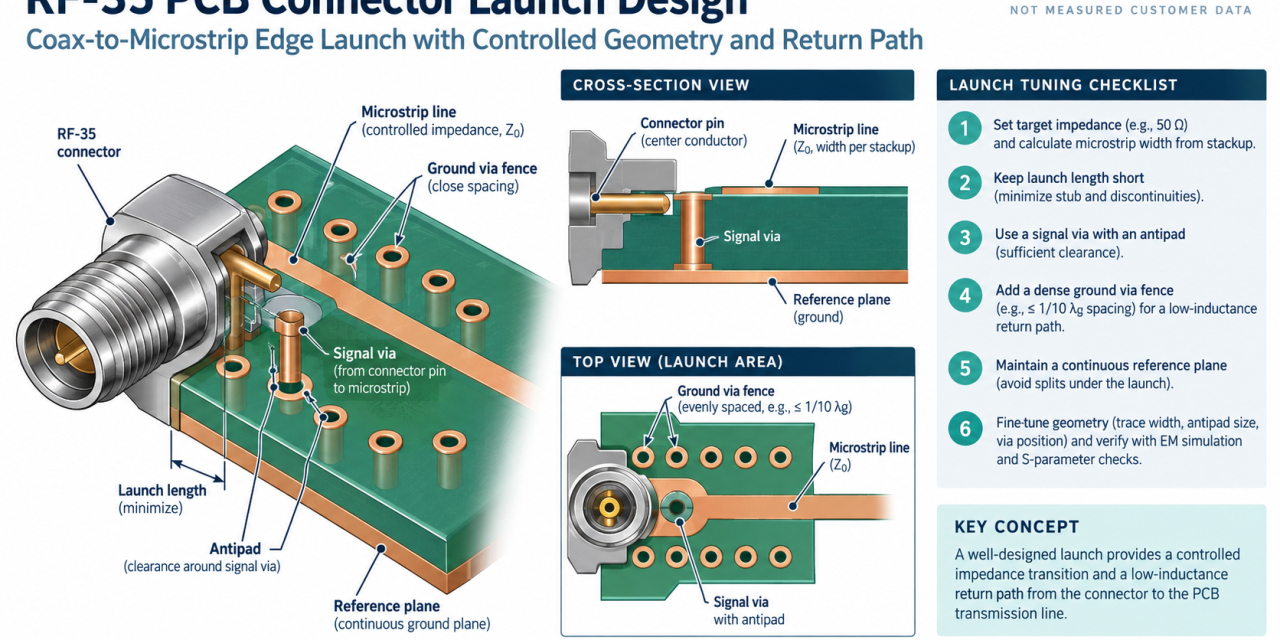
RF-35 PCB Connector Launch and Via Transition: A Practical Verification Workflow

A connector launch is the shortest and most fragile transmission-line section on many microwave boards. The signal leaves a coaxial pin, crosses a pad and via, and then enters a controlled planar line. This guide uses an RF-35 PCB example to show how to release that transition with a defined return path, manufacturable clearances, and...

RF-35 PCB Thermal Stability: Controlling CTE, Registration, and Drill Reliability

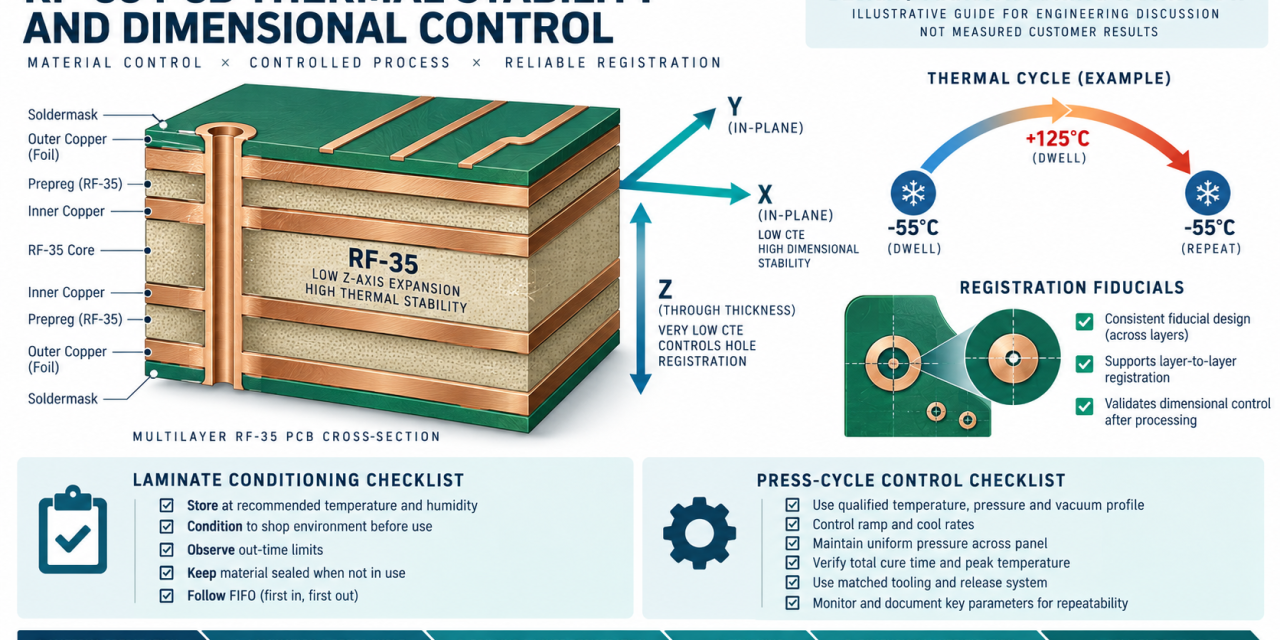
Thermal drift is an electrical problem when a microwave board moves enough to change trace geometry, connector alignment, or plated-hole stress. This article treats RF-35 PCB as a production material choice and focuses on the thermal-mechanical controls that keep a high-frequency design repeatable from panel build through assembly. Taconic RF-35 typical property tables report a...

RF-35 PCB: High-Performance Low-Loss RF PCB Material for Microwave and Wireless Communication Systems

1.Why RF-35 PCB Materials Are Widely Used in RF Electronics Modern RF and microwave systems continue advancing toward: Higher operating frequencies Faster wireless communication Lower signal attenuation requirements Higher integration density Applications such as: 5G wireless infrastructure Automotive radar systems Satellite communication equipment RF transceiver modules Aerospace microwave electronics require PCB materials capable of delivering:...

RF-35 PCB: High-Frequency Low-Loss PCB Material for RF and Microwave Applications

1.Why RF-35 PCB Materials Matter in High-Frequency Electronics Modern RF and microwave systems demand increasingly higher performance in: Signal transmission speed Frequency stability Low insertion loss Controlled impedance accuracy Applications such as: 5G communication infrastructure Automotive radar systems RF transceiver modules Aerospace communication equipment Microwave antennas require advanced PCB materials capable of maintaining stable electrical...

Taconic PCB: High-Frequency Materials for Reliable RF and Microwave Designs

What Is a Taconic PCB? A Taconic PCB is a high-performance RF PCB manufactured using Taconic materials, which are engineered for low loss, stable dielectric properties, and reliable high-frequency performance. Taconic PCB materials are widely used in RF, microwave, and high-speed digital applications, where signal integrity is critical. Common Taconic material families used in Taconic...

RF-35 PCBs: Cost-Effective Low-Loss Solutions for RF Applications

An RF-35 PCB is a printed circuit board built using Taconic RF-35 laminate, a ceramic-filled PTFE-based material designed for high-frequency applications. With a dielectric constant of approximately 3.5 and a low dissipation factor, RF-35 provides a balance between signal performance, thermal stability, and manufacturability. Compared to standard FR-4, RF-35 significantly reduces signal loss at high...

RF-35 PCB: A Reliable Low-Loss Material for High-Frequency RF Applications

As wireless communication technologies continue to evolve, the demand for reliable high-frequency PCB materials has increased significantly. Applications such as RF communication systems, antennas, radar modules, and microwave devices require PCB substrates that provide stable electrical performance and low signal loss. One widely used solution in RF circuit design is the RF-35 PCB, a high-frequency...

5G Router PCB – High-Frequency PCB Solutions for Next-Generation Networking

What Is a 5G Router PCB? A 5G Router PCB is a printed circuit board specifically designed for 5G wireless routers and communication devices. Unlike standard PCB designs, 5G router PCBs must handle multi-GHz signals, support MIMO antenna arrays, and maintain signal integrity in high-density multilayer designs. These PCBs enable ultra-fast data transmission, low latency,...