HDI PCB - KKPCB
 
HomeTag

HDI PCB - KKPCB

High Layer Count PCB: Advanced Multilayer Solutions for Complex Electronic Systems

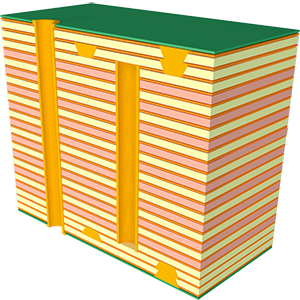
What is a High Layer Count PCB? A High Layer Count PCB refers to a multilayer printed circuit board with a large number of layers, typically 10 layers and above, and often reaching 20, 30, or even 50+ layers in advanced applications. A high layer count PCB is designed to handle complex routing, high-speed signals,...

Buried Via PCB: Advanced Multilayer PCB Technology for High-Density Designs

What is a Buried Via PCB? A Buried Via PCB is a multilayer printed circuit board where vias are located between internal layers only, without extending to the outer layers. Unlike through-hole vias, a buried via PCB allows connections between inner layers while keeping the outer layers free for routing, enabling higher circuit density and...

HDI PCB: High-Density Interconnect Technology for Advanced Electronics & Miniaturized Designs

What is an HDI PCB? An HDI PCB (High-Density Interconnect PCB) is an advanced printed circuit board designed with higher wiring density per unit area, using technologies such as microvias, fine lines, and sequential lamination. Compared to conventional PCBs, an HDI PCB enables more compact layouts, improved electrical performance, and higher signal density, making it...

Fine Line PCB: Advanced Manufacturing for High-Density & Miniaturized Circuit Designs

What is a Fine Line PCB? A Fine Line PCB refers to a printed circuit board with extremely narrow trace width and spacing, typically below 100 μm (4 mil) and often reaching 50 μm (2 mil) or less in advanced designs. These PCBs are essential for high-density interconnect (HDI) and miniaturized electronic products, where space...

BT Epoxy PCB: High-Performance Substrates for IC Packaging and High-Speed Design

What Is a BT Epoxy PCB? A BT Epoxy PCB is a high-performance PCB built using BT epoxy resin (Bismaleimide-Triazine), a material widely used in IC substrate and semiconductor packaging applications. Compared to standard FR-4, a BT Epoxy PCB offers: Higher glass transition temperature (Tg) Lower dielectric loss Better dimensional stability Improved reliability under thermal...

Fine Line PCBs: Pushing the Limits of Precision and Density in Modern Electronics

What Is a Fine Line PCB? A Fine Line PCB refers to a board manufactured with extremely narrow trace width and spacing, typically: ≤100 µm (4 mil) → standard fine line ≤75 µm (3 mil) → advanced ≤50 µm (2 mil) or below → ultra-fine line These geometries go beyond conventional PCB fabrication limits and...

Microvia PCBs: Design, Reliability, and Engineering Trade-Offs Explained

Why Microvias Are Critical in Modern PCB Design As electronic devices continue to shrink while performance demands increase, traditional through-hole vias become a limiting factor. Microvias solve this by enabling high-density interconnects with shorter electrical paths. They are essential when: BGA pitch ≤ 0.8 mm (especially ≤ 0.5 mm) Routing congestion limits layout feasibility High-speed...

HDI PCBs Explained: Stack-Up Choices, Via Strategies, and Cost Trade-Offs

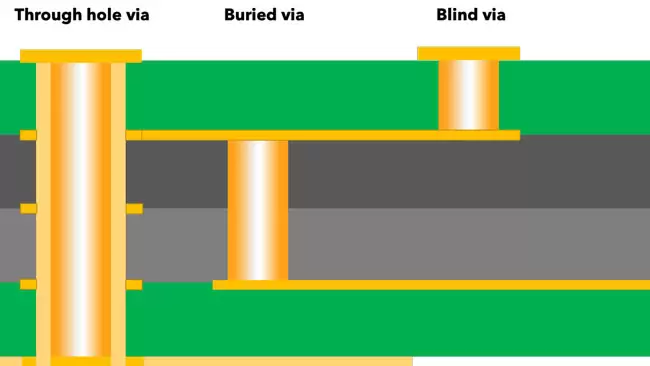
What Actually Defines an HDI PCB? An HDI PCB (High-Density Interconnect PCB) is not defined by layer count alone, but by how efficiently interconnections are implemented. The key differentiators are: Microvias (laser-drilled vias) Blind and buried vias Fine line and spacing (typically ≤100 µm) High connection density per unit area The goal of HDI is...

High Pin Count PCBs: Managing Complexity in Advanced Electronic Systems

System Complexity as the Driving Force Modern electronic systems are no longer defined by individual components, but by highly integrated devices with massive I/O requirements. CPUs, GPUs, FPGAs, and advanced SoCs now feature hundreds to thousands of pins, driving the need for High Pin Count PCBs. This shift introduces a new level of complexity: Multiple...

HDI PCBs: High-Density Interconnect Solutions for Next-Generation Electronics

Why HDI PCBs Are No Longer Optional As electronic devices become smaller, faster, and more complex, traditional multilayer PCB designs struggle to keep up. HDI (High-Density Interconnect) PCBs address this challenge by enabling higher routing density, shorter signal paths, and better electrical performance. At the core of HDI technology is the use of: Microvias (laser-drilled...