Blog

Explore the KKPCB Blog for the latest PCB manufacturing and assembly news, industry insights, expert tips, and technology trends, helping you stay informed and optimize your electronics projects.
Why You Need Rigid Flexible Circuits From KKPCB

These PCBs create a more challenging design for rigid-flex manufacturers, but we’ve been able to supply successful designs with full compliance and reliability. By engineering these in a 3D environment, we’re able to achieve spatial efficiency and incorporate folds and flexes to help you meet the desired shape that works best with your application. A rigid-flex printed...

What is an HDI printed circuit board?

HDI printed circuit board have a higher density per unit circuit than traditional PCBs. They use a combination of buried and blind vias and microvias (0.006 inches in diameter or less). A high-density board is a PCB that has one or more of the following features: Through and buried vias Through surface-to-surface vias At least...

How to avoid radio frequency and microwave PCB design issues

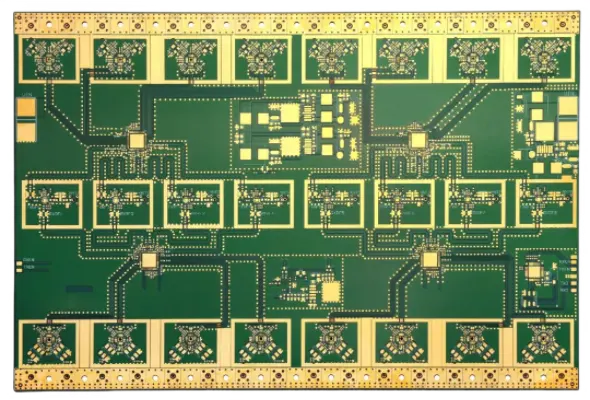
With the rapid development of wireless communication, radar systems, satellite communication, automotive electronics, and high-frequency industrial applications, RF (Radio Frequency) and microwave PCB technology has become increasingly important. Unlike conventional low-frequency PCB designs, RF and microwave circuits operate at higher frequencies where even small variations in PCB structure can significantly affect electrical performance. Common design...

What is the difference between flexible PCB and just scratching the printing circuit board?

1. What Is a Flexible PCB? A flexible PCB (Flex PCB) is a specially engineered printed circuit board made from flexible materials such as polyimide. It is designed to bend, twist, or fold without damaging the circuit. Key Characteristics: Built on flexible substrates (e.g., polyimide) Designed for dynamic or static bending High reliability under mechanical...

N4800-20 High-Speed Multifunctional Epoxy Laminate & Prepreg

As the demand for high-bandwidth data transmission and 5G infrastructure grows, the choice of PCB base materials becomes a critical factor in system performance. N4800-20, developed by Nelco, is a high-speed, multifunctional epoxy laminate and prepreg system designed specifically for the next generation of high-speed digital (HSD) applications. It offers a unique balance of thermal reliability and superior signal integrity, making...

Manufacturing and Application of HDI Boards

HDI board manufacturing is the fastest growing field in the printed circuit board industry. From the first 32-bit computer launched by HP in 1985 to today’s large-scale customer servers using 36 sequentially laminated multi-layer printed circuit boards and stacked micro-vias, HDI/micro-via technology is undoubtedly the future PCB architecture. Large ASICs and FPGAs with smaller device pitches,...

PCB Production Process: Subtractive and Additive Methods

Printed Circuit Boards (PCBs) are the foundation of modern electronic products, providing electrical connections and mechanical support for components. From consumer electronics and automotive systems to communication equipment and semiconductor applications, PCB manufacturing technology directly influences product performance, reliability, and production efficiency. During PCB fabrication, conductive patterns are created through different manufacturing approaches. The two...

HDI Board: High Density Interconnect Technology

HDI boards, or High Density Interconnect boards, represent a significant advancement in PCB manufacturing, particularly suited for high-density circuit applications. These boards utilize micro-blind buried via technology to achieve compact designs with high line distribution density. Key characteristics include: Manufacturing Process: HDI boards typically employ micro-blind buried via technology, necessitating non-mechanical drilling methods such as laser...

Key Points of RF Circuit Board Design

RF circuit board design is a critical and often complex area of PCB engineering. While there are many uncertainties in theory, practical design rules can be followed to optimize performance. The following key points will focus on RF circuit board partitioning and design strategies. 1. Microvias in RF Design Microvias are essential for connecting different layers on...

Practical Skills in High-Frequency PCB Design

In PCB design, achieving smaller, faster, and more cost-effective products is key. High-frequency PCB design presents unique challenges, especially at interconnection points, where electromagnetic properties must be carefully managed. This article focuses on practical skills for interconnection within the PCB board, providing valuable insights for engineers. For high-frequency applications, consider the following PCB design skills: Use 45° Transmission Line Corners:...