kkpcb04 - KKPCB - Page 96 of 104
 
HomeAuthor

kkpcb04 - KKPCB - Page 96 of 104

Enhance Signal Integrity and Thermal Reliability with ADAS PCB Platforms for Automotive Radar Systems

Advanced Driver Assistance Systems rely heavily on 77 GHz automotive radar modules, where the ADAS PCB directly determines signal integrity, insertion loss, dielectric stability, and system-level thermal reliability. As radar sensors expand from single-beam to multi-beam architectures, PCB materials and stackup selection have become primary constraints for RF linearity and long-distance object detection. The objective...

Extend Thermal Robustness and RF Power Efficiency with RO4835 PCB Substrates in High-Density Microwave Power Amplifier Platforms

High-density microwave power amplifier platforms demand PCB materials capable of maintaining stable dielectric performance, high RF power efficiency, and long-term thermal robustness under continuous high-power loads. RO4835 PCB substrates are engineered precisely for these conditions. By combining a tightly controlled dielectric constant, low dissipation factor, and excellent oxidative stability, RO4835 PCBs offer a reliable foundation...

Achieve Ultra-Consistent Dk/Df Performance Through RO4835 PCB Engineering for 5G Massive-MIMO Radio Units

The Importance of Dk/Df Stability in 5G Systems As 5G communication systems continue to evolve, especially in Massive MIMO radio units, maintaining ultra-consistent dielectric constant (Dk) and dissipation factor (Df) is critical for ensuring stable RF performance and reliable high-speed signal transmission. In high-frequency RF PCB design, even small variations in Dk/Df performance can lead...

Enhance Thermal Reliability and High-Power RF Efficiency Through Advanced 5G Router PCB Stackups

5G router PCB platforms operate under multi-band RF loads, high-density routing, and continuous thermal cycling in compact CPE enclosures. Achieving stable RF efficiency requires a stackup engineered around low-loss materials, controlled dielectric stability, and carefully optimized thermal paths. This article analyzes how engineered 5G router PCB stackups improve RF efficiency, insertion-loss performance, and long-term thermal...

Improve Long-Term Reliability and Temperature Cycling Endurance Using Alumina PCB Platforms in High-Power LED Arrays

High-power LED systems require extreme reliability, efficient heat spreading, and stable electrical performance across thousands of thermal cycles. Alumina PCB, Alumina Ceramic PCB, and Al₂O₃ PCB substrates have become the preferred materials for LED lighting modules due to their high thermal conductivity, mechanical stability, and superior dielectric strength. 1. Heat Dissipation for High-Power LED Packages...

Achieve Multi-Gig Channel Reliability and Tight Impedance Control with Megtron 7 PCB Stackups for Advanced Server Motherboards

Modern server motherboards require predictable impedance, extremely low jitter, and stable multi-gigabit routing to support DDR5, PCIe 6.0, and high-density network interfaces. FR-4-class materials fail to provide consistent loss and dielectric stability. Megtron 7 PCB laminates supply ultra-low Df, tight dielectric tolerances, and high-temperature reliability suited for 8–64 GT/s environments. KKPCB adapts Megtron 7 PCB...

Enhance High-Speed Signal Integrity and Low-Loss Performance with Megtron 7 PCB Platforms for 112G/224G SerDes Systems

Next-generation 112G/224G SerDes channels push FR-4 far beyond its electrical limits. As data center switching, AI computing, and PCIe-6/7 architectures scale upward, loss tangent, copper roughness, and impedance drift become critical bottlenecks. Megtron 7 PCB laminates—Df 0.0012 class, highly stable Dk, and low copper-permittivity interaction—provide an electrically clean foundation for long-reach PAM4 channels. KKPCB integrates...

Stabilize Wideband Impedance and Reduce Signal Drift Using RO4835 PCB Laminates in Mission-Critical Satellite Links

Satellite communication hardware depends on highly stable RF PCB materials capable of maintaining low-loss transmission, tight impedance control, and long-term dielectric stability under extreme environmental shifts. RO4835 PCB laminates—known for oxidation-resistant resin systems, stable Dk over temperature, and low insertion loss up to Ka-band—are frequently selected for mission-critical RF payloads, transceiver modules, phased arrays, and...

Optimizing High-Frequency Stability and Low-Loss Transmission Using RF-35 PCB Laminates for Modern Wireless Systems

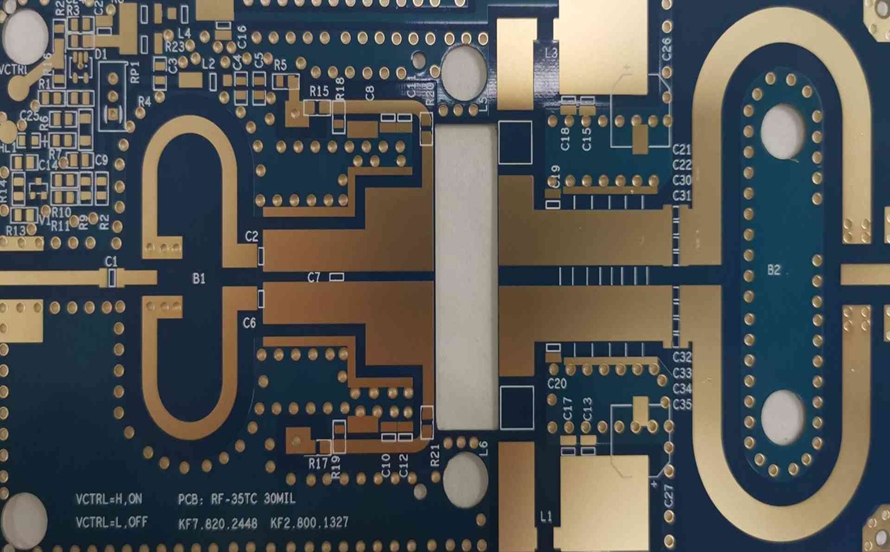
As modern wireless systems continue to evolve toward higher frequencies and faster data rates, achieving high-frequency stability and low-loss signal transmission has become a critical requirement in RF PCB design. One of the most effective ways to optimize high-frequency PCB performance is through advanced material selection—specifically RF-35 PCB laminates. RF-35 laminates are engineered for high-frequency...

Boost High-Frequency Linearity and Long-Term Reliability with RO4835 PCB Platforms for Next-Generation RF Front Ends

The Hidden Killer of Next-Gen RF Front-End Performance in 2025 As 5G mmWave base stations, LEO satellite user terminals, and aerospace active phased-array systems push toward 28–40 GHz and even 60 GHz D-band prototypes, two parameters have become non-negotiable: Third-order intermodulation distortion (IP3) must exceed +50 dBm at the antenna port Passive intermodulation (PIM) must...