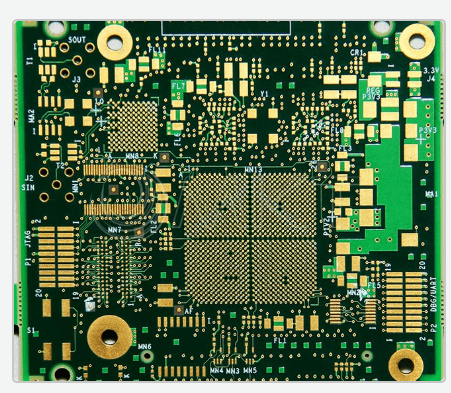
signal integrity PCB - KKPCB
 
HomeTag

signal integrity PCB - KKPCB

Enable Ultra-Complex Routing and Signal Integrity with High Layer Count PCB Architectures for Advanced Electronic Systems

High Layer Count PCB: The Backbone of Ultra-Complex Electronic Integration A High Layer Count PCB refers to a multilayer printed circuit board typically exceeding 12 layers and extending to 20, 30, or even 60+ layers for advanced electronic systems. High layer count PCB designs are essential for applications requiring dense routing, high-speed signal transmission, controlled...

Optimize High-Frequency Signal Integrity and Power Efficiency with Low Dissipation Factor PCB Materials

Why Low Dissipation Factor PCB Matters in High-Frequency Electronics As electronic systems evolve toward higher frequencies, faster data rates, and tighter power budgets, signal loss within the PCB itself becomes a dominant performance constraint. In RF, microwave, mmWave, high-speed digital, and satellite communication systems, even minor dielectric losses can accumulate across long signal paths, directly...

High Speed PCB Engineering for Signal Integrity, Power Integrity, and Ultra-Low-Latency Electronic Systems

As modern electronics become faster, more compact, and more data-intensive, the High Speed PCB has evolved into a critical engineering platform for communication systems, servers, AI accelerators, radar units, embedded computing modules, and advanced industrial electronics. A well-engineered High Speed PCB ensures clean signal transmission, stable power behavior, and low-jitter operation across multi-gigabit channels. High-speed...

Advanced Robotics PCB Design: Optimizing Signal Integrity, Power Distribution, and Sensor Integration for Industrial Automation

Modern industrial automation, autonomous robots, and collaborative robotic systems depend heavily on Robotics PCBs as the central electronic platform for control, sensing, and communication. Engineers designing Robotics PCBs face unique challenges: ensuring low-latency signal transmission, maintaining power stability for high-current actuators, integrating a diverse set of sensors, and protecting sensitive electronics from electromagnetic interference. 1....

Engineering Low Dissipation Factor PCBs for High-Frequency and RF Performance

1. Engineering Context  As electronic systems push into higher frequencies—5G, mmWave sensing, radar, satellite communication, and precision instrumentation—the dissipation factor (Df) of PCB materials has become a primary performance determinant.A Low Dissipation Factor PCB minimizes dielectric loss, preserves signal integrity, and ensures stable operation at frequencies where traditional FR-4 rapidly degrades. Low Df PCBs bridge...

Optimize High-Frequency Signal Integrity and Thermal Stability with TLY-5 PCB Laminates for 5G RF Front-End Modules

As 5G RF front-end modules push into sub-6 GHz and mmWave bands, PCB materials must deliver extreme electrical precision, low-loss propagation, and predictable thermal behavior. TLY-5 PCB laminates, based on PTFE composites engineered with ultra-low dielectric constant (Dk ≈ 2.17) and low dissipation factor (Df ≈ 0.0009), have emerged as one of the most reliable...

Boost Design Accuracy and Signal Integrity Using High-Precision PCB Prototype Fabrication Technologies

High-precision PCB prototype fabrication has become the backbone of modern electronics development. As product cycles shrink and system complexity rises—spanning RF modules, high-speed digital interfaces, IoT sensors, EV power systems, and aerospace electronics—the demand for PCB prototype accuracy, signal integrity stability, and manufacturing predictability has never been higher. A high-reliability prototype is not “just a...

Improve Multi-Gigabit Transmission and Low-Loss Routing Through Impedance Controlled PCB Engineering for Data Center Switches

Modern data center switches demand high-speed, multi-gigabit transmission across densely packed PCB layers. Maintaining low insertion loss, tight impedance control, and minimal crosstalk is critical to guarantee reliable signal integrity, reduce latency, and preserve network throughput. Impedance-controlled PCB architectures provide predictable high-frequency performance for differential pair routing and dense multilayer stackups. KKPCB leverages precision lamination,...

Megtron 6 PCB Material: A Complete Technical Guide to Properties, Performance, and High-Speed Applications

Megtron 6 is a premium high-speed, low-loss PCB laminate developed by Panasonic, designed specifically for next-generation high-frequency and high-data-rate systems. Positioned between standard FR-4 and PTFE-based microwave materials, Megtron 6 delivers exceptionally low transmission loss, stable dielectric performance, and robust thermal reliability—making it a preferred choice in telecom, networking, data-center, computing, and RF applications. By...

Optimizing Signal Integrity in RO4003C PCBs for mmWave and RF Power Applications

Signal Integrity — The Invisible Backbone of mmWave Performance   As 5G networks and radar systems transition into 24–77 GHz mmWave frequencies, signal integrity (SI) has become one of the most critical yet challenging aspects of RF PCB engineering.   At these frequencies, every micron of copper geometry, dielectric uniformity, and via structure directly influences...