PCB Design Services | Professional PCB Layout & Design - KKPCB
 
HomeCategory

PCB Design Services | Professional PCB Layout & Design - KKPCB

Industrial Automation PCB Engineering for High-Reliability Control, Sensing, and Power Management Systems

Industrial Automation PCB engineering sits at the core of modern manufacturing, robotics, and process-control systems. In factory environments filled with electrical noise, high temperatures, continuous vibration, and mission-critical timing demands, the Industrial Automation PCB must deliver unwavering reliability, low signal distortion, and stable power delivery. As factories evolve toward smart, interconnected, high-speed architectures, the expectations...

Engineering High Speed PCB for Signal Integrity, Low-Loss Routing, and Next-Generation Data Transmission

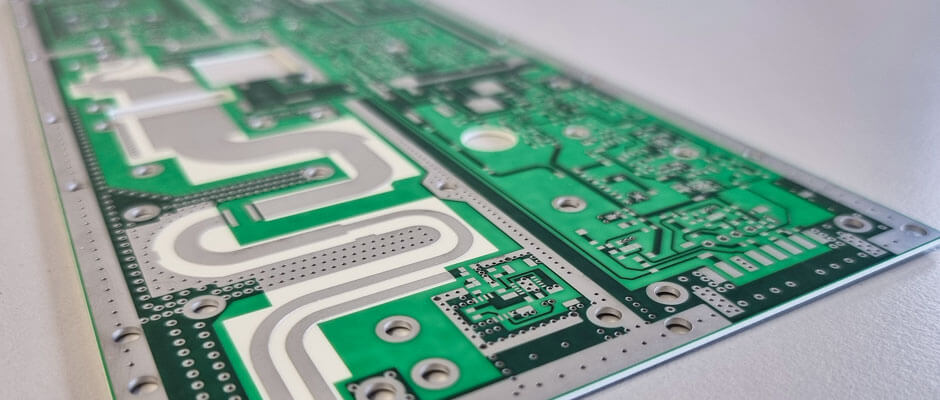
As digital systems move toward higher data rates, smaller form factors, and lower power consumption, the demand for High Speed PCB solutions continues to accelerate. From 10–112 Gbps SerDes links to DDR4/DDR5 memory buses and advanced communication modules, a High Speed PCB must deliver loss control, impedance stability, and electromagnetic reliability in increasingly complex environments....

Engineering Double Layer HF PCB for Ultra-Stable RF Performance and Low-Loss Microwave Signal Integrity

As RF communication, IoT edge devices, automotive radar, and compact wireless modules continue to evolve, the Double Layer HF PCB has become a preferred architecture for delivering high-frequency stability, low insertion loss, and predictable electromagnetic performance. Although limited to two copper layers, a Double Layer HF PCB—when engineered correctly—can outperform many multilayer structures in signal...

Engineering Low Dissipation Factor PCBs for High-Frequency and RF Performance

1. Engineering Context  As electronic systems push into higher frequencies—5G, mmWave sensing, radar, satellite communication, and precision instrumentation—the dissipation factor (Df) of PCB materials has become a primary performance determinant.A Low Dissipation Factor PCB minimizes dielectric loss, preserves signal integrity, and ensures stable operation at frequencies where traditional FR-4 rapidly degrades. Low Df PCBs bridge...

Unleash Multi-Gigabit Data Fidelity with Precision-Engineered High Speed PCB Architectures for Next-Gen Digital Systems

A High Speed PCB forms the electrical backbone of every modern digital communication system, from multi-gigabit SerDes channels to DDR memory interfaces and high-frequency RF-digital mixed platforms. As data rates continue pushing beyond 10 Gbps, 25 Gbps, and even 56–112 Gbps PAM-4, the engineering demands on a High Speed PCB become far more stringent. Signal...

Achieve Low-Loss Transmission and Stable Impedance Performance with Double Layer HF PCB Engineering for High-Frequency Communication Systems

A Double Layer HF PCB may appear structurally simple, yet in high-frequency engineering it provides a remarkably efficient platform for low-loss propagation, stable impedance, and predictable electromagnetic behavior. When RF designers need high-frequency stability without the cost or stackup escalation of multilayer PCBs, a Double Layer HF PCB offers the ideal balance between manufacturability and...

Engineering Ultra-Low Loss Performance with Low Dissipation Factor PCB Materials for High-Frequency and High-Speed Systems

Low Dissipation Factor PCB Engineering for High-Frequency, High-Power, and Low-Loss Electronic Platforms A Low Dissipation Factor PCB is the backbone of modern high-frequency hardware, designed to minimize dielectric loss, reduce signal attenuation, and maintain stable RF performance across extreme bandwidths. As systems scale into mmWave, sub-THz, and multi-gigabit domains, the dissipation factor (Df) becomes a...

High Speed PCB Engineering Strategies for Ultra-Reliable, High-Bandwidth, Next-Generation Electronic Systems

A High Speed PCB is no longer a specialty board reserved for telecom giants—it has become the core platform for every high-bandwidth, low-latency, high-frequency electronic architecture. Whether powering 56G/112G SerDes, PCIe 5.0/6.0 interconnects, next-generation routers, AI accelerator hardware, or advanced radar/5G infrastructure, the High Speed PCB defines the system’s ultimate signal integrity, timing accuracy, power...

Industrial Automation PCB Engineering for High-Reliability Control, Sensing, and Power Systems

Industrial Automation PCB: High-Reliability Engineering for Modern Automated Systems Industrial Automation PCB technology is the backbone of automated factories, motion-control systems, industrial robots, PLC modules, sensor interfaces, and high-duty power conversion equipment. Unlike consumer electronics, an Industrial Automation PCB must deliver continuous uptime, deterministic performance, and long operational life under electrical noise, mechanical stress, and...

Smart Factory PCB Engineering for High-Reliability Automation, Real-Time Control, and Industrial Intelligence

Smart manufacturing pushes electronics into an environment where precision, robustness, and real-time responsiveness are mandatory. At the center of this ecosystem lies the Smart Factory PCB, the hardware foundation that drives IIoT sensor nodes, PLC control modules, autonomous robots, edge-computing gateways, and high-speed industrial communication networks. A Smart Factory PCB must deliver electrical reliability, long-term...