
A production handoff can fail even when the first prototype looks good: a variant may use a different stackup, a coupon may not represent the critical line, or a purchasing note may omit a revision. This guide uses the RO4835 PCB to build a traceable handoff for radar and high-frequency products without presenting unverified customer results.
Make the variant boundary explicit
Each RO4835 PCB variant should identify its material callout, finished dielectric, copper class, layer count, impedance intent, and assembly option. A suffix in the part number is not enough if the stackup or coupon changes. Freeze the variant matrix before a purchase order is released.
| Handoff record | Typical gap | Control |
|---|---|---|
| Stackup revision | Wrong construction released | Link drawing, Gerber, and traveler revisions |
| Coupon definition | Non-representative evidence | Match coupon geometry to critical line |
| Material lot | Unapproved substitution | Record approved source and deviation owner |
| Inspection plan | Ambiguous acceptance | Define method, sample, and tolerance |
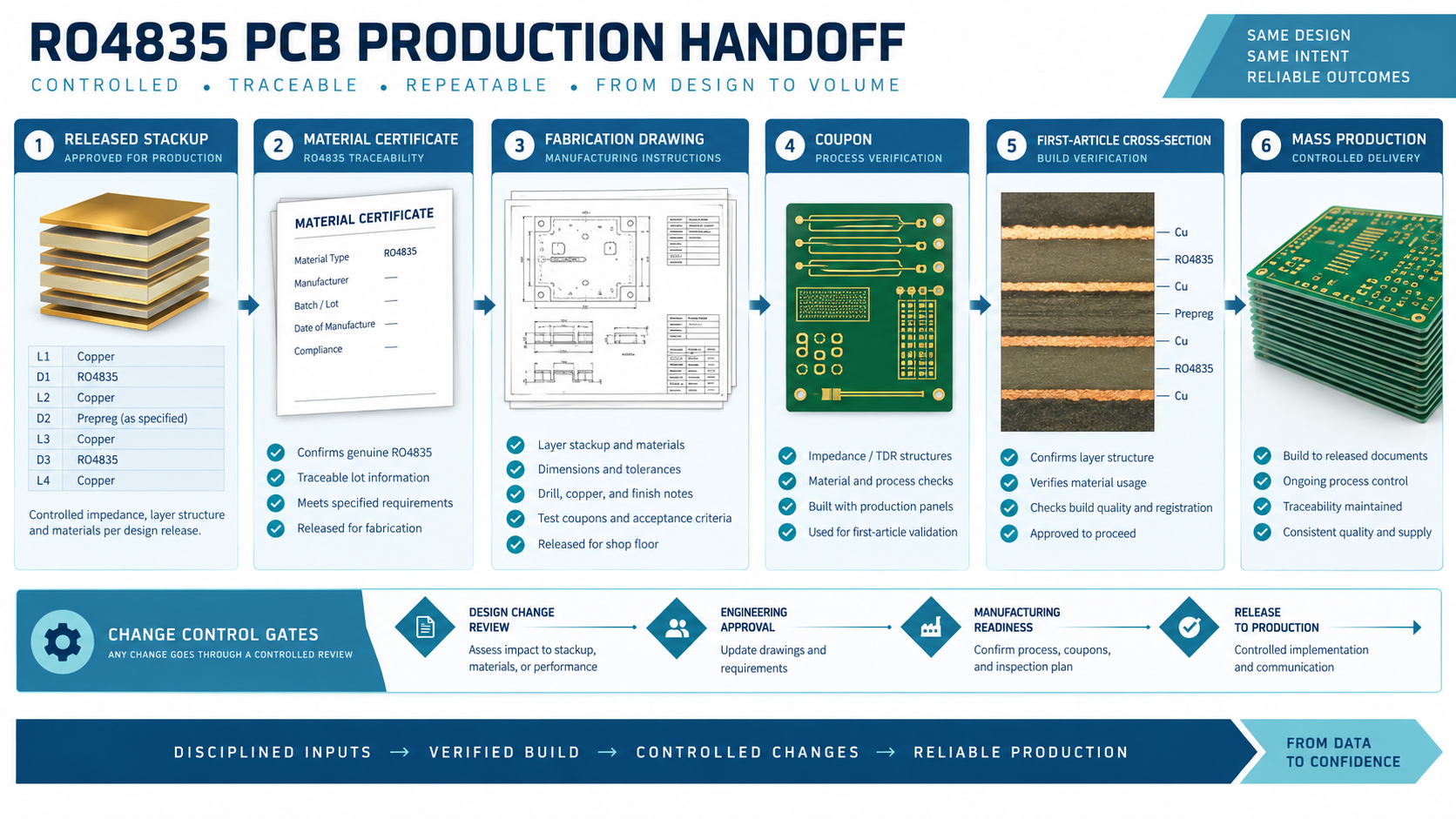
Illustrative production-handoff map connecting variant control, stackup release, inspection, and shipment records.
Build a coupon that represents the product
A coupon for a controlled impedance PCB should expose the same critical line width, reference height, copper treatment, and plating environment as the product. If the coupon is located elsewhere on the panel, document why its process exposure is representative. Keep modeled targets separate from measured values and report calibration details.
Coupon release questions
- Does the coupon use the same line family and reference layers as the RF channel?
- Is its panel location exposed to similar etch and plating conditions?
- Are the measurement fixture, calibration, sample count, and environment recorded?
- Who can approve a deviation when a result falls outside the target?
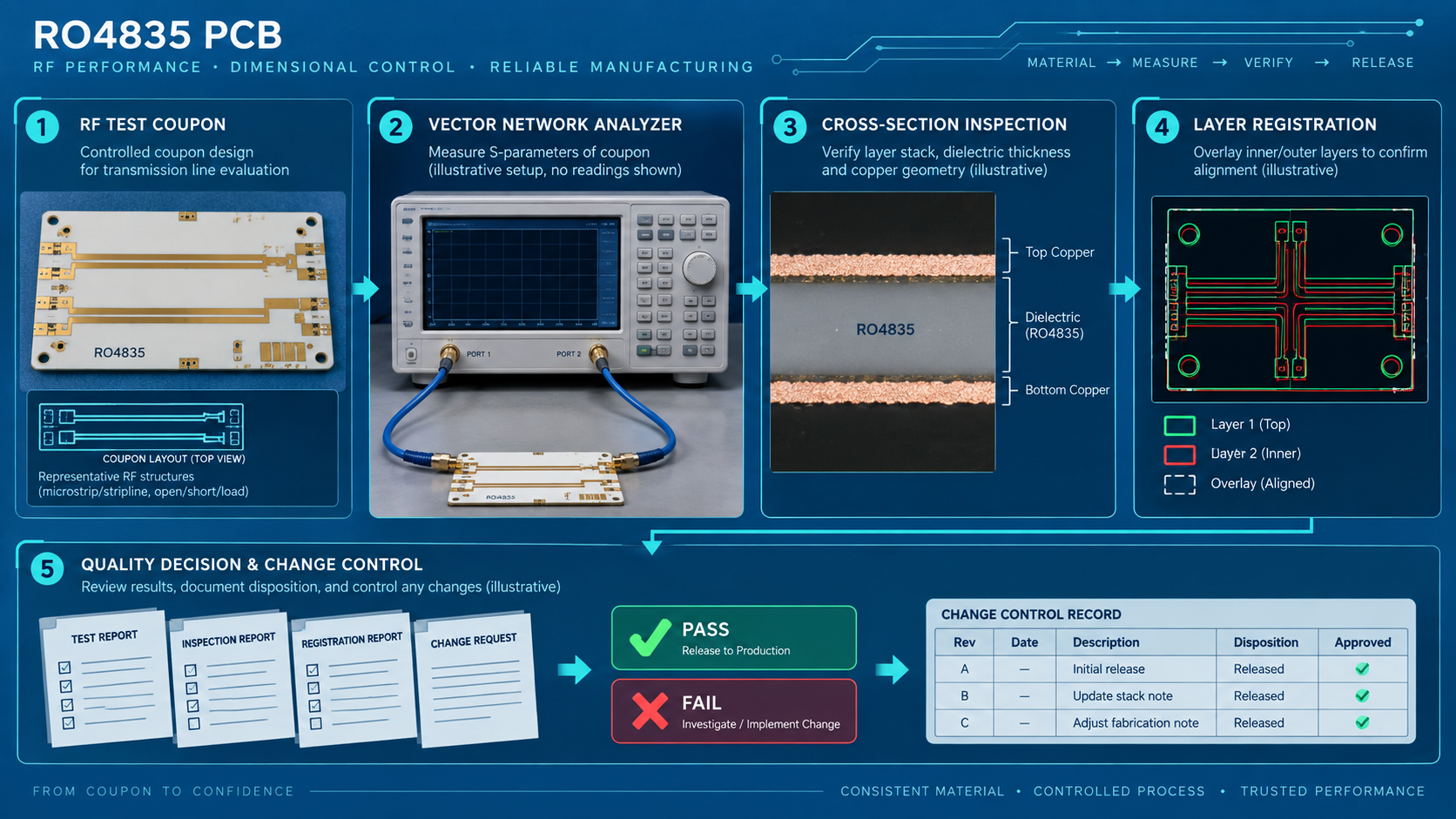
Illustrative coupon-validation flow for a high-frequency PCB production release.
Keep purchasing and engineering on the same revision
The PCB manufacturing traveler should reference the released stackup, fabrication notes, drill data, impedance requirements, inspection plan, and approved deviation route. A multilayer PCB variant must also carry its press and registration assumptions. This avoids a commercial substitute being treated as an electrically equivalent board without review.
- Lock the material and supplier source before quoting volume.
- Link every variant to its own drawing and approved data package.
- Identify which fields are target values and which require measurement.
- Record first-article findings against the same revision sent to production.
- Close deviations before shipment or document a named disposition.
Example acceptance dashboard
In an illustrative program, the RO4835 PCB dashboard can show material approval, stackup sign-off, coupon status, dimensional inspection, and open deviations. If an HDI PCB option is included, add microvia and sequential-lamination checkpoints. These are process controls, not a claim of measured customer performance.
Questions for project managers
Should every variant receive a new coupon?
Use a representative coupon for variants that share critical geometry and process exposure; otherwise define a separate coupon family.
Can purchasing change the laminate after design freeze?
Only through a documented engineering review that rechecks stackup, impedance, loss, and reliability assumptions.
What closes the handoff?
A controlled revision, accepted inspection evidence, closed deviations, and clear ownership for the next build.
Sources: Vendor-typical RO4835 material context and KKPCB public High-Frequency PCB, PCB Materials, PCB Manufacturing, Multilayer PCB, HDI PCB, and controlled-impedance categories. No external hyperlinks or claimed customer measurements are used.
For the final RO4835 PCB handoff, keep the RO4835 PCB variant matrix, coupon validation, inspection record, and deviation log under one release revision.
Use a release meeting to compare the electrical drawing with the fabrication data, assembly notes, and inspection plan. The project owner should record open questions, confirm the approved material source, and assign a date for closing deviations. Keep the RO4835 PCB acceptance gate tied to the same revision as the RO4835 PCB traveler so a later quotation cannot silently change a critical requirement.
