
What Is RO4350B PCB?
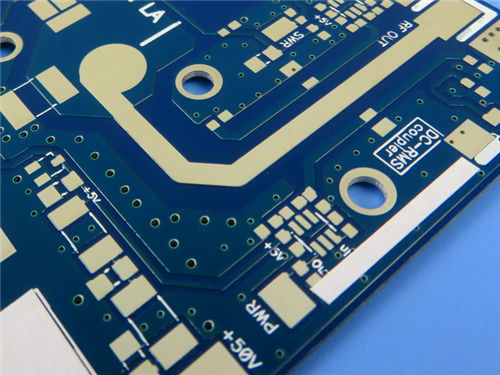
RO4350B PCB is a high-frequency laminate produced by Rogers Corporation, specifically designed for RF, microwave, and high-speed digital applications. It offers low dielectric loss (Df), stable dielectric constant (Dk), and excellent thermal reliability, making it ideal for circuits operating from hundreds of MHz to several GHz.
RO4350B PCB is widely used in 5G infrastructure, satellite communication, radar systems, and high-speed data transmission devices.
Key Features of RO4350B PCB
1. Low Dielectric Loss
RO4350B has a low dissipation factor (Df ~0.0037 at 10 GHz), which minimizes signal attenuation in high-frequency traces. This allows:
-
Longer transmission lines without significant loss
-
Improved insertion loss and return loss performance
-
Higher efficiency in RF and microwave systems
2. Stable Dielectric Constant
With a dielectric constant (Dk) of ~3.48, RO4350B maintains:
-
Consistent impedance control across layers
-
Predictable signal phase characteristics
-
Stable high-frequency performance in multilayer designs
This stability is crucial for antennas, filters, and RF modules.
3. High Thermal Reliability
RO4350B PCB features low coefficient of thermal expansion (CTE) and high Tg, providing:
-
Dimensional stability under thermal cycling
-
Minimal warpage in multilayer boards
-
Reliable soldering and component mounting
It can operate in temperatures ranging from -55°C to +280°C, suitable for harsh environments.
4. Excellent Mechanical and Chemical Stability
-
Resistant to moisture absorption
-
Stable under soldering and cleaning processes
-
Compatible with standard PCB fabrication techniques
These properties ensure long-term reliability for industrial and aerospace applications.
Design Considerations for RO4350B PCB
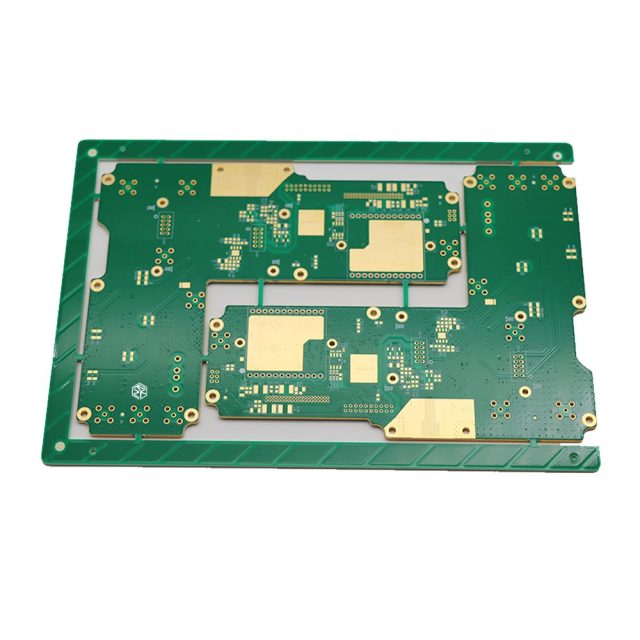
When designing RO4350B PCBs, engineers should consider:
-
Controlled impedance routing for high-speed signals
-
Via design optimization, including back-drilling if needed
-
Stack-up planning to separate signal, power, and ground layers
-
Hybrid structures combining RO4350B for critical RF layers and FR4 for non-critical layers to optimize cost
Proper design ensures high signal integrity and minimal electromagnetic interference (EMI).
Applications of RO4350B PCB
RO4350B PCBs are widely used in:
-
5G base station and antenna modules
-
RF transceiver boards
-
Satellite communication systems
-
Radar and aerospace electronics
-
High-speed digital systems (PCIe, DDR5 interface boards)
-
IoT and automotive radar modules
Its low-loss and high-frequency stability makes it a preferred choice for demanding RF and microwave applications.
RO4350B PCB vs Standard FR4 PCB
| Feature | FR4 PCB | RO4350B PCB |
|---|---|---|
| Dielectric Loss (Df) | 0.02–0.03 | 0.0037 |
| Dielectric Constant (Dk) | 4.2–4.5 | 3.48 |
| High-Frequency Performance | Limited | Excellent |
| Thermal Reliability | Moderate | High |
| Signal Integrity | Moderate | Very High |
| Cost | Low | Higher |
RO4350B PCB is chosen when signal performance, high frequency, and low loss are critical.
Conclusion
RO4350B PCB provides low loss, stable dielectric properties, and high thermal reliability for advanced RF, microwave, and high-speed digital systems. Its precise impedance control and mechanical stability make it ideal for applications requiring long-term reliability and optimal signal integrity.
For 5G, satellite, radar, and high-speed communication applications, RO4350B PCB is a high-performance solution that ensures efficiency and durability.
