
With the rapid development of high-frequency communication, automotive radar, 5G infrastructure, and advanced electronic systems, traditional FR-4 materials are increasingly challenged by applications requiring low signal loss, stable dielectric performance, and precise impedance control.
For RF and microwave PCB designs, material selection directly affects:
- Signal transmission quality
- Insertion loss
- Phase stability
- Thermal reliability
- Manufacturing consistency
Among various high-frequency PCB materials, Rogers RO4000 series laminates, especially RO4003C and RO4350B, have become widely adopted solutions due to their excellent electrical performance and compatibility with standard PCB manufacturing processes.
Unlike PTFE-based microwave materials that often require special processing methods, RO4003C and RO4350B can be fabricated using similar processes to standard epoxy/glass PCB manufacturing, helping reduce production complexity and cost.
1. Overview of Rogers RO4003C and RO4350B Materials
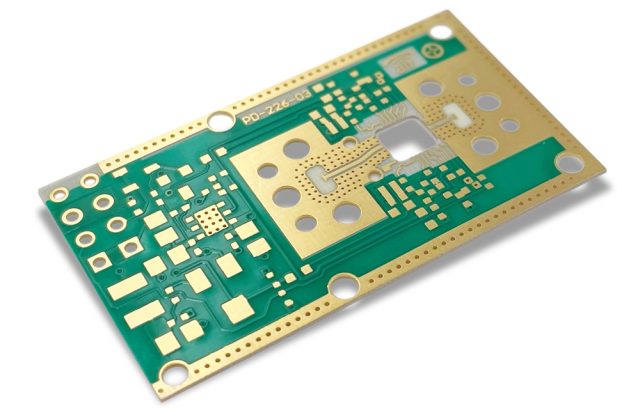
1.1 Rogers RO4003C PCB
RO4003C is a high-frequency laminate designed for RF and microwave applications requiring low loss and stable electrical performance.
Key characteristics include:
- Low dielectric loss
- Stable dielectric constant
- Excellent dimensional stability
- Compatibility with standard PCB processes
Typical electrical properties:
- Dk: approximately 3.38 ± 0.05
- Dissipation factor: approximately 0.0027 at 10 GHz
RO4003C is commonly selected for applications where signal loss reduction and high-frequency performance are primary considerations.
1.2 Rogers RO4350B PCB
RO4350B is another high-frequency laminate within the RO4000 series, offering a balance between electrical performance, thermal reliability, and manufacturing flexibility.
Key characteristics include:
- Controlled dielectric constant
- Low signal loss
- Improved thermal stability
- UL 94 V-0 flame rating capability
Typical electrical properties:
- Dk: approximately 3.48 ± 0.05
- Dissipation factor: approximately 0.0037 at 10 GHz
RO4350B is widely used in applications requiring both RF performance and higher reliability under demanding operating conditions.
2. Advantages of Rogers RO4003C and RO4350B PCB
2.1 Excellent High-Frequency Performance
The biggest advantage of RO4003C and RO4350B is their ability to maintain stable electrical performance at high frequencies.
Compared with conventional FR-4 materials, these laminates provide:
- Lower dielectric loss
- More stable signal propagation
- Better impedance consistency
This makes them suitable for:
- RF circuits
- Microwave systems
- High-speed communication equipment
2.2 Low Signal Transmission Loss
At high frequencies, signal attenuation becomes a major design challenge.
Loss sources include:
- Dielectric loss
- Copper conductor loss
- Material instability
RO4003C and RO4350B help reduce signal degradation by providing:
- Low dissipation factor
- Stable dielectric properties
- Predictable electrical performance
These characteristics are especially important for:
- Long-distance RF transmission
- High-frequency signal paths
- Precision measurement systems
2.3 Stable Dielectric Constant for Impedance Control
Controlled impedance is essential for modern RF and high-speed PCB designs.
Material variation can affect:
- Trace impedance
- Signal phase
- Transmission performance
RO4003C and RO4350B provide controlled dielectric characteristics, supporting reliable design of:
- 50Ω RF transmission lines
- Differential signal structures
- Microwave circuits
2.4 Excellent Thermal and Dimensional Stability
High-frequency PCB applications often operate under temperature variations.
Important factors include:
- Thermal expansion
- Mechanical stability
- Layer registration accuracy
RO4000 series materials provide low Z-axis expansion and good dimensional stability, helping improve:
- Plated through-hole reliability
- Multilayer PCB consistency
- Long-term product reliability
2.5 Compatible with Standard PCB Manufacturing Processes
One important advantage of RO4003C and RO4350B is manufacturing compatibility.
Compared with some PTFE-based materials, these laminates:
- Do not require complex special processing
- Can utilize standard PCB fabrication methods
- Support higher-volume production
This helps manufacturers achieve:
- Better process control
- Reduced manufacturing difficulty
- More competitive production costs
3. Comparison Between RO4003C and RO4350B
| Item | RO4003C | RO4350B |
|---|---|---|
| Material Type | Hydrocarbon ceramic laminate | Hydrocarbon ceramic laminate |
| Dk | Approx. 3.38 | Approx. 3.48 |
| Loss Performance | Lower dielectric loss | Low loss performance |
| Thermal Performance | Excellent stability | Improved thermal reliability |
| Flame Rating | Not UL 94 V-0 | UL 94 V-0 rated |
| Main Advantage | Low-loss RF performance | Balanced RF and reliability performance |
4. Applications of Rogers RO4003C PCB
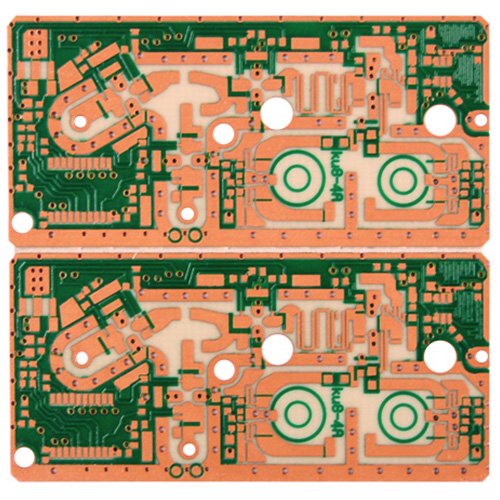
4.1 RF Communication Equipment
RO4003C is widely used in:
- RF modules
- Wireless communication devices
- Base station components
Advantages:
- Low insertion loss
- Stable signal transmission
- Accurate impedance control
4.2 Microwave Circuit Applications
Microwave circuits require precise electrical performance.
Applications include:
- Filters
- Matching networks
- Amplifiers
- Oscillators
RO4003C helps maintain:
- Phase consistency
- Frequency stability
- Signal accuracy
4.3 Automotive Radar Systems
Modern automotive radar systems require reliable high-frequency transmission.
Typical applications:
- 77GHz radar sensors
- ADAS systems
- Vehicle sensing modules
Key requirements:
- Low signal loss
- Stable dielectric performance
- Environmental reliability
5. Applications of Rogers RO4350B PCB
5.1 Power Amplifiers and RF Modules
RO4350B is suitable for RF systems requiring:
- High power handling
- Stable electrical characteristics
- Thermal reliability
5.2 5G Communication Systems
5G equipment requires:
- High-frequency operation
- Low transmission loss
- Precise signal control
RO4350B can support:
- Antenna systems
- RF front-end modules
- Communication infrastructure
5.3 Industrial and Aerospace Electronics
Applications requiring high reliability include:
- Radar equipment
- Satellite communication
- Industrial wireless systems
RO4350B provides:
- Mechanical stability
- Consistent electrical performance
- Long-term reliability
6. PCB Manufacturing Considerations for Rogers Materials
Although RO4003C and RO4350B are compatible with standard PCB processes, manufacturing still requires careful control.
6.1 Impedance Control
Manufacturers need to control:
- Trace width
- Copper thickness
- Dielectric thickness
- Stack-up structure
Typical verification methods:
- TDR testing
- Impedance coupons
6.2 Lamination Process Control
Important parameters include:
- Temperature
- Pressure
- Material combination
Improper processing may affect:
- Layer bonding
- Thickness consistency
- Electrical performance
6.3 Hybrid Stack-Up Design
For cost optimization, engineers may combine:
- Rogers materials for RF layers
- FR-4 materials for digital/control layers
Benefits:
- Maintains RF performance
- Reduces material cost
- Improves design flexibility
7. How to Select Between RO4003C and RO4350B?
The selection depends on application requirements.
Choose RO4003C when priority is:
- Lower signal loss
- RF performance optimization
- Microwave precision
Choose RO4350B when priority is:
- Thermal reliability
- Flame resistance
- Balanced RF and mechanical performance
A complete evaluation should consider:
- Operating frequency
- Signal loss requirements
- Thermal environment
- Manufacturing capability
- Cost requirements
Conclusion
Rogers RO4003C and RO4350B are widely recognized high-frequency PCB materials that provide an effective balance between electrical performance, reliability, and manufacturability.
Their advantages include:
- Low dielectric loss
- Stable electrical properties
- Reliable impedance control
- Excellent dimensional stability
- Compatibility with PCB manufacturing processes
From RF communication and microwave circuits to automotive radar and advanced electronic systems, RO4003C and RO4350B continue to support the development of high-performance PCB solutions.
