
As wireless communication, radar technology, and high-speed electronic systems continue to advance, operating frequencies are rapidly moving into the multi-gigahertz and millimeter-wave ranges. In these applications, PCB material selection becomes a critical factor affecting signal integrity, insertion loss, and overall system performance. Conventional FR-4 materials often struggle at high frequencies due to higher dielectric loss and unstable electrical characteristics.
RO3003 PCB is a high-performance high frequency PCB solution manufactured using Rogers RO3003 laminate, an ultra-low loss PTFE-based material designed specifically for RF PCB, microwave PCB, and high frequency signal PCB applications. With excellent dielectric stability and minimal signal attenuation, RO3003 PCB is widely used in demanding RF environments such as 5G and mmWave communication, radar systems, satellite communication, GPS, and high-frequency antenna designs.
What Is RO3003 PCB?
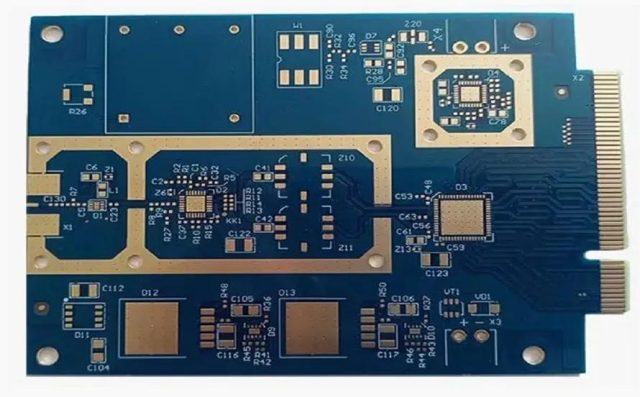
A RO3003 PCB refers to a printed circuit board fabricated using Rogers RO3003 high frequency laminate. RO3003 belongs to the Rogers RO3000 series and is engineered to provide stable electrical properties across a wide frequency range. It features a low and consistent dielectric constant (Dk) and an extremely low dissipation factor (Df), making it ideal for precision RF and microwave designs.
Compared with standard FR-4 materials, RO3003 PCB offers:
-
Significantly lower dielectric loss
-
More stable impedance control
-
Improved high frequency signal integrity
-
Reduced insertion loss and return loss
-
Predictable electrical behavior at GHz and mmWave frequencies
These advantages make RO3003 PCB a preferred choice for advanced RF circuit boards where signal quality is critical.
Key Advantages of RO3003 PCB
Ultra-Low Loss Performance
One of the most important benefits of RO3003 PCB is its ultra-low dielectric loss, which helps minimize signal attenuation during high frequency transmission. Lower loss directly improves RF efficiency and allows signals to travel longer distances with less degradation.
This makes RO3003 PCB ideal for:
-
RF front-end modules
-
Microwave transmission lines
-
High frequency RF trace routing
-
Low loss antenna feed networks
Stable Dielectric Constant for Controlled Impedance
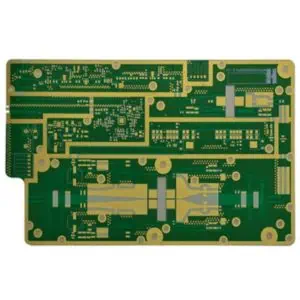
Accurate impedance control is essential in RF PCB and microwave PCB designs. Variations in dielectric constant can cause impedance mismatch, signal reflection, and degraded RF performance.
RO3003 PCB provides a stable dielectric constant over frequency and temperature, enabling reliable impedance targets such as:
-
50Ω single-ended impedance
-
75Ω impedance lines
-
Differential RF signal pairs
This stability supports consistent performance in controlled impedance PCB layouts.
Excellent Signal Integrity at High Frequency
With its low loss and stable dielectric properties, RO3003 PCB helps maintain excellent signal integrity even at high operating frequencies. It reduces phase distortion, minimizes noise, and improves overall RF system reliability.
For high frequency signal PCB designs, RO3003 PCB ensures:
-
Clean signal transmission
-
Reduced signal distortion
-
Lower electromagnetic interference (EMI) risk
Typical Applications of RO3003 PCB
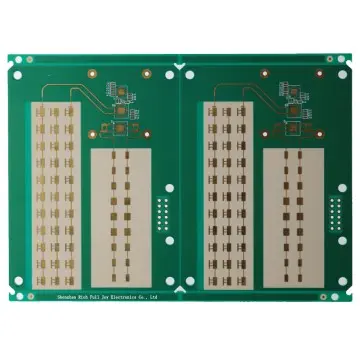
Thanks to its superior electrical performance, RO3003 PCB is widely used in many high frequency and RF applications, including:
-
RF and microwave communication systems
-
5G and mmWave wireless equipment
-
Radar and sensing systems
-
Satellite communication and GPS modules
-
High frequency antenna and RF feed networks
-
RF test and measurement equipment
-
High speed RF modules and IoT devices
In these applications, RO3003 PCB helps ensure reliable signal transmission and long-term performance stability.
RO3003 PCB Manufacturing Considerations
Manufacturing a RO3003 PCB requires specialized processes and experience compared to standard FR-4 PCB fabrication. PTFE-based materials have different thermal and mechanical properties, which must be carefully managed during PCB production.
Key manufacturing considerations include:
-
Precise controlled impedance PCB stack-up design
-
Proper handling of PTFE materials during lamination
-
Accurate drilling and via processing
-
Copper roughness optimization for RF performance
-
Hybrid stack-up capability with FR-4 if required
Choosing an experienced RO3003 PCB manufacturer is essential to achieve consistent quality and electrical performance.
RO3003 PCB vs FR-4 PCB
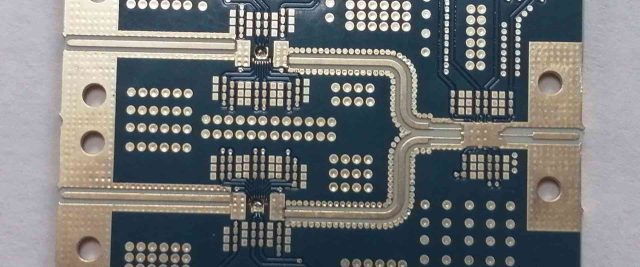
While FR-4 remains cost-effective for low and mid-frequency designs, it is not always suitable for high frequency RF applications. RO3003 PCB clearly outperforms FR-4 PCB in terms of dielectric loss, impedance stability, and signal integrity.
RO3003 PCB is especially recommended when:
-
Operating frequency exceeds several GHz
-
Low insertion loss is critical
-
Controlled impedance accuracy is required
-
RF performance consistency is a priority
Conclusion
RO3003 PCB is an ideal solution for engineers and designers working on advanced high frequency PCB, RF PCB, and microwave PCB projects. With its ultra-low loss performance, stable dielectric properties, and excellent signal integrity, RO3003 PCB enables reliable operation in demanding RF environments.
For applications such as 5G communication, radar, satellite systems, and high frequency antennas, RO3003 PCB delivers the electrical performance and reliability required to meet modern RF design challenges.
