
What Is a Rigid-Flex PCB?
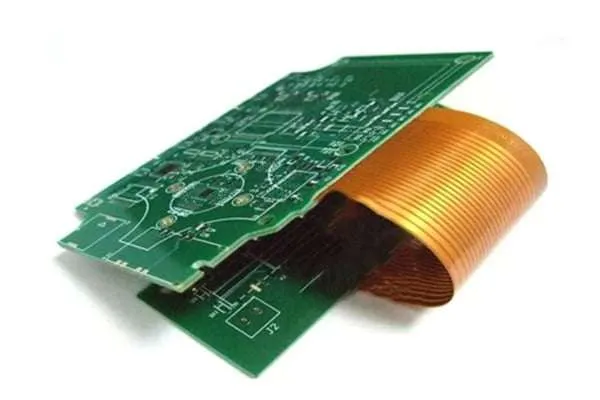
A Rigid-Flex PCB combines rigid circuit board sections with integrated flexible circuit layers into a single unified structure. This hybrid design allows the board to bend in specific areas while maintaining structural stability in others.
Unlike traditional assemblies that connect separate rigid boards using cables or connectors, rigid-flex technology integrates everything into one compact and reliable solution. This reduces interconnection failures and improves overall system durability.
Rigid-flex PCBs are widely used in applications where space, weight, and reliability are critical.
Key Advantages of Rigid-Flex PCB
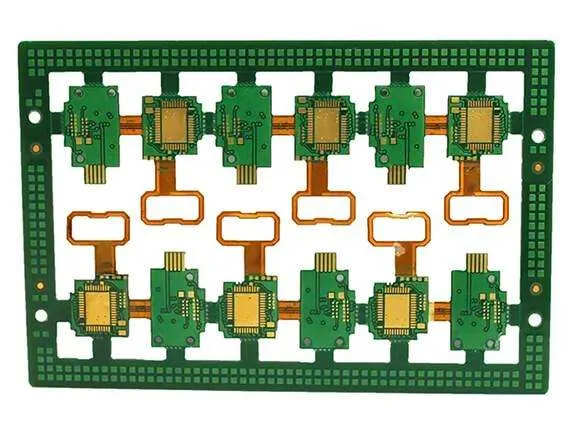
1. Space and Weight Reduction
Rigid-flex designs eliminate connectors and ribbon cables, allowing:
-
More compact product design
-
Reduced assembly space
-
Lower overall weight
This is particularly important in aerospace, medical, and portable electronics.
2. Improved Reliability
By removing connectors and solder joints between separate boards, rigid-flex PCB:
-
Reduces potential failure points
-
Enhances vibration resistance
-
Improves long-term durability
This makes it ideal for mission-critical systems.
3. Design Flexibility
Flexible sections allow:
-
3D assembly configurations
-
Folding or bending during installation
-
Integration into tight enclosures
Engineers can design products with higher structural efficiency.
4. Enhanced Signal Integrity
Rigid-flex PCB supports:
-
Controlled impedance routing
-
Multilayer stack-up design
-
Shielding layers for EMI control
-
High-speed digital and RF integration
It is suitable for high-speed and high-frequency applications.
Structure of Rigid-Flex PCB
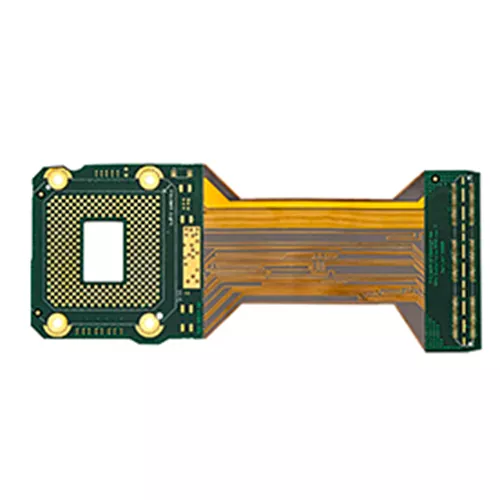
A typical rigid-flex PCB includes:
-
Rigid FR4 multilayer sections
-
Flexible polyimide layers
-
Adhesive or adhesive-less bonding
-
Coverlay protection on flex areas
-
Reinforcement plates if required
Stack-up design must carefully manage bending radius, copper thickness, and material compatibility to ensure mechanical durability.
Applications of Rigid-Flex PCB
Rigid-flex PCBs are widely used in:
-
Aerospace electronics
-
Medical devices
-
Military equipment
-
UAV systems
-
Industrial robotics
-
Automotive electronics
-
Wearable devices
In high-vibration or space-constrained environments, rigid-flex PCB provides significant structural advantages.
Manufacturing Considerations
Rigid-flex PCB production requires:
-
Precise layer alignment
-
Controlled lamination process
-
Accurate flex material handling
-
Bending radius calculation
-
Careful impedance verification
Due to structural complexity, manufacturing experience and strict quality control are essential.
Rigid-Flex PCB vs Traditional PCB Assembly
| Feature | Traditional Rigid PCB + Cable | Rigid-Flex PCB |
|---|---|---|
| Assembly Complexity | Higher | Lower |
| Connector Reliability | Moderate | Improved |
| Weight | Higher | Lower |
| Space Utilization | Limited | Optimized |
| Vibration Resistance | Moderate | High |
Rigid-flex PCB simplifies assembly while enhancing reliability.
Conclusion
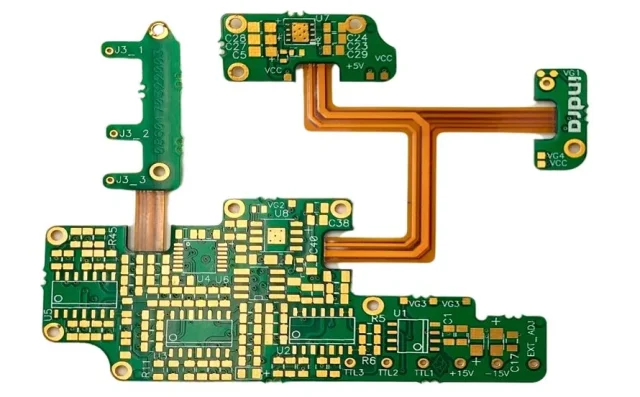
Rigid-Flex PCB technology offers a powerful solution for compact, high-reliability electronic systems. By integrating rigid and flexible structures into a single board, it reduces assembly complexity, improves durability, and enables innovative 3D designs.
For aerospace, medical, automotive, and industrial applications, rigid-flex PCB provides a dependable and space-efficient interconnect solution.
