
The most expensive Megtron 7 PCB problem is often a release problem, not a material problem. A prototype may route correctly, yet the volume panel has no representative coupon, uneven copper, an impractical depanelization rail, or an ECO that quietly changes the impedance construction. A useful DFM gate turns the electrical intent into a package that purchasing, fabrication, assembly, and quality can all read.
Freeze the build definition
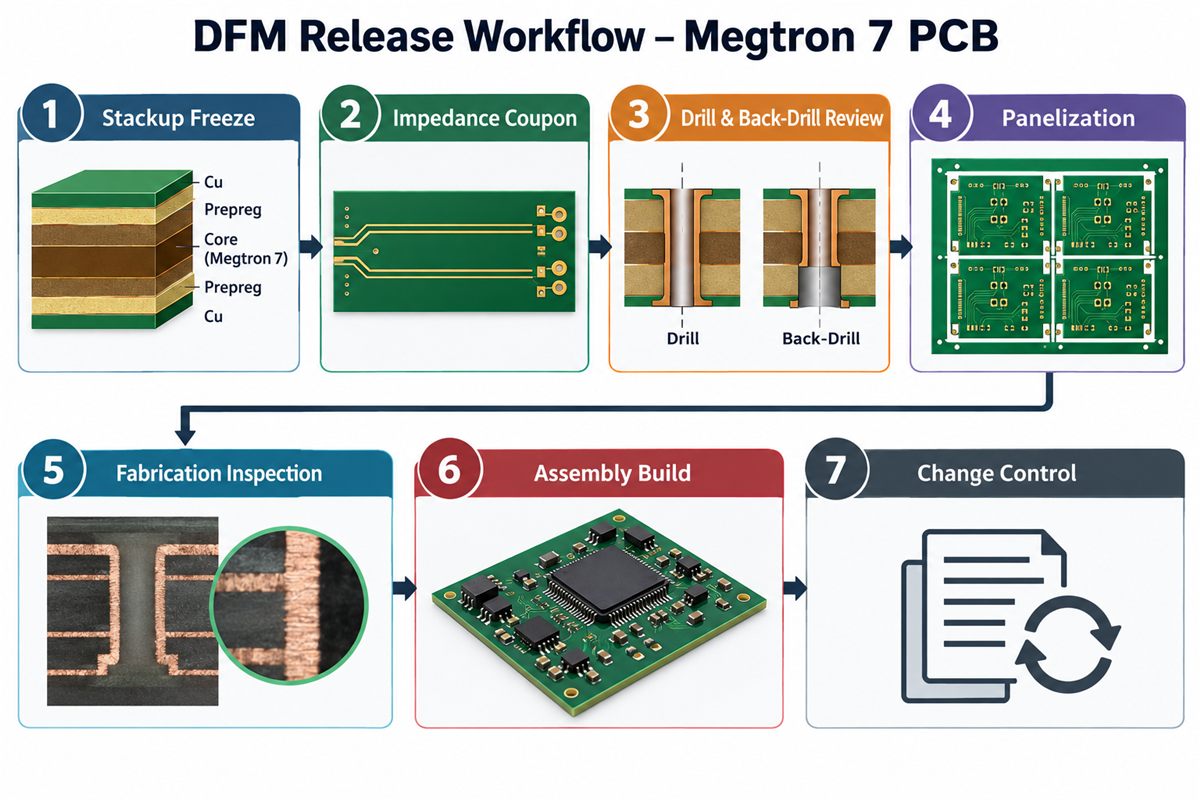
Begin with a single controlled stackup that names the Megtron 7 grade, glass style, prepreg construction, copper foil, finished copper, surface finish, and allowed substitutions. Panasonic publishes several MEGTRON 7 variants, so “Megtron 7” alone is not enough for procurement. The release should identify the exact laminate/prepreg family and note which values are typical supplier data rather than guaranteed finished-board results. A Megtron 7 PCB material record prevents an ambiguous purchase order.
Link the layer table to the impedance table and to the fabrication drawing. A PCB material sourcing review can verify availability and lead time, while the PCB layout release review checks that critical routes, plane openings, and via transitions match the stackup. Any proposed material or press substitution must trigger a documented electrical impact review.
Make panelization represent the product
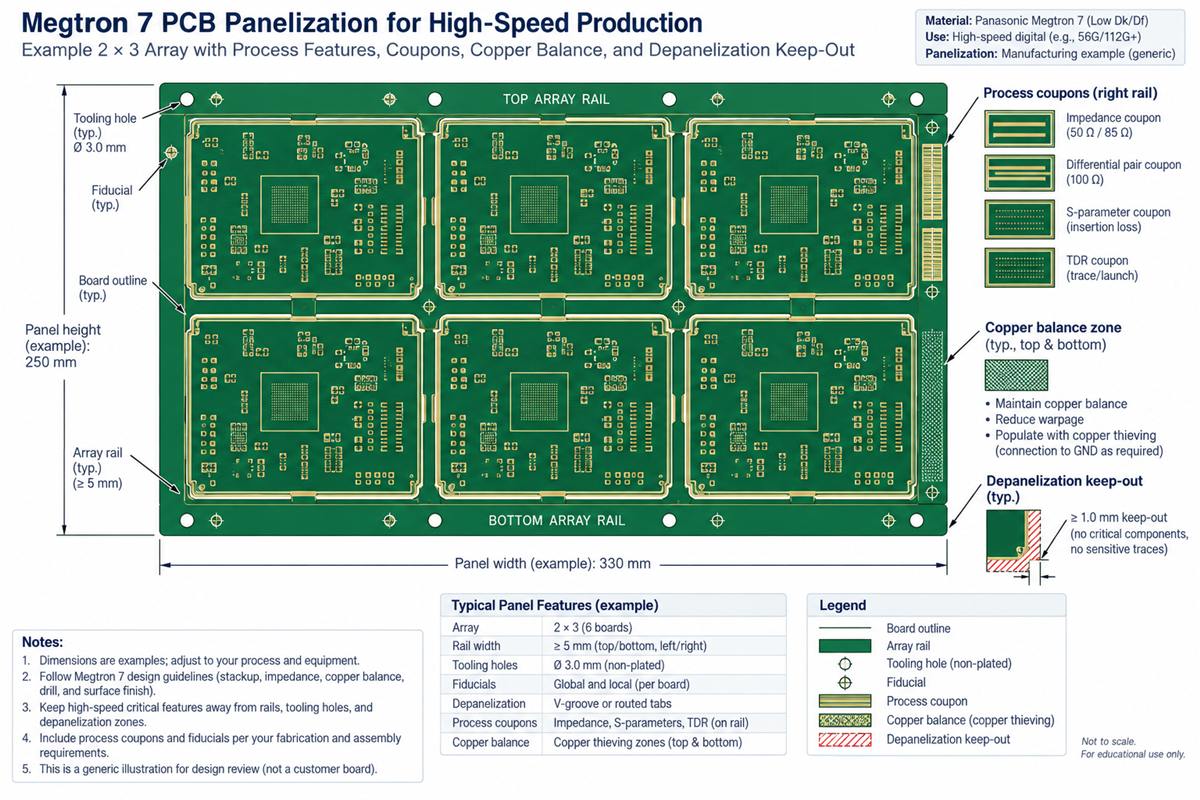
Panelization is an electrical decision when the board carries controlled-impedance channels. Keep high-speed edges away from rails, tooling holes, V-grooves, and routed tabs. Balance copper on top and bottom so press and plating behavior stay predictable. Add fiducials and coupons where the fabricator and assembler can access them without cutting into the product datum.
Coupons should represent the risk being released. Include single-ended and differential impedance where required, and add a representative via or launch structure when the connector is critical. If an insertion-loss coupon is not feasible, state exactly what the impedance coupon does and does not prove. The Megtron 7 PCB can translate the panel into drill, routing, plating, and inspection operations.
Close the production handoff
At handoff, separate three classes of information: product requirements, design targets, and acceptance evidence. Do not label a simulated loss curve as a measurement. Do not let an old Gerber package remain in a shared folder after an ECO. Record the released file hash or revision, the stackup revision, the coupon revision, and the owner who approves a change.
For the first build, combine Megtron 7 PCB with PCB assembly planning so solder mask, connector, and inspection constraints are considered before panel approval. If the board uses fine-pitch or laser-via features, the HDI manufacturing capability check belongs in the same release gate, not after the first rejection.
A project manager can close the gate with six questions: Is the exact Megtron 7 variant named? Is the panel copper balanced? Do coupons represent the controlled features? Are drill and finish notes complete? Is the ECO owner clear? Has the front-end and assembly datum been checked? When all six answers are documented, the Megtron 7 PCB is ready for a controlled build.
Confirm the Megtron 7 PCB release drawing and the assembly datum before the build.
Add a production inspection gate before volume release.
Add a before volume release.
For a project manager, the release package should also identify the panel owner, coupon disposition, inspection records, and the ECO trigger that reopens the stackup review. A Megtron 7 PCB can be electrically correct yet still lose schedule when those ownership points are implicit.
Sources: Panasonic MEGTRON 7 series and R-5785/R-5680 typical data; KKPCB PCB Materials, PCB Layout, manufacturing, high-frequency, and assembly capability pages. Panel dimensions, coupon limits, and inspection criteria remain project-specific release decisions.
