
A high-speed board can pass fabrication inspection and still lose performance during assembly. Moisture exposure, an unsuitable reflow window, connector coplanarity, or residue under a shield can change the mechanical position of a launch and weaken a controlled return path. A production-ready Megtron 7 PCB connects material handling to RF and signal-integrity requirements.
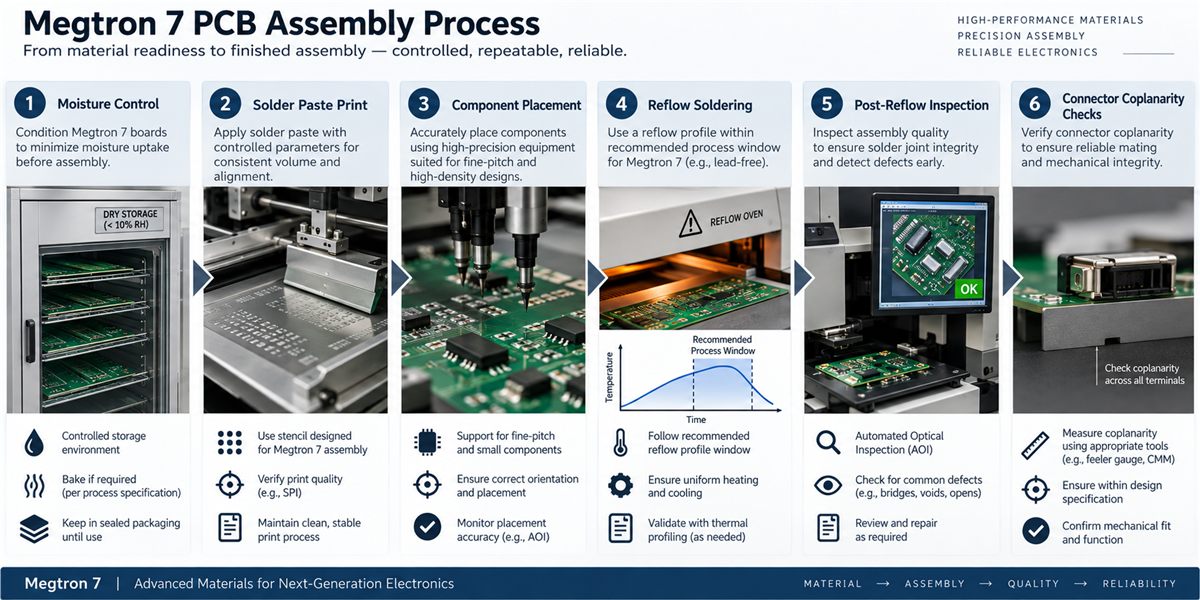
Control moisture before reflow
Panasonic publishes MEGTRON 7 grades with high thermal resistance and low typical water absorption, but a laminate’s published value does not replace shop-floor handling. Boards can absorb moisture during routing, cleaning, storage, and queue time. Define the exposure window from bake or dry-pack opening to soldering, and record how panels are identified when the window is exceeded.
Moisture control is especially important for thick multilayer constructions and boards with large copper planes. A disciplined PCB material handling procedure separates laminate behavior from the actual assembly environment. It should specify dry storage, bake criteria, transfer time, and the evidence retained with the lot. Do not claim a bake temperature or duration as a universal rule; use the material supplier’s handling guidance and the assembly profile qualification.
Build the reflow and inspection plan
Reflow must satisfy the solder paste and component limits without creating avoidable thermal stress in the board. Profile the actual assembly stack with representative copper density, large thermal pads, and the connector body. Record ramp, soak, peak, and time-above-liquidus as process data for the build. A profile window is a production control, not a marketing claim.
For high-speed modules, inspect more than solder fillets. Check connector coplanarity, press-fit alignment, shield contact, voiding under thermal pads, and the position of components that define the RF path. A PCB assembly capability review can map AOI, X-ray, electrical test, and manual inspection to the actual risk list. Keep the launch datum visible on the assembly drawing so inspection can relate a connector position to the board stackup.
Cleaning chemistry also matters. Residue near a high-impedance node can increase leakage or attract contamination, while aggressive cleaning can stress exposed finishes and connectors. Define cleanliness criteria and verify compatibility with solder mask, surface finish, and any conformal coating. The Megtron 7 PCB handling record should travel with the assembly traveler.
Release thermal-mechanical evidence
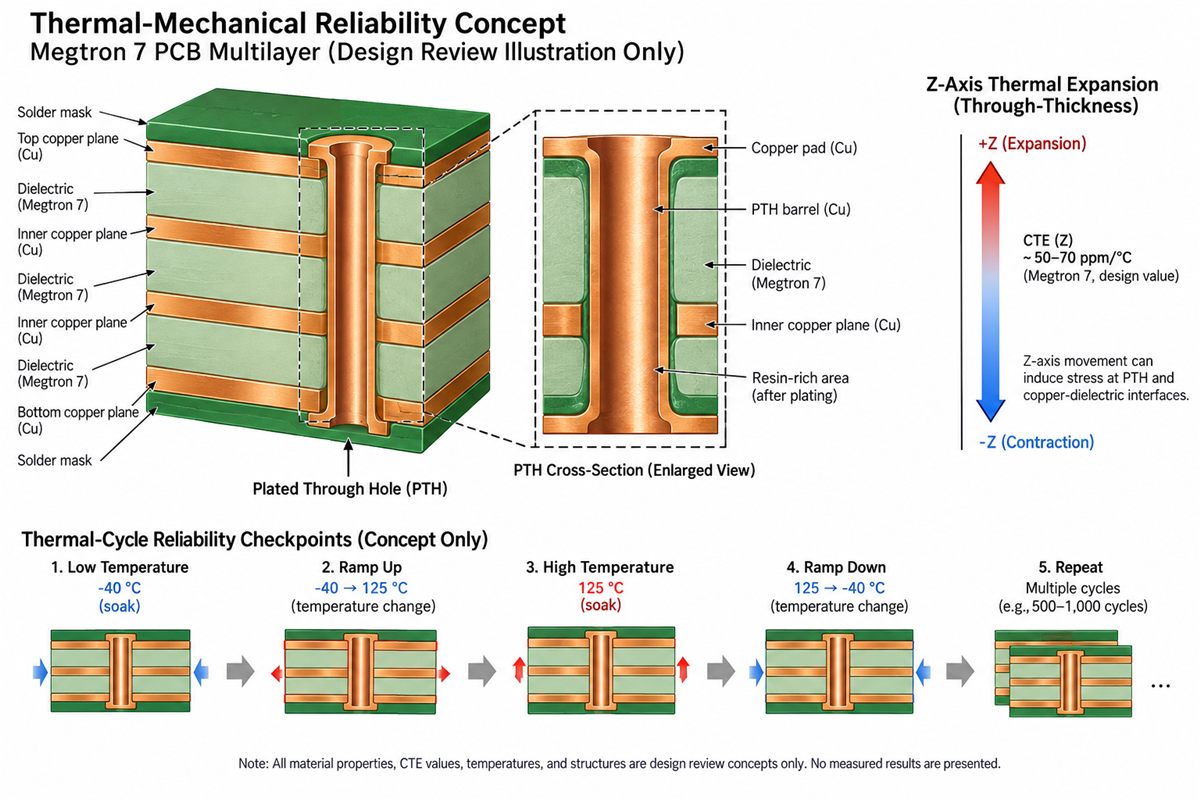
A thermal-cycle plan should connect board construction to the failure mechanism being screened. Review plated-hole strain, barrel and pad geometry, copper balance, and the position of large components. Panasonic lists typical Tg and T288 values for MEGTRON 7 grades; these are material data-sheet references, not proof that a specific assembled board has passed a cycle test.
For an engineering release, define the sample, cycle range, inspection method, and acceptance criteria before the test. Use PCB manufacturing controls to keep drill, plating, and copper balance consistent, then use PCB layout review to confirm that thermal reliefs and return paths remain intentional. If the application is an automotive or industrial module, the automotive PCB assembly workflow can be used as a reference for environmental planning. Keep a Megtron 7 PCB RF inspection note with the lot.
The release decision should answer four questions: was moisture controlled, was the reflow window qualified, were connector and RF-critical features inspected, and is the reliability evidence tied to this stackup? If yes, the Megtron 7 PCB remains a controlled electrical product after assembly rather than an unverified laminate choice.
Keep a Megtron 7 PCB layout note with the assembly traveler.
Keep a Megtron 7 PCB layout note with the assembly traveler.
Sources: Panasonic MEGTRON 7 series typical thermal and electrical data; KKPCB PCB Materials, PCB Assembly, manufacturing, and automotive assembly capability pages. Assembly profile and reliability limits must be qualified for the actual product construction.
