
With the rapid development of high-power electronics, electric vehicles, LED lighting, renewable energy systems, and advanced industrial equipment, thermal management has become one of the most critical challenges in electronic product design.
As electronic components become more compact while power density continues to increase, traditional FR-4 PCBs may face limitations in heat dissipation performance.
Copper Core PCB, also known as copper-based PCB or copper substrate PCB, has emerged as an advanced thermal management solution. By integrating a copper core layer into the PCB structure, it provides excellent heat conduction capability while maintaining reliable electrical insulation and mechanical stability.
Today, Copper Core PCB technology is widely used in applications where efficient heat dissipation, high current capability, and long-term reliability are essential.
1. What Is a Copper Core PCB?
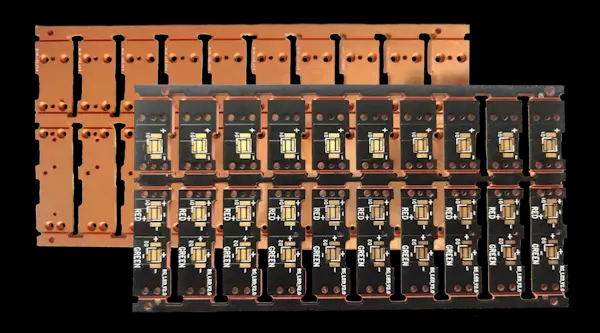
A Copper Core PCB is a type of metal core PCB (MCPCB) that uses copper as the base metal layer.
Unlike conventional FR-4 PCBs, which mainly rely on epoxy resin and fiberglass structures, copper core PCBs contain:
- Copper core layer
- Dielectric insulation layer
- Copper circuit layer
The copper core acts as an efficient thermal pathway, transferring heat away from high-power components and improving overall system reliability.
A typical copper core PCB structure includes:
Copper Circuit Layer → Insulation Layer → Copper Core Layer
This structure enables both electrical insulation and effective thermal management.
2. Why Copper Core PCB Is Important for Modern Electronics
Modern electronic devices face increasing challenges related to:
- Higher power density
- Smaller product size
- Increased operating temperatures
- Longer service life requirements
Excessive heat can lead to:
- Component aging
- Performance degradation
- Reduced reliability
- Premature system failure
Copper Core PCB helps address these challenges by providing faster heat dissipation compared with traditional PCB materials.
3. Key Advantages of Copper Core PCB
3.1 Excellent Thermal Conductivity
The primary advantage of copper core PCB is its superior thermal performance.
Copper has excellent thermal conductivity, allowing heat generated by components to transfer quickly through the PCB structure.
Benefits include:
- Reduced component temperature
- Improved thermal stability
- Extended product lifetime
This makes copper core PCB especially suitable for high-power applications.
3.2 Improved Current Carrying Capability
Copper core structures can support higher current loads compared with standard PCB materials.
Advantages include:
- Reduced electrical resistance
- Lower voltage drop
- Improved power efficiency
This is valuable for:
- Power converters
- Motor control systems
- Battery management systems
3.3 Enhanced Mechanical Stability
Copper provides strong mechanical support and dimensional stability.
Benefits include:
- Reduced deformation
- Improved structural strength
- Better reliability under thermal stress
This is especially important for products exposed to temperature cycling.
3.4 Better Heat Dissipation for High-Power Components
High-power components such as:
- Power MOSFETs
- IGBT modules
- LED drivers
- Voltage regulators
generate significant heat during operation.
Copper core PCBs provide an efficient thermal path to remove heat and maintain stable operating conditions.
4. Copper Core PCB vs Traditional FR-4 PCB
| Feature | Copper Core PCB | FR-4 PCB |
|---|---|---|
| Thermal Conductivity | Excellent | Moderate |
| Heat Dissipation | High | Limited |
| Current Capability | Higher | Lower |
| Mechanical Strength | Strong | Moderate |
| Weight | Higher | Lower |
| Cost | Higher | Lower |
| High-Power Applications | Suitable | Limited |
The choice between copper core PCB and FR-4 PCB depends on application requirements, thermal conditions, and cost considerations.
5. Applications of Copper Core PCB
5.1 LED Lighting Systems
LED devices require efficient heat dissipation to maintain brightness and lifetime.
Copper core PCBs are widely used in:
- High-power LED modules
- Automotive lighting
- Industrial lighting systems
They help reduce LED junction temperature and improve operational stability.
5.2 Electric Vehicle Electronics
The growth of electric vehicles has increased demand for advanced thermal management solutions.
Copper core PCBs are used in:
- Battery management systems (BMS)
- Motor controllers
- Power conversion modules
Their thermal capability helps support high-current operation and reliability.
5.3 Power Electronics
Power electronic systems generate significant heat during switching operation.
Applications include:
- Inverters
- Power supplies
- Industrial controllers
- Energy storage systems
Copper core PCB improves thermal performance and reduces component stress.
5.4 Industrial Control Equipment
Industrial equipment often requires long-term operation under demanding conditions.
Copper core PCB provides advantages in:
- Thermal reliability
- Mechanical strength
- Electrical performance
5.5 Automotive Electronics
Automotive environments involve:
- Temperature fluctuations
- Vibration
- High reliability requirements
Copper core PCB supports applications requiring stable operation under harsh conditions.
6. PCB Design Considerations for Copper Core PCB
Although copper core PCB provides excellent thermal performance, proper design is essential.
6.1 Thermal Path Optimization
Engineers should carefully design heat transfer paths.
Important considerations include:
- Component placement
- Thermal interface design
- Copper area distribution
Efficient thermal paths improve overall performance.
6.2 Material Compatibility
Different materials have different thermal expansion characteristics.
Designers should consider:
- Copper core thickness
- Dielectric material selection
- Thermal expansion differences
This helps prevent mechanical stress during temperature changes.
6.3 Layer Structure Design
Copper core PCB structures require precise stack-up planning.
Key factors include:
- Copper thickness
- Insulation layer thickness
- Electrical clearance
- Thermal requirements
6.4 Manufacturing Process Control
Copper core PCB manufacturing requires careful process management.
Important factors include:
- Copper bonding reliability
- Layer alignment accuracy
- Insulation consistency
- Surface finishing quality
Manufacturing control directly affects long-term reliability.
7. Challenges of Copper Core PCB
Despite its advantages, copper core PCB also has some challenges.
Higher Manufacturing Cost
Copper materials and specialized processing increase production costs.
More Complex Fabrication
Compared with standard FR-4 PCB, copper core PCB requires additional control during:
- Lamination
- Drilling
- Etching
- Thermal processing
Design Limitations
Due to the rigid copper core structure, flexibility and miniaturization may be limited compared with some advanced PCB technologies.
8. Future Development Trends of Copper Core PCB
As industries continue moving toward higher power density and improved energy efficiency, copper core PCB technology is expected to expand further.
Future trends include:
- Electric vehicle power systems
- Advanced semiconductor applications
- Renewable energy equipment
- High-performance industrial electronics
- Intelligent lighting systems
The combination of thermal performance and electrical reliability makes copper core PCB an important technology for next-generation electronic products.
Conclusion
Copper Core PCB represents an important advancement in PCB technology by addressing one of the biggest challenges in modern electronics: thermal management.
With excellent thermal conductivity, strong mechanical stability, and high current capability, copper core PCBs provide reliable solutions for high-power and high-reliability applications.
However, successful implementation requires careful consideration of material selection, thermal design, PCB stack-up, and manufacturing processes.
As electronic systems continue becoming more powerful and compact, Copper Core PCB will continue playing an important role in improving performance, reliability, and product lifetime.
