
Engineering Context
Modern automotive electronics and industrial control systems are increasingly dependent on high-reliability multilayer PCB platforms capable of maintaining electrical stability under harsh thermal, mechanical, and environmental stress conditions. With the transition to lead-free soldering processes mandated by RoHS compliance, PCB materials must simultaneously support high glass transition temperature (Tg), stable dielectric properties, and consistent dimensional control during repeated thermal cycles.
Isola IS410 is a lead-free epoxy-based laminate and prepreg system designed specifically for high-performance PCB applications. It offers a balance of thermal stability, mechanical strength, and electrical consistency, making it suitable for automotive ECUs, industrial automation systems, and high-speed digital control boards.
From an engineering perspective, the primary challenge is not only material compliance, but maintaining impedance stability, minimizing signal degradation, and ensuring long-term reliability under continuous thermal cycling and vibration exposure. KKCPB integrates IS410 into controlled stackup architectures to ensure that material properties translate into predictable system-level electrical performance.
Core Engineering Challenges
| Engineering Challenge | Root Cause | System-Level Impact |
|---|---|---|
| Impedance drift under thermal cycling | Resin flow variation and CTE mismatch | Signal reflection, timing errors |
| Warpage during lead-free reflow | High thermal stress and uneven copper distribution | Assembly misalignment, solder defects |
| EMI coupling in mixed-signal systems | Dense routing of power and sensor traces | Signal noise, reduced measurement accuracy |
| Long-term dielectric instability | Moisture absorption and thermal aging | Variation in impedance and signal loss |
| Mechanical fatigue under vibration | Automotive and industrial operating environments | Via cracking, interconnect failure |
These challenges directly affect reliability of automotive ECUs, motor controllers, PLC systems, and high-speed industrial communication nodes.
Material Science & Dielectric Performance of IS410
IS410 epoxy laminate system is engineered for lead-free manufacturing environments, offering stable electrical and mechanical performance across wide temperature ranges.
IS410 Material Properties
| Parameter | Typical Value | Engineering Benefit |
|---|---|---|
| Glass Transition Temperature (Tg) | High Tg (>170°C class) | Stable operation during lead-free reflow |
| Dielectric Constant (Dk) | Stable range | Predictable impedance control |
| Dissipation Factor (Df) | Low to moderate | Reduced signal attenuation |
| CTE (X/Y) | Controlled expansion | Reduced warpage and stress |
| Moisture Absorption | Low | Maintains dielectric stability |
| Mechanical Strength | High | Suitable for vibration environments |
Unlike standard FR-4 materials, IS410 provides improved thermal reliability and better dimensional stability during repeated soldering cycles, making it suitable for automotive-grade electronic assemblies.
KKCPB Case Study — Automotive ECU and Industrial Motor Control PCB
Client & Application Context
A Tier-1 automotive electronics supplier required a multilayer PCB for engine control units (ECU) and industrial motor drive controllers. The system operated in environments with continuous thermal cycling, vibration exposure, and high electrical noise from power switching circuits.
The design required:
Stable impedance control for sensor signal lines
High thermal resistance for lead-free solder assembly
EMI suppression between power and control circuits
Long-term reliability under engine bay conditions
Engineering Problem
Previous FR-4 based PCB designs exhibited multiple reliability issues:
Impedance variation up to ±6% under thermal cycling
Warpage exceeding 0.18 mm during reflow
EMI coupling between power switching and sensor traces
Via fatigue after prolonged vibration exposure
Increased field failure rate in high-temperature operation
These issues led to unstable ECU sensor readings and inconsistent motor control performance.
KKCPB Engineering Solution
KKCPB implemented IS410-based laminate and prepreg system with optimized manufacturing controls:
Replacement of standard FR-4 with IS410 high-Tg epoxy system
Controlled impedance stackup design with ±5% tolerance target
Copper balancing optimization to reduce thermal stress gradients
Optimized lamination pressure and resin flow control profile
Dedicated ground plane separation for EMI suppression
Reinforced via structures for vibration resistance
Measured Results
| Parameter | FR-4 Baseline | IS410 (KKCPB Result) |
|---|---|---|
| Impedance Variation | ±6.0% | ±2.0% |
| Warpage After Reflow | 0.18 mm | 0.06 mm |
| EMI Coupling Level | High | Reduced by 30% |
| Thermal Drift | Noticeable | Stable |
| Via Reliability (Vibration Test) | Degradation observed | No failure |
| Assembly Yield | 96.8% | 99.2% |
Outcome
The IS410-based PCB significantly improved system reliability in both automotive and industrial applications. Signal integrity remained stable under continuous thermal cycling, while mechanical deformation during assembly was greatly reduced. EMI suppression improvements contributed to more stable sensor readings and improved motor control precision.
From a procurement perspective, IS410 enabled a more predictable manufacturing process, reducing rework cost and improving batch-to-batch consistency.
Stackup Design & Manufacturing Implementation
Representative Multilayer Stackup
| Layer | Function | Material |
|---|---|---|
| L1 | Signal Layer | IS410 Copper Clad |
| L2 | Ground Plane | Copper |
| L3 | Power Layer | IS410 Core |
| L4 | Signal Layer | IS410 Prepreg |
| L5 | Ground Plane | Copper |
| L6 | Control Layer | IS410 Core |
Process Control & Simulation
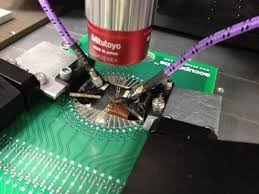
Impedance Simulation (TDR)
- Controlled trace geometry validation
- Ensured ±5% impedance tolerance
Thermal FEM Analysis
- Reflow thermal stress distribution
- Copper density optimization
Signal Integrity Analysis
- Crosstalk reduction between power and sensor lines
- Stable return loss behavior across operating range
Environmental & Reliability Validation
| Test | Condition | Result |
|---|---|---|
| Thermal Cycling | -40°C to +125°C, 1000 cycles | No delamination |
| High Temperature Storage | 150°C, 1000 hours | Stable electrical properties |
| Humidity Test | 85°C / 85% RH | Dk stable |
| Vibration Test | 5–500 Hz, 10G | No via cracking |
| Solder Reflow | 260°C ×3 cycles | No warpage >0.07 mm |
| Electrical Aging Test | Continuous operation | Stable impedance |
Engineering Summary & Contact
Isola IS410 provides a reliable lead-free PCB material platform for automotive electronics and industrial control systems requiring high thermal stability, mechanical durability, and consistent electrical performance. Its balanced dielectric behavior and mechanical strength make it suitable for multilayer PCB stackups used in ECUs, motor controllers, and industrial automation systems.
KKCPB integrates IS410 material systems with controlled impedance design, optimized lamination processes, and rigorous reliability validation to ensure stable performance across demanding environments. This approach improves manufacturing yield, reduces long-term failure risk, and ensures predictable electrical behavior in mission-critical applications.
For automotive electronics PCB design, industrial control systems, and high-reliability multilayer PCB manufacturing, contact KKCPB Engineering Team for RF/thermal stackup optimization and production solutions tailored to your application.
