What Is a Rogers PCB?
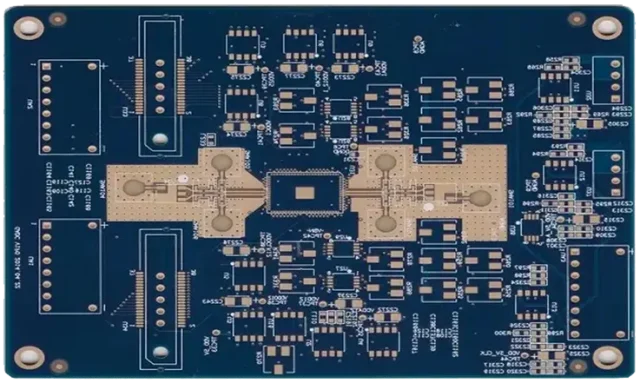
A Rogers PCB refers to a printed circuit board manufactured using high-frequency laminate materials developed by Rogers Corporation. These materials are specifically engineered to provide low dielectric loss, stable electrical performance, and reliable operation at high frequencies.
Unlike standard FR4 substrates, Rogers materials are designed for RF and microwave applications where signal integrity, insertion loss, and impedance stability are critical.
Rogers PCBs are widely used in communication systems, radar modules, satellite equipment, and advanced RF electronics.
Why Choose Rogers Material Over Standard FR4?
At higher frequencies, conventional FR4 materials begin to exhibit:
-
Higher dielectric loss
-
Increased signal attenuation
-
Greater variation in dielectric constant (Dk)
-
Reduced phase stability
Rogers laminates are formulated to overcome these limitations.
Key Electrical Advantages
-
Low dissipation factor (Df) for reduced insertion loss
-
Stable dielectric constant across frequency
-
Consistent electrical performance over temperature variation
-
Improved impedance control accuracy
These characteristics are essential in GHz-range and microwave systems.
Types of Rogers Materials
Rogers Corporation offers multiple material families optimized for different applications, including:
-
High-frequency PTFE-based laminates
-
Hydrocarbon ceramic laminates
-
High-speed digital laminates
-
RF and microwave composite materials
Each material series is designed for specific performance ranges, balancing loss performance, mechanical stability, and cost efficiency.
Structural Configurations of Rogers PCB
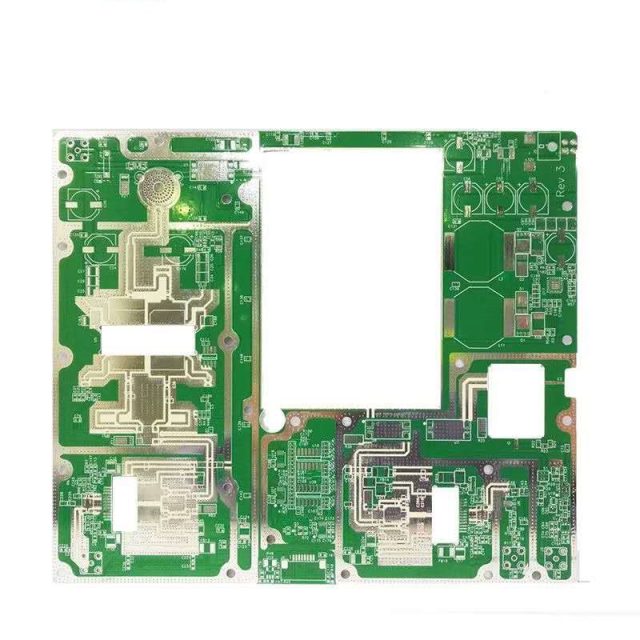
Rogers PCBs can be manufactured in various stack-up structures:
-
Single-layer RF boards
-
Double-layer RF boards
-
Multilayer hybrid structures (Rogers + FR4)
-
Controlled impedance multilayer designs
-
HDI-compatible RF constructions
Hybrid stack-ups are often used to optimize cost while maintaining RF performance in critical signal layers.
Applications of Rogers PCB
Rogers PCBs are widely used in:
-
5G base station modules
-
Antenna arrays
-
Automotive radar systems (24GHz / 77GHz)
-
Satellite communication systems
-
RF power amplifiers
-
Aerospace communication electronics
-
High-speed network infrastructure
In applications above 1GHz, Rogers materials significantly reduce signal loss and improve overall system stability.
Manufacturing Considerations
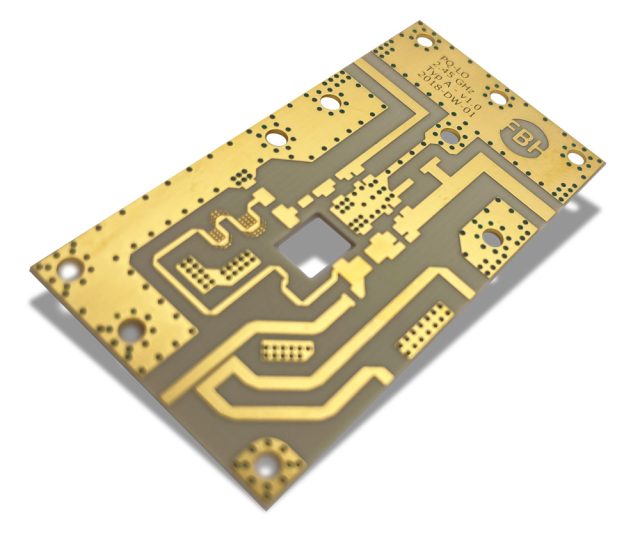
Rogers PCB fabrication requires specialized handling due to material characteristics such as:
-
Different thermal expansion properties
-
Specific lamination temperature profiles
-
Controlled drilling parameters
-
Precise impedance verification
Professional manufacturing capability ensures stable dielectric thickness, minimal copper roughness variation, and consistent RF performance.
Rogers PCB vs Standard FR4 PCB
| Feature | Standard FR4 PCB | Rogers PCB |
|---|---|---|
| Frequency Suitability | Low–Moderate | High / Microwave |
| Dielectric Loss | Higher | Low |
| Dk Stability | Moderate | High |
| Cost | Lower | Higher |
| RF Performance | Limited | Excellent |
For high-frequency and microwave systems, Rogers PCB provides superior signal transmission performance and long-term reliability.
Conclusion
Rogers PCB technology delivers low-loss, stable dielectric performance essential for modern RF and microwave applications. By combining advanced material properties with precise impedance control and professional fabrication processes, Rogers PCBs ensure reliable signal transmission in high-frequency environments.
As communication systems move toward higher data rates and higher operating frequencies, Rogers PCB solutions remain a key choice for performance-driven designs.