
Precision mmWave systems increasingly depend on PCB materials that can maintain electromagnetic uniformity, suppress parasitic modes, and control insertion loss across wideband operating ranges. RT/duroid 5880 PCB stackups have become a leading choice for these environments because their low dielectric constant, low-loss tangent, and exceptional stability under thermal and mechanical stress allow engineers to design routing networks with predictable and repeatable high-frequency behavior.
1. Dielectric Stability as the Foundation for Uniform Field Distribution
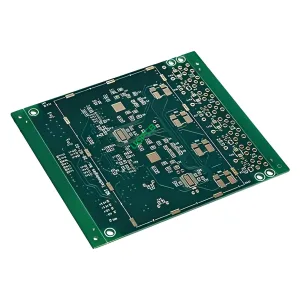
The dielectric constant (Dk ≈ 2.20) of RT/duroid 5880 is among the lowest available for engineered RF substrates. More importantly, its Dk stability across temperature, humidity, and frequency variation supports electromagnetic field uniformity inside microstrip, grounded coplanar waveguide (GCPW), and stripline structures.
High-frequency routing networks—especially in the 24–110 GHz mmWave region—depend on this consistent Dk to prevent unintended impedance drift, asymmetrical fields, and mode conversion at layer transitions.
This behavior is particularly important for transition-heavy architectures such as:
• Beamforming front-end modules
• High-density phased-array T/R channels
• Broadband radar transceiver tiles
• Satellite payload mmWave signal distribution grids
A stable dielectric is the first step in eliminating field distortion and ensuring predictable routing geometry across stacked layers.
2. Low-Loss Tangent Enables Long mmWave Routing Without Excess Signal Decay
With a dissipation factor (Df ≈ 0.0009 at 10 GHz), RT/duroid 5880 PCB stackups allow designers to maintain narrow phase error margins and reduce amplitude imbalance between paths.
In dense multi-layer schemes used in Ka-band and W-band architectures, even a small reduction in Df translates into meaningful improvements in:
• EIRP uniformity
• Phase synchronisation across antenna elements
• Overall transceiver noise figure
• Group delay equalization in long distribution paths
Low dielectric losses directly support cleaner mmWave propagation, enabling arrays to maintain ideal constructive/destructive interference patterns without requiring excessive calibration overhead.
3. Mode-Suppression Through Controlled Stackup Architecture
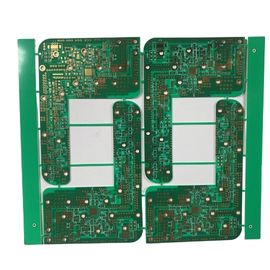
Parasitic modes—higher-order surface modes, cavity resonances, and slotline leakage—are common failure points in high-frequency routing networks. RT/duroid 5880’s mechanical softness, paired with engineered copper cladding, allows for exceptionally uniform bonding between layers.
This uniformity reduces micro-voids and dielectric discontinuities that would otherwise serve as initiation points for parasitic mode excitation.
Engineers typically incorporate:
• Tight dielectric thickness tolerances
• Laser-defined GCPW ground via fences
• Hybrid 5880/RO4835 composite stackups for mechanical stiffness
• High-density via backfilling for cavity suppression
These techniques, combined with the material’s inherent isotropy, produce routing channels that minimize trapped-mode formation even in ultra-dense boards or folded multi-tier RF transitions.
4. Thermal and Mechanical Stability for Phase-Critical Networks
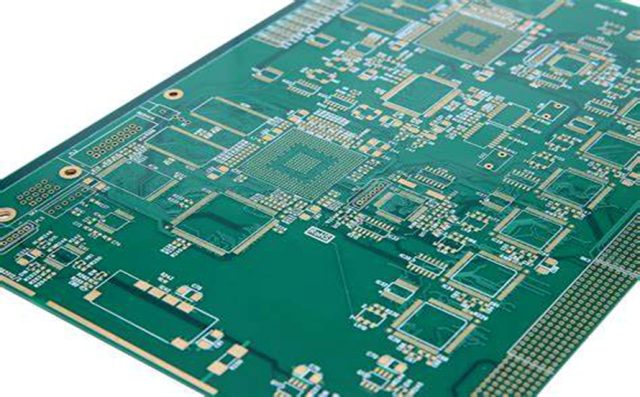
Phase stability is a limiting factor in mmWave beamforming, frequency-modulated radar, and satellite backhaul nodes.
RT/duroid 5880’s low thermal expansion coefficient (CTE) in the z-axis enables vertical alignment precision for buried striplines and mode-controlled channels. This maintains consistent propagation velocity even during rapid thermal cycling.
Benefits include:
• Reduced differential expansion between copper and dielectric
• More stable interconnect geometries
• Lower risk of delamination at elevated power levels
• Consistent impedance during satellite thermal cycles (>2000 cycles)
This material supports mission-critical environments such as LEO spacecraft, high-altitude platforms, or military radar systems where temperature swings are severe.
5. Ideal Material Platform for Precision mmWave Routing Networks
RT/duroid 5880 PCB stackups can reliably support:
• 24–40 GHz automotive radar arrays
• 37–52 GHz 5G FR2 radio units
• 60–90 GHz short-range high-capacity links
• 71–110 GHz mmWave scientific and aerospace instrumentation
• Satellite Ka-band and Q/V-band payload routing grids
The combination of electromagnetic uniformity, mode-suppression capability, thermal stability, and extremely low insertion loss positions RT/duroid 5880 as a premium substrate for any system where mmWave precision is non-negotiable.
