
Prototype success does not automatically create a repeatable production baseline. A material substitution, a different panel orientation, or a “small” drill-table change can move an RF launch outside the assumptions used by design. A Taconic TLY-5 PCB production release should connect the RF model, DFM review, coupon plan, inspection evidence, and engineering-change route. That package gives design, sourcing, manufacturing, and test teams one version of the truth.
Turn the RF model into a release package
Start with the features that drive performance and schedule: layer pair, dielectric height, copper profile, trace width, via transition, connector launch, and panel registration. For a Taconic TLY-5 PCB, supplier data such as typical Dk and Df is an input to the model. The released package must also state the selected construction, press target, tolerance, finish, mask condition, and the method used to inspect each item.
Use a requirement matrix with separate columns for design target, fabrication target, inspection method, and disposition. This prevents a project manager from treating a nominal model value as a measured guarantee. It also makes sourcing changes visible: if a new core or copper foil changes a controlled variable, the change is routed to engineering instead of being accepted as a purchasing substitution.
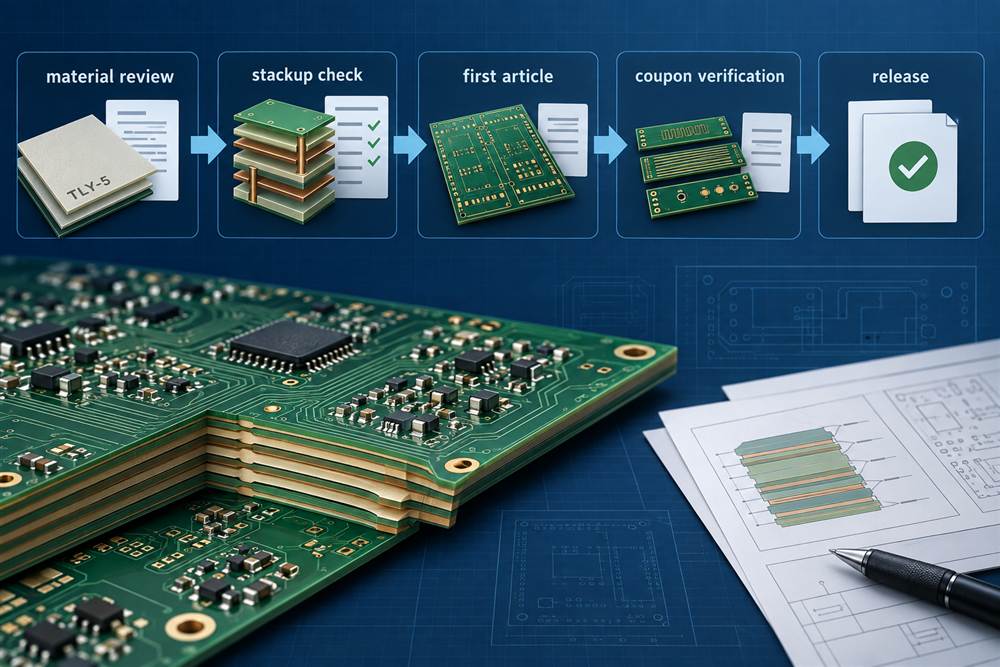
Use coupons that correlate to product risk
A Taconic TLY-5 PCB coupon is useful when it represents the same layer pair, finished copper, via type, and transition as the product. A generic impedance strip may be easy to measure but unable to reveal registration, drill, or connector-launch risk. Place coupon features where panel effects are understood and identify which product dimension each coupon is intended to represent.
For a controlled-impedance PCB release, record the coupon drawing, test method, calibration reference, and acceptance window. If the coupon is only a design target, label it that way. Do not convert a calculated value into an “actual measured result” in the report. The evidence becomes more credible when the team can see the boundary between typical material data, engineering prediction, and production observation.
RF test coupon questions for the release meeting
-
- Does the coupon use the same pressed dielectric and copper treatment as the RF net?
- Does the transition coupon include the same drill and antipad assumptions?
- Can the inspection team locate the coupon on the panel and trace it to a lot?
- What action is required when a coupon result is outside the design target?
Control material and process changes
Every change request should identify the affected layer, material, process, supplier, and performance risk. The PCB manufacturing review should compare the old and new stackup, copper, drilling, plating, finish, mask, panelization, and inspection method. A new material may have a similar nominal Dk while its pressed thickness, resin distribution, or processing window changes the effective RF geometry.
When the change touches the antenna, filter, or connector interface, open an RF review before approving it. A Taconic TLY-5 PCB change-control gate should ask whether the model, launch drawing, coupon, assembly route, and test fixture remain valid. If they do not, define a limited first article and the evidence needed to re-baseline production.
Make the production handoff auditable
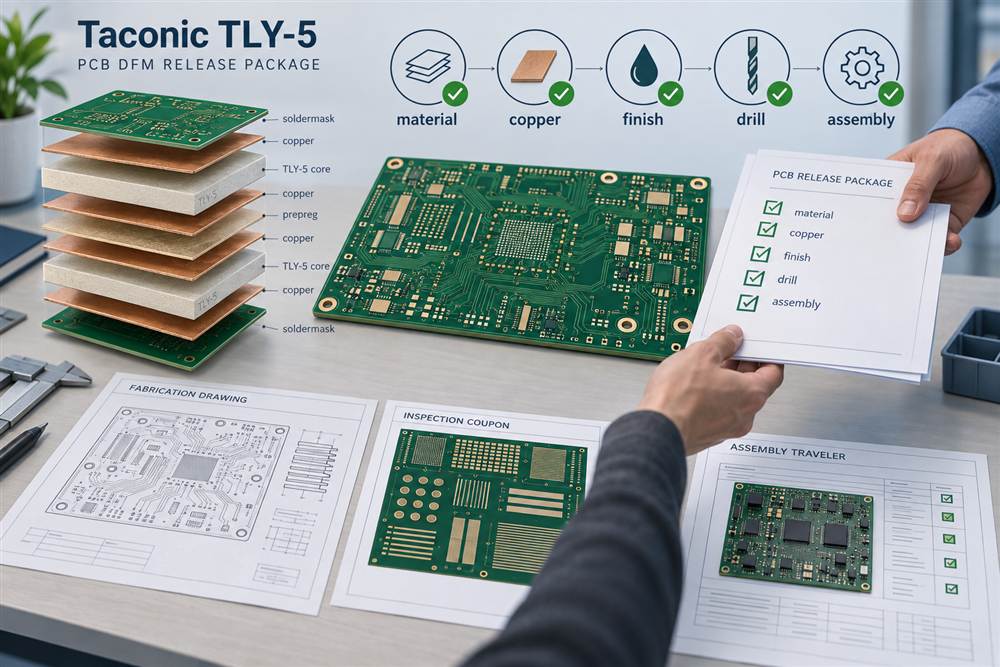
A good handoff is readable by a fabricator and a program manager. Include the controlled stackup, impedance notes, drill and back-drill table, via-fence map, finish and mask notes, panel drawing, coupon intent, assembly constraints, and acceptance criteria. The package should name the revision owner and show which values are design targets versus measured observations.
Link the PCB assembly traveler to the same board revision. Paste, connector placement, shield installation, cleaning, inspection, and rework limits can change the RF interface even when the bare board is correct. A material or finish change should therefore be visible to assembly and test, not hidden in a purchasing note.
Use DFM review as a decision gate rather than a final checklist. Ask whether registration, drill, copper balance, solder mask, and inspection access are compatible with the RF geometry. When the answer is documented, the project team can decide whether to revise layout, adjust the process window, or run a controlled first article.
Production release checklist
- Freeze material, stackup, copper, finish, mask, and via assumptions.
- Correlate each RF coupon to a product feature and panel location.
- Record DFM findings, owners, and disposition before release.
- Route all material or process changes through RF and assembly review.
- Archive drawings, inspection evidence, and revision decisions together.
The goal is not paperwork for its own sake. It is a Taconic TLY-5 PCB baseline that can be quoted, built, inspected, assembled, and changed without losing the electrical intent. When the release package is correlated to real manufacturing features, the next lot starts from evidence instead of memory.
For procurement, the Taconic TLY-5 PCB release package should carry the Taconic TLY-5 PCB stackup and the Taconic TLY-5 PCB coupon revision. Treat a Taconic TLY-5 PCB material change as an engineering change, not a silent substitution.
Sources: AGC public TLY-5 material data; Analog Devices and Qorvo RF design and verification practices; industry DFM and production-release methods; KKPCB stackup, coupon, manufacturing, and PCBA change-control procedures reviewed for this article.
