
1. Project Background
With the increasing demand for intelligent environmental management, modern sewage treatment systems require higher levels of automation, monitoring, and control capability.
A customer in the industrial automation sector was developing a sewage treatment control system that required a reliable PCBA solution capable of operating continuously in complex industrial environments.
The control board needed to support:
- Stable signal acquisition and processing
- Reliable communication between control modules
- Long-term operation under humid and challenging conditions
- Consistent performance during mass production
However, during the transition from prototype validation to production, the customer encountered several challenges related to PCB design optimization, component reliability, and manufacturing consistency.
To improve product reliability and production readiness, the customer selected KKPCB as a PCB fabrication and PCBA assembly partner.
2. Application Scenario
The PCBA was designed for an industrial sewage treatment automation system, serving as the core electronic control module for equipment monitoring and operation management.
Typical system functions include:
- Pump control and monitoring
- Water quality sensor signal acquisition
- Industrial communication interfaces
- Automatic process control
- Real-time equipment status monitoring
Such applications require electronic assemblies with:
- High reliability
- Stable electrical performance
- Strong environmental adaptability
- Long service life
3. Key Manufacturing Challenges
1. Environmental Reliability Requirements
Sewage treatment equipment typically operates in environments with:
- High humidity
- Dust exposure
- Temperature fluctuations
- Continuous operation requirements
These conditions create challenges for PCBA reliability, including:
- PCB moisture resistance
- Component protection
- Corrosion prevention
- Long-term solder joint reliability
2. Signal Stability and Control Accuracy
Industrial automation systems often integrate multiple sensors and communication interfaces.
Potential PCB-level risks include:
- Signal interference
- Noise coupling
- Unstable sensor signals
- Communication errors
The PCB design needed proper consideration of:
- Signal routing
- Grounding strategy
- Power distribution
- EMI control
3. Manufacturing Consistency During Production
During the transition from prototype to batch production, the customer required:
- Stable PCBA quality
- Reduced assembly defects
- Consistent electrical performance
- Efficient production scheduling
Manufacturing challenges included:
- Component placement accuracy
- Soldering quality control
- Testing coverage
- BOM availability management
4. KKPCB Engineering and Manufacturing Support
To address these challenges, KKPCB provided a comprehensive PCB and PCBA solution covering design optimization, manufacturing, assembly, and quality control.
PCB Design Optimization and DFM Review
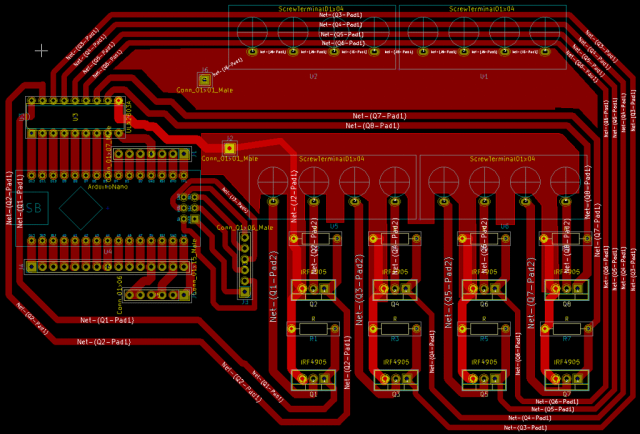
Before production, KKPCB engineering team performed a detailed DFM review focusing on:
- PCB manufacturability
- Component placement optimization
- Trace and spacing verification
- Assembly process compatibility
The review helped identify potential manufacturing risks early and improved production readiness.
Signal Integrity and Power Optimization
For stable industrial control performance, KKPCB optimized key PCB design aspects:
- Improved grounding structure
- Optimized signal routing
- Enhanced power distribution design
- Reduced potential interference sources
These improvements helped maintain stable communication and reliable control operation.
Component Sourcing and BOM Optimization
To improve supply chain reliability, KKPCB supported:
- BOM review
- Component availability analysis
- Alternative component recommendations
- Procurement coordination
This reduced risks caused by:
- Component shortages
- Long lead times
- Cost fluctuations
PCBA Manufacturing and Quality Control
KKPCB applied strict manufacturing controls throughout PCB assembly:
Including:
- Automated SMT assembly
- AOI inspection
- X-ray inspection for hidden solder joints
- Functional testing support
These processes ensured:
- Assembly accuracy
- Soldering reliability
- Production consistency
Protective Manufacturing Measures
Considering the harsh operating environment, KKPCB recommended additional reliability improvements, including:
- Conformal coating protection
- Optimized packaging solutions
- Enhanced moisture protection measures
These improvements helped increase the durability of the PCBA in industrial applications.
5. Project Results
Through close cooperation between the customer and KKPCB engineering team, the project achieved significant improvements:
Reliability Improvement
- Enhanced resistance against humidity and environmental stress
- Improved long-term operational stability
- Reduced potential field failure risks
Manufacturing Improvement
- Improved production consistency
- Reduced assembly-related defects
- Increased production efficiency
Supply Chain Optimization
- Reduced component sourcing risks
- Improved production scheduling flexibility
- Supported faster project delivery
6. KKPCB Advantages in Industrial Automation PCBA Projects
Through this project, KKPCB demonstrated capabilities in:
One-Stop PCB & PCBA Manufacturing
Supporting customers with:
- PCB fabrication
- SMT/DIP assembly
- Component sourcing
- Testing
- Final packaging
Engineering-Oriented Manufacturing Support
KKPCB focuses not only on production but also on:
- DFM analysis
- Manufacturing risk identification
- Process optimization
- Reliability improvement
Flexible Production Capability
Supporting:
- Prototype development
- Small-batch production
- Medium-volume manufacturing
while maintaining quality consistency.
Conclusion
Industrial automation equipment requires PCBA solutions that can deliver stable performance under demanding operating conditions.
Through PCB manufacturing expertise, PCBA assembly capability, and engineering-driven optimization, KKPCB helped the customer improve the reliability, manufacturability, and production readiness of their sewage treatment system control board.
For industrial automation applications requiring reliable PCB and PCBA solutions, early engineering collaboration can help identify hidden risks and build a stronger foundation for successful mass production.
