
Isola Astra® MT77 is an ultra-low-loss RF and microwave laminate and prepreg system developed for millimeter-wave circuits and beyond. Its typical Dk of 3.00, Df of 0.0017, 200 °C Tg, and FR-4-compatible processing make it a practical option for automotive radar, phased arrays, aerospace electronics, and other high-frequency PCBs. This page summarises the official Astra MT77 data sheet, explains the electrical and thermal values, compares the material with PTFE-based microwave laminates, and shows how KKPCB builds Astra MT77 PCBs. The complete PDF data sheet is embedded and available to download at the end.
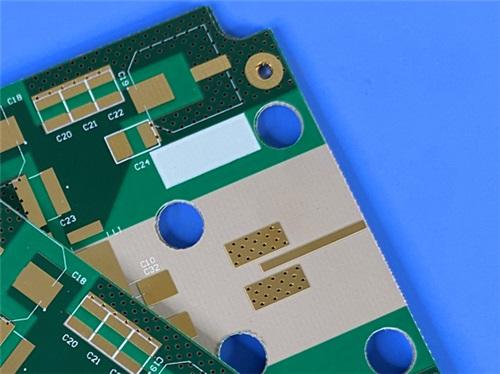
1. What Is Isola Astra MT77?
Astra MT77 is a glass-reinforced thermoset laminate from Isola Group. It is designed for commercial RF and microwave printed circuits that need low insertion loss, stable phase performance, and repeatable impedance at millimeter-wave frequencies. Unlike many PTFE-based microwave materials, Astra MT77 can be processed with standard FR-4 production equipment and methods.
The material is listed to IPC-4103/17 under UL file E41625. Isola also describes it as RoHS compliant, lead-free assembly compatible, and suitable for HDI, VIPPO, any-layer technology, and multiple lamination cycles.
Astra MT77 laminate and prepreg naming
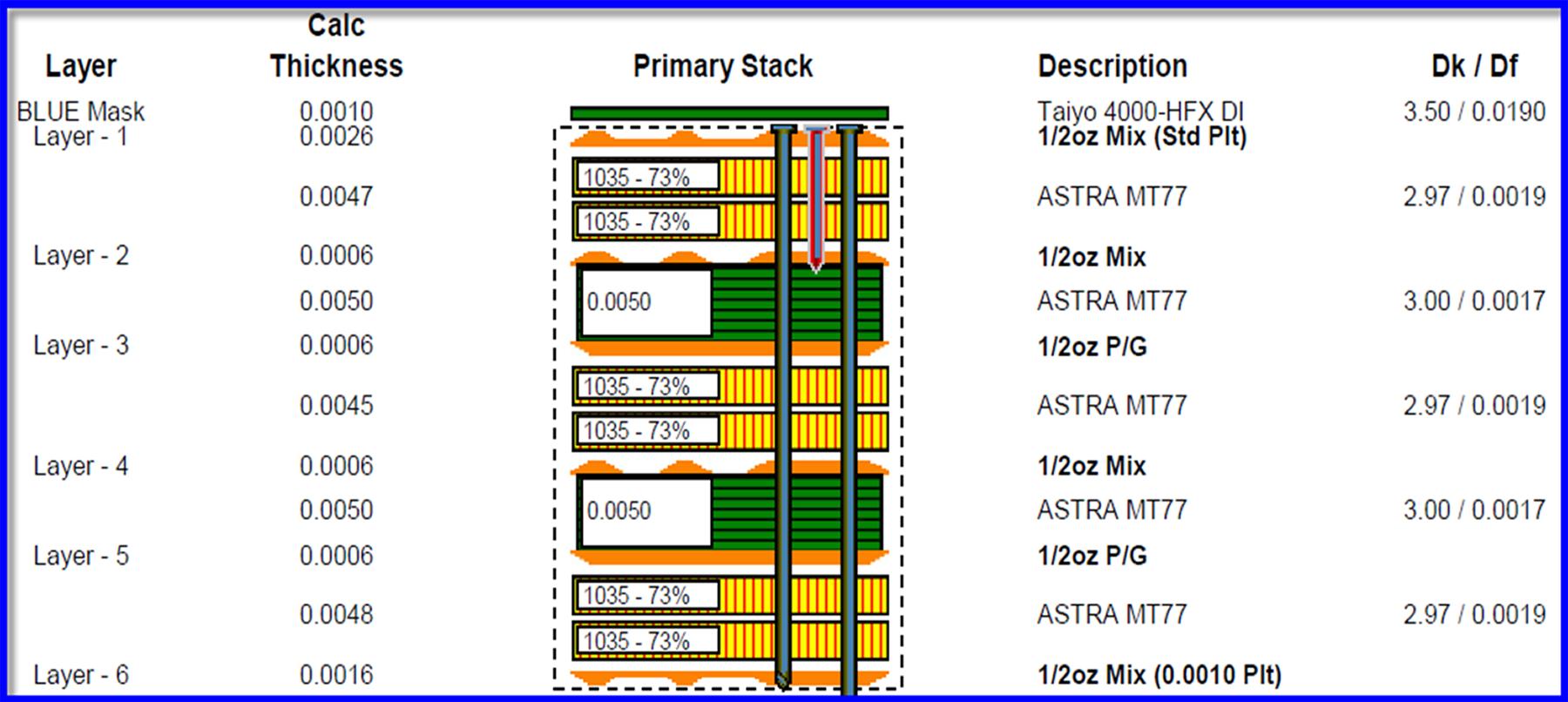
Astra MT77 is the product-family name used for both the copper-clad laminate and its matching prepreg. A multilayer stack-up should use the matched Astra MT77 core and prepreg system unless the designer and fabricator approve a hybrid construction.
2. Isola Astra MT77 Key Specifications
The values below are typical values published by Isola. They support material selection and initial stack-up planning; the final impedance model should use the construction and Dk convention agreed with the PCB manufacturer.
| Property | Test method / condition | Typical value |
|---|---|---|
| Glass transition temperature (Tg) | DSC, IPC-TM-650 2.4.25C | 200 °C |
| Decomposition temperature (Td) | TGA, 5% weight loss | 360 °C |
| Time to delamination, T260 / T288 | TMA, IPC-TM-650 2.4.24.1 | >60 / >60 min |
| Z-axis CTE, pre-Tg / post-Tg | IPC-TM-650 2.4.24C | 50–70 / 250–350 ppm/°C |
| X/Y-axis CTE, pre-Tg | IPC-TM-650 2.4.24C | 12 ppm/°C |
| Thermal conductivity | ASTM E1952 | 0.45 W/m·K |
| Dielectric constant (Dk) | IPC-TM-650 2.5.5.5, 2 GHz / 10 GHz | 3.00 / 3.00 |
| Dissipation factor (Df) | Bereskin stripline, 2 GHz / 10 GHz | 0.0017 / 0.0017 |
| Dielectric breakdown | IPC-TM-650 2.5.6B | 45.4 kV |
| Peel strength, 1 oz EDC foil | IPC-TM-650 2.4.8.3 | 1.0 N/mm |
| Moisture absorption | IPC-TM-650 2.6.2.1A | 0.1% |
| Flammability | UL 94 | V-0 |
| Relative thermal index | UL 796 | 130 °C |
What the Astra MT77 numbers mean in practice
- Dk 3.00 with Df 0.0017: supports low insertion loss and predictable phase length in antennas, feed networks, filters, couplers, and long RF traces.
- Stable electrical properties: Isola specifies stable Dk from -40 °C to +140 °C and up to W-band frequencies, helping radar and aerospace circuits maintain tuning across temperature.
- 200 °C Tg and >60-minute T288: provide thermal margin for lead-free assembly and multilayer reliability.
- FR-4 process compatibility: can reduce manufacturing complexity compared with specialty PTFE workflows.
3. Astra MT77 vs PTFE-Based Microwave Laminates
Astra MT77 and PTFE laminates can both serve high-frequency designs, but they use different resin systems and manufacturing approaches. The table summarises the practical selection points rather than claiming that one material is universally better.
| Selection point | Astra MT77 | Typical PTFE-based laminate |
|---|---|---|
| Resin system | Glass-reinforced thermoset | PTFE-based composite |
| Typical Dk / Df | 3.00 / 0.0017 at 10 GHz | Depends on the selected grade and reinforcement |
| PCB processing | FR-4-compatible methods | May require specialised surface preparation and process controls |
| Desmear | No plasma desmear required | Depends on the PTFE system and fabricator process |
| Drilling | Reduced drill wear according to Isola | Tooling and parameters are material-specific |
| Best fit | Low-loss RF/millimeter-wave boards needing scalable FR-4-style fabrication | Designs qualified around a specific PTFE electrical or environmental requirement |
A substitution should always be approved by the designer. Controlled-impedance and phase-critical features must be recalculated with the new material’s construction data, copper profile, and dielectric model.
4. Astra MT77 Core, Prepreg, and Copper Options
Isola lists standard laminate thicknesses of 2.5, 5, 7.5, 10, 12.5, 15, 20, 30, and 60 mil. Prepreg is supplied in panel tooling with moisture-barrier packaging. Standard copper options include 0.5 oz, 1 oz, and 2 oz, with thinner copper also available.
Copper foil options include high-volume low-profile copper and embedded-resistor foil. For low-loss or phase-sensitive lines, the copper profile matters because conductor roughness can increase attenuation and change the effective electrical length. Glass style, resin content, cured prepreg thickness, and the selected Dk convention also affect the final impedance.
5. Building Isola Astra MT77 PCBs at KKPCB
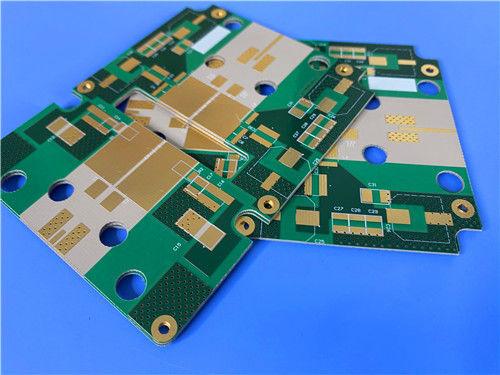
Astra MT77 is suitable for the high-frequency PCB and multilayer PCB constructions produced by KKPCB. For Astra MT77 builds, KKPCB:
- Builds the stack-up with matched Astra MT77 cores and prepreg, unless an approved hybrid construction is specified.
- Models impedance with the agreed Dk, cured dielectric thickness, copper weight, and copper profile.
- Controls etch compensation for fine RF traces, coupled gaps, antennas, and filter structures.
- Reviews launches, cavities, shields, edge plating, and mechanical tolerances before fabrication.
- Supports impedance coupons and, when required, S-parameter or insertion-loss test planning.
- Confirms any equivalent material with the customer before substitution.
See our high-frequency PCB capabilities and PCB materials pages for related manufacturing information.
6. Typical Applications of Astra MT77
- Automotive radar, adaptive cruise control, blind-spot detection, pre-crash sensing, lane-departure warning, and stop-and-go systems.
- Millimeter-wave antennas, phased arrays, filters, couplers, power dividers, and RF front ends.
- Aerospace and defense radar, communication links, guidance electronics, and temperature-sensitive RF assemblies.
- Low-loss high-speed digital interconnects and networking hardware.
7. Download the Isola Astra MT77 Data Sheet (PDF)
The official Isola Astra MT77 laminate and prepreg data sheet is embedded below. It contains the complete typical-values table, available thicknesses, copper options, applicable standards, and ordering information.
Download the Isola Astra MT77 Data Sheet (PDF)
Source: Isola Group, Astra® MT77 Laminate and Prepreg. All rights to the data sheet belong to Isola Group; values are typical and for reference only.
Frequently Asked Questions
Clear answers to the most common electrical, thermal, and manufacturing questions about Isola Astra MT77.
Quote Your Isola Astra MT77 PCB with KKPCB
Send your Gerber or ODB++ files, stack-up, operating frequency, and impedance requirements to KKPCB. Our engineers will review the Astra MT77 construction and material choice before production. Contact KKPCB for a quote.