
A High-Speed Logic PCB is a printed circuit board designed to carry digital signals at high frequencies, often in the range of hundreds of MHz to several GHz. Unlike standard PCBs, high-speed logic boards require special attention to signal integrity, timing accuracy, and electromagnetic compatibility.
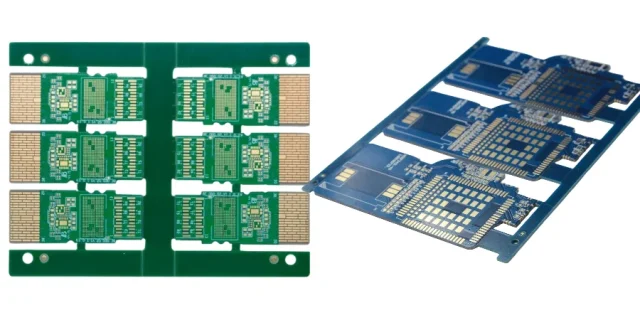
These PCBs are commonly used in:
-
Multi-gigabit computing systems
-
FPGA and microcontroller evaluation boards
-
High-speed networking and data communication
-
Test and measurement devices
The goal is to ensure that fast logic signals propagate without reflection, skew, or timing errors.
Key Challenges
Designing high-speed logic PCBs presents several engineering challenges:
-
Signal Degradation: Long traces or improper layer stack-ups can cause reflections, ringing, and overshoot.
-
Crosstalk and EMI: High-density routing increases the risk of unwanted coupling between adjacent signals.
-
Timing Skew: Differential signals or parallel buses can become misaligned if trace lengths are not matched.
-
Thermal Effects: Switching high-speed logic generates heat that may affect material properties and timing stability.
-
Impedance Control: Variations in trace geometry or substrate properties can introduce impedance mismatches, causing signal integrity issues.
Design Solutions
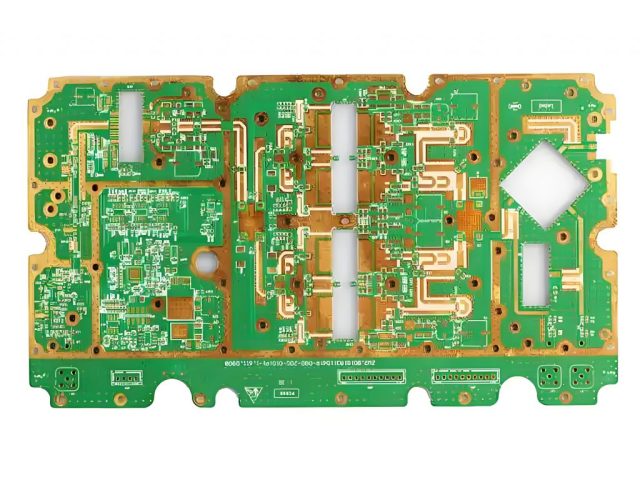
Engineers use multiple strategies to address these challenges:
-
Controlled Impedance Routing: Traces are designed as microstrip, stripline, or differential pairs to maintain consistent impedance.
-
Trace Length Matching: Critical signals and differential pairs are carefully routed to minimize timing skew.
-
Crosstalk Mitigation: Ground planes, guard traces, and proper layer allocation reduce interference between signals.
-
Decoupling and Power Distribution: Adequate bypass capacitors and low-impedance power planes stabilize voltage rails.
-
Layer Stack-Up Optimization: Separating high-speed signals from noisy layers and placing ground planes strategically improves signal integrity.
Materials & Manufacturing
Material selection and manufacturing processes are crucial for high-speed logic PCBs:
-
Low-Loss Laminates: PTFE-based or ceramic-filled materials reduce dielectric loss and maintain stable Dk at high frequencies.
-
High-Precision Drilling & Plating: Microvias and through-holes must be precise to prevent impedance discontinuities.
-
Surface Finishes: ENIG or hard-gold finishes ensure reliable soldering and low contact resistance.
-
Quality Assurance:
-
Impedance testing and time-domain reflectometry (TDR)
-
AOI/X-ray inspections to verify vias and multilayer alignment
-
Thermal cycling to confirm stability under operating conditions
-
KKPCB applies these processes to produce high-speed logic PCBs with reliable signal performance for demanding applications.
Real-World Applications
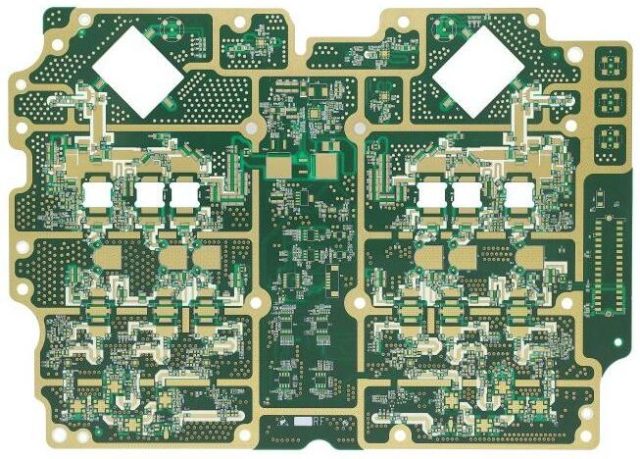
High-speed logic PCBs are critical in modern electronics that require fast, reliable digital signals:
-
FPGA & Microcontroller Boards: For rapid prototyping and testing complex digital logic
-
High-Speed Networking: Gigabit routers, switches, and backplanes
-
Data Centers: Multi-gigabit signal distribution and server boards
-
Test & Measurement Equipment: Logic analyzers, oscilloscopes, and diagnostic tools
-
High-Speed Consumer Electronics: Graphics cards, CPUs, and advanced gaming systems
By integrating controlled impedance, precise routing, low-loss materials, and rigorous QA, KKPCB delivers High-Speed Logic PCBs capable of maintaining accurate, fast, and reliable signal transmission in cutting-edge digital systems.
