Hot air solder leveling (HASL) coats the pads with a layer of solder. Electroless nickel immersion gold (ENIG) deposits a nickel barrier followed by a thin layer of gold. Choosing the wrong one rarely shows up at bare-board inspection; it shows up later as poor solder paste printing, open BGA joints, press-fit problems or unnecessary cost. This HASL vs ENIG guide compares the two finishes on the points that matter to engineering and purchasing teams.
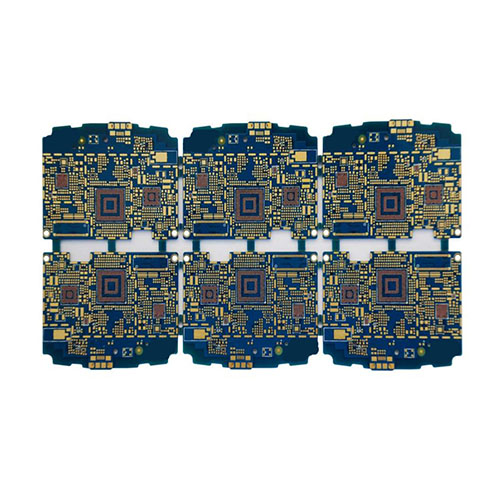
1. How HASL and ENIG Are Applied
HASL and lead-free HASL
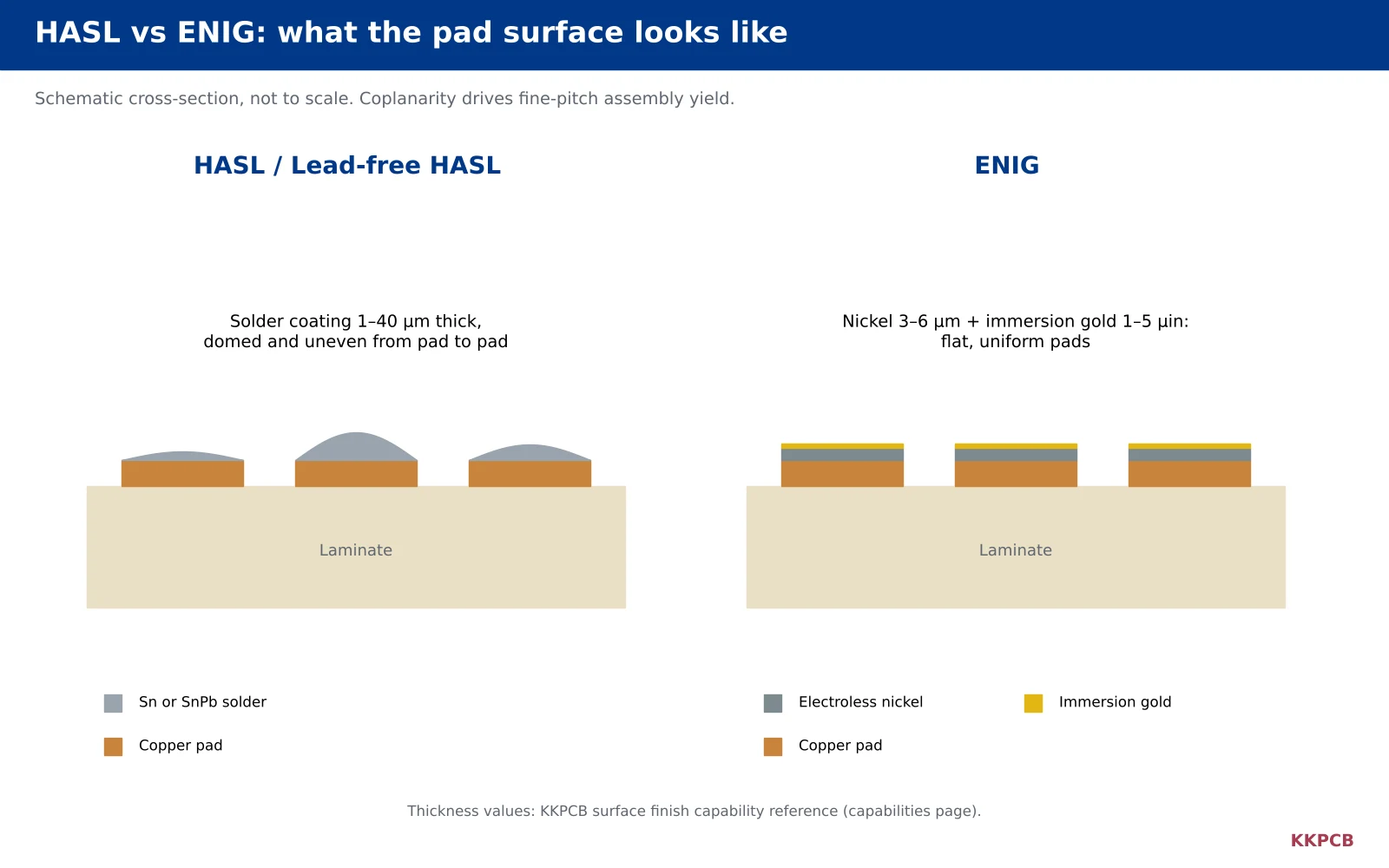
The board is fluxed and dipped into molten solder, then hot-air knives blow the excess solder off the surface. What remains is a solder coating on every exposed pad and hole. Traditional HASL uses tin-lead solder; lead-free HASL uses a tin-based alloy and is the version used for RoHS products.
Because the coating is shaped by surface tension and air flow, its thickness varies from pad to pad. KKPCB’s capability reference for HASL and lead-free HASL is a coating of 1–40 µm.
ENIG
ENIG is a chemical process. An electroless nickel layer is deposited on the copper, then an immersion reaction replaces the top atoms of nickel with gold. The gold protects the nickel from oxidation; during soldering the gold dissolves into the solder and the joint forms on the nickel.
KKPCB’s ENIG reference is nickel 3–6 µm with gold 1–5 µin for prototypes. The deposit follows the copper surface closely, so pads stay flat.
2. HASL vs ENIG: Side-by-Side Comparison
| Criterion | HASL / lead-free HASL | ENIG |
|---|---|---|
| Surface flatness | Uneven; domed pads, thickness 1–40 µm | Flat and uniform |
| Fine-pitch BGA / QFN | Not recommended for very fine pitch | Well suited |
| Solder joint interface | Solder to copper | Solder to nickel (gold dissolves) |
| Thermal stress on the board | Board is exposed to molten solder during finishing | Chemical process, no solder dip |
| Press-fit holes | Hole size varies with coating thickness | Consistent hole size |
| Wire bonding | Not suitable | Aluminum wire possible; gold wire normally needs ENEPIG |
| High-frequency loss | No nickel layer | Nickel adds conductor loss at high frequencies |
| Typical failure mode to control | Uneven coating, bridging on fine pitch | “Black pad” from nickel corrosion if the process is poorly controlled |
| Relative cost | Lower | Higher |
| KKPCB size limit | Up to 520×650 mm | Up to 520×800 mm |
3. HASL vs ENIG for Flatness and Fine-Pitch Assembly
Flatness is the main reason designers move from HASL to ENIG. Solder paste is printed through a stencil that sits on the pads; if neighbouring pads have different heights, the stencil cannot seal properly and paste volume varies. On large pads and through-hole components this rarely matters. On fine-pitch BGAs, QFNs and 0201 or 01005 passives it becomes a direct cause of bridging and open joints.
As a practical rule, HASL is comfortable on boards whose finest pitch is around 0.65 mm or larger. Below roughly 0.5 mm pitch, ENIG, OSP or another flat finish is the safer choice. KKPCB’s capability notes also state that 6 mil fine-pitch BGA pads require OSP or plated gold rather than a solder-coated finish.
4. HASL vs ENIG: Solder Joint Reliability
With HASL, solder paste melts into an existing solder coating on copper, and the intermetallic layer forms between tin and copper. This is a well-understood, robust joint.
With ENIG, the thin gold dissolves during reflow and the joint forms between tin and nickel. A well-controlled ENIG process gives reliable joints with good wetting. The risk to manage is “black pad”: excessive corrosion of the nickel during the immersion gold step, which leaves a weak, brittle interface. Good chemistry control, correct nickel phosphorus content and appropriate gold thickness are the preventive measures, which is why the nickel and gold thickness should be specified on the fabrication drawing.
5. HASL vs ENIG: Thermal Impact on the PCB
HASL requires the bare board to pass through molten solder. For thin boards, high-layer-count boards or materials sensitive to thermal shock, this extra thermal excursion is a consideration in addition to the later assembly reflow cycles.
ENIG is applied in chemical baths at much lower temperatures, so it adds no solder-dip thermal cycle. This is one reason ENIG is preferred on dense multilayer and HDI PCB designs.
6. Press-Fit, Edge Connectors and Wire Bonding
- Press-fit: the finished hole diameter of a press-fit hole is tightly toleranced. HASL coating thickness inside the hole varies, so flat finishes such as ENIG or immersion tin are usually specified.
- Edge connectors: neither HASL nor ENIG is designed for repeated insertion. Gold fingers use selective hard gold; KKPCB supports combinations such as ENIG + gold fingers and LF-HASL + gold fingers.
- Wire bonding: HASL cannot be used. ENIG can support some aluminum wire bonding; gold wire bonding normally calls for ENEPIG or plated soft gold.
7. High-Frequency Considerations
At radio and microwave frequencies, current flows in a thin skin near the conductor surface. In an ENIG finish, part of that current path passes through nickel, which is ferromagnetic and more resistive than copper, adding conductor loss. For many designs the effect is acceptable, but for long, loss-sensitive RF traces engineers often choose immersion silver, OSP or a nickel-free finish such as EPIG. Our article on EPIG vs ENIG vs ENEPIG covers these options, and our high-frequency PCB team can review RF stack-ups.
8. HASL vs ENIG: Cost and Lead Time
Lead-free HASL is generally the lower-cost finish and remains a sensible default for through-hole-heavy, cost-driven boards with relaxed pitch. ENIG costs more because of its chemistry and gold content, but on fine-pitch boards that extra cost is often recovered through higher assembly yield. The right comparison is therefore total cost per good assembled board, not finish price alone.
9. How to Decide HASL vs ENIG for Your Board
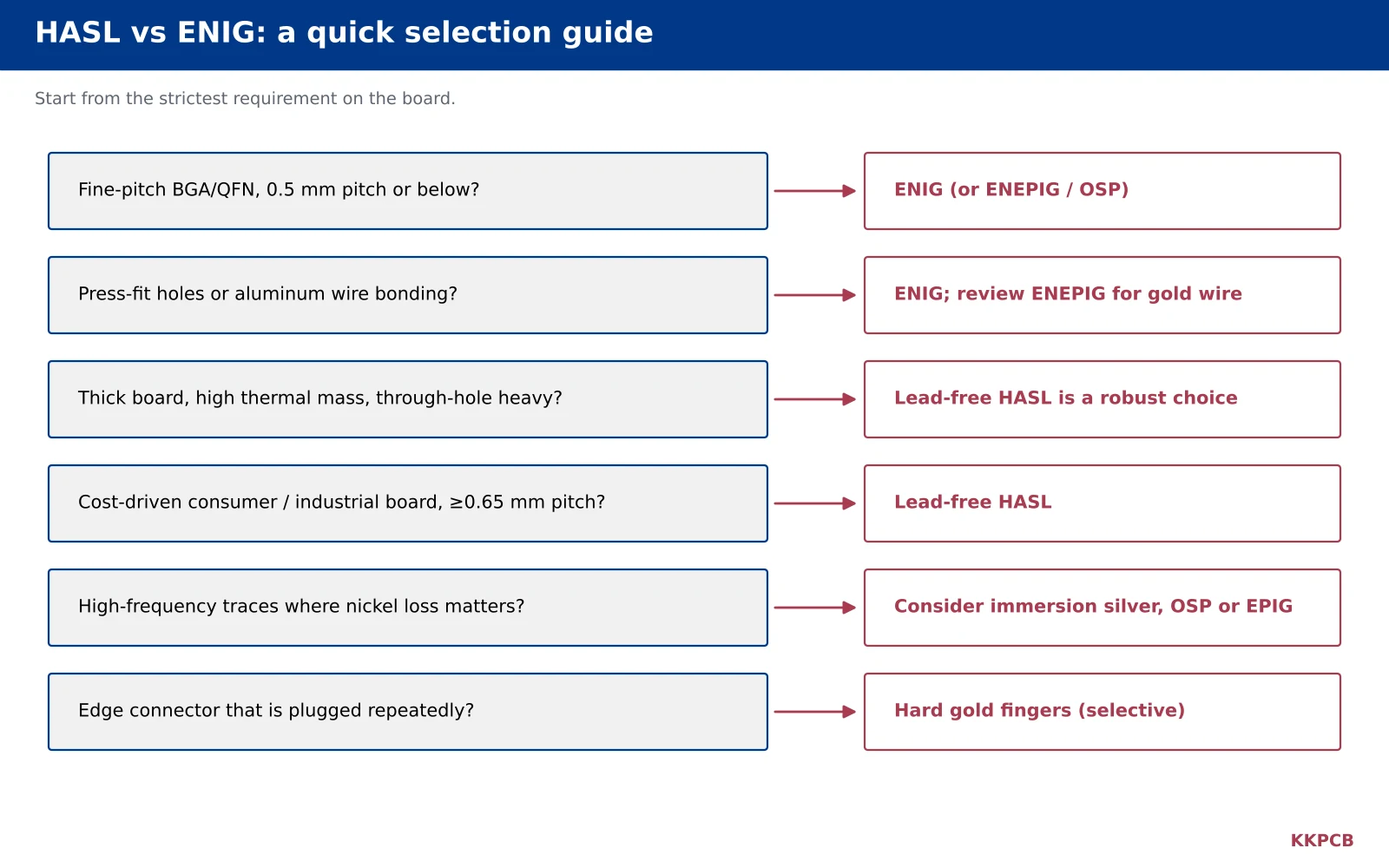
Use the strictest requirement on the board to decide:
- Fine pitch or BGA at 0.5 mm or below: choose ENIG (or OSP / ENEPIG).
- Press-fit or wire bonding: choose ENIG or a dedicated finish; never HASL.
- RF loss is critical: evaluate immersion silver, OSP or EPIG before ENIG.
- Robust, cost-sensitive, larger pitch: lead-free HASL is appropriate.
- Mixed needs: consider a selective combination, such as ENIG + gold fingers.
10. Beyond HASL and ENIG: Other Finishes Worth Comparing
HASL and ENIG are the two most requested finishes, but they are not the only options. When neither fits perfectly, one of the following often does:
| Finish | KKPCB thickness reference | Where it fits | Watch out for |
|---|---|---|---|
| OSP | 0.20–0.40 µm | Flat, low-cost finish for fine-pitch SMT | Shorter shelf life; limited multiple-reflow tolerance; handling sensitive |
| Immersion silver | Ag 6–12 µin | Fine pitch and high-frequency boards; no nickel layer | Tarnishes in sulfur-containing environments; needs careful packaging |
| Immersion tin | Sn ≥1 µm | Flat finish for press-fit and controlled assembly | Storage time and tin whisker considerations |
| ENEPIG | Ni 3–5 µm · Pd 1–6 µin · Au 1–4 µin | Soldering plus gold wire bonding; mixed-technology boards | Higher cost than ENIG |
| EPIG (nickel-free) | Pd 1–5 µin · Au 1–5 µin | RF and nickel-sensitive designs, bonding | Specialized process; confirm availability for your board size |
| Hard gold | 2–80 µin prototype; >50 µin by review | Edge connectors and wear contacts | Usually applied selectively, not to solder pads |
In practice, OSP is the most common alternative when a board needs flat pads but the budget does not allow ENIG. It performs well on fine-pitch SMT lines that assemble boards soon after fabrication. Immersion silver and nickel-free EPIG are chosen mainly for RF performance.
11. What to Specify on the Fabrication Drawing
Ambiguous finish notes are a frequent cause of quotation questions and mismatched expectations. A complete surface finish specification normally includes:
- Finish type, written explicitly: “lead-free HASL” rather than “HASL”, or “ENIG” rather than “gold”.
- Thickness requirements, especially nickel and gold for ENIG. If you have no specific requirement, state that the fabricator’s standard process window is acceptable.
- Selective areas, such as gold fingers, with their extent, thickness and bevel angle. KKPCB supports gold-finger bevels of 20°, 30°, 45° or 60°.
- Applicable acceptance class, for example IPC Class 2 or Class 3.
- RoHS or lead-free requirement, which also rules out tin-lead HASL.
- Packaging and storage expectations, if boards will be stored before assembly.
Including these points with the Gerber data lets the fabricator confirm feasibility in the first quotation round instead of after several engineering queries.
For the full list of finishes, thicknesses and combinations available at KKPCB, see our PCB surface finishes guide and the surface finish section of the capabilities page.
Frequently Asked Questions
In HASL vs ENIG, is ENIG always the better choice?
No. ENIG is better for flatness, fine pitch and press-fit, but lead-free HASL is a robust, lower-cost finish for boards with larger pitch and many through-hole components. The best choice depends on the most demanding component on the board.
Is lead-free HASL RoHS compliant?
Lead-free HASL uses a lead-free alloy and is the HASL version used for RoHS products. Traditional tin-lead HASL is only used where the product and its market allow lead.
What is black pad in ENIG?
Black pad is a defect where the nickel layer is excessively corroded during the immersion gold step, creating a weak interface that can cause brittle solder joints. It is prevented by controlling the ENIG chemistry and specifying appropriate nickel and gold thickness.
Which finish has better shelf life?
Both HASL and ENIG are considered long-shelf-life finishes when boards are stored correctly in sealed, dry packaging. OSP and immersion finishes are more sensitive to storage time and handling.
Can I use HASL on some pads and ENIG on others?
Mixing HASL and ENIG on the same board is not a normal production combination. Common selective combinations include ENIG + OSP, ENIG + gold fingers and LF-HASL + gold fingers; discuss the requirement with your fabricator during DFM review.
Choose the Right Finish with KKPCB
KKPCB offers HASL, lead-free HASL, ENIG, ENEPIG, EPIG, immersion silver, immersion tin, OSP and hard gold, including selective combinations. Our engineers review pad geometry, component pitch and assembly requirements before production, and we support both PCB manufacturing and PCB assembly under one roof.
Still weighing HASL vs ENIG for your board? Contact KKPCB with your Gerber files and component list for a finish recommendation.
PCB fabrication at KKPCB follows the acceptance criteria of IPC (IPC-6012, IPC-A-600).