
Automotive Radar PCB production release begins when design evidence, supplier capability, and change control agree. The last ten percent of a board program is rarely a single design change. It is the point where a prototype stackup, a supplier process, a connector choice, and an enclosure must become one controlled release.
For front and corner radar sensors exposed to vibration, temperature cycling, radome constraints, and strict end-of-line calibration, the Automotive Radar PCB package needs to show not only that the board works, but also which assumptions are allowed to change without reopening the RF, thermal, or reliability risk.
Use the Automotive Radar PCB release as a controlled engineering object: the board, stackup, fabrication note, assembly recipe, and verification record must describe the same physical path. The guidance below is intentionally practical; it separates a design target from a supplier typical value and keeps any inference visible.
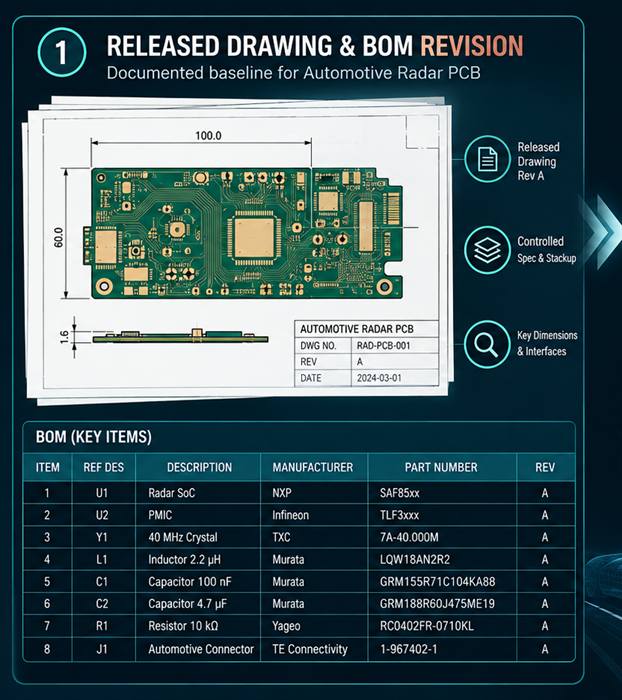
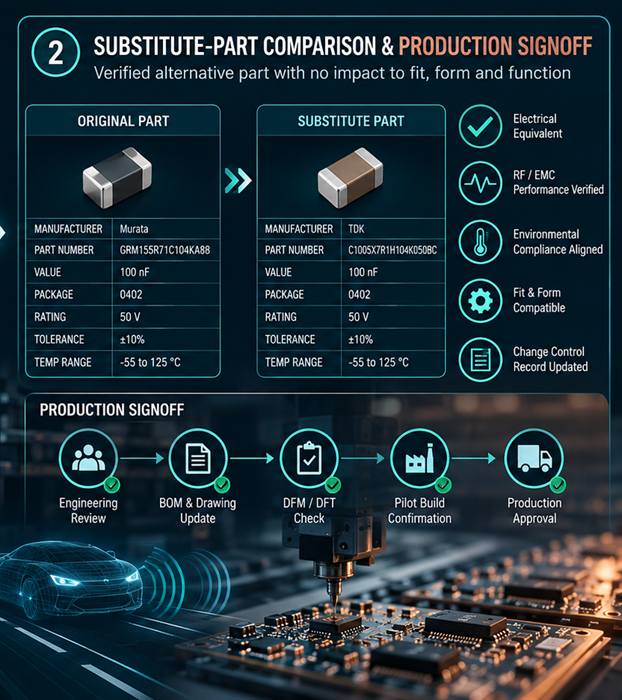
Table of Contents
Automotive Radar PCB — Build the release around decisions
A useful release file records the decisions that affect product behavior: approved stackup, material construction, finished copper, controlled impedance, drill and plating class, connector interface, solder-mask rule, assembly profile, and the acceptance method for critical features. Each item needs an owner and revision. For Automotive Radar PCB, keep the product requirement next to the board rule so a future engineer can tell whether a dimension is functional or merely inherited. The project file should cross-reference PCB materials and RF PCB design so the same constraint is visible to both design and sourcing. The controlled release record for this section is Automotive Radar PCB; use the linked page as the internal capability reference while the article supplies the engineering decision.Make the DFM conversation measurable
Ask the fabricator to respond to the actual geometry: minimum trace and space on the RF layer, annular ring after registration, via-to-copper clearance, copper balance, panel rails, fiducials, and coupon placement. The PCB manufacturing review should list open questions and the date they were closed. Avoid a generic “DFM approved” line; it does not explain whether the supplier accepted the launch, the thermal pad, or the edge-to-antenna clearance. A practical handoff also names controlled impedance PCB, PCB manufacturing, and PCB assembly where those terms describe the physical feature being released. The controlled release record for this section is Automotive Radar PCB; use the linked page as the internal capability reference while the article supplies the engineering decision.
Protect the signal budget during substitutions
Component substitutions are often made for lead time, but a substitute may change pad length, shield geometry, loss, thermal resistance, or assembly force. For Automotive Radar PCB, require a comparison of the electrical footprint, mechanical envelope, thermal path, and supplier qualification before a part is swapped. The PCB materials and PCB assembly records should share the same change number so a material or process change cannot bypass RF review. Keep high-reliability PCB beside the drawing revision, and use signal integrity for the verification owner rather than leaving the requirement in email. The controlled release record for this section is Automotive Radar PCB; use the linked page as the internal capability reference while the article supplies the engineering decision.Use a staged verification matrix
Separate prototype learning from production acceptance. Early builds may use a broader engineering range while production gates use a narrower released tolerance. Define which checks are dimensional, which are visual, which are coupon-based, and which are functional. If a value is a design target or typical supplier value, label it that way; call something measured only when the measurement, condition, and sample are retained. This makes the project manager’s status report honest without weakening the engineering decision. The manufacturing traveller can then connect DFM review with RF front-end PCB and preserve evidence for the next lot. The controlled release record for this section is Automotive Radar PCB; use the linked page as the internal capability reference while the article supplies the engineering decision.
Close with a controlled handoff
Before volume release, compare the final Gerber or ODB++ package, stackup, BOM, drawing, assembly program, inspection plan, and change log. Confirm that the front-end team, mechanical team, fabricator, and assembler are all using the same revision. A board that is electrically correct but built from mixed revisions is not released. For Automotive Radar PCB, the safest handoff is a short, signed package that makes the critical geometry and its verification method impossible to overlook. Before sign-off, confirm thermal management PCB and via-in-pad PCB are linked to the same revision and acceptance method.Release checklist for the next build
- State the operating band, enclosure state, and environmental boundary for Automotive Radar PCB.
- Identify the controlled material construction, copper profile, and pressed dielectric tolerance.
- Show the complete signal and return path through connectors, vias, shields, and planes.
- Tie fabrication and assembly checks to a revisioned drawing, coupon, or inspection record.
- Label typical values, design targets, engineering ranges, and measured values separately.
- Record the owner and closure evidence for every open RF, thermal, and mechanical risk.
