
Taconic TLY-5 PCB thermal cycling can expose a registration problem long before a field failure is visible. Different copper, dielectric, mask, connector, and enclosure structures expand at different rates. In a multilayer RF board, that movement can change a via-to-pad relationship, connector datum, or phase-critical line. The right response is to read the CTE path and inspection evidence together.
Table of Contents
Map the CTE path through the construction
List copper thickness, dielectric layers, plated holes, stiffeners, connectors, and the enclosure interface. Taconic TLY-5 PCB stackup records should separate supplier typical values from finished targets. The RF PCB design materials review can then identify which interfaces deserve a fiducial, coupon, or cross-section after thermal exposure.
Protect drill-to-copper and connector datums
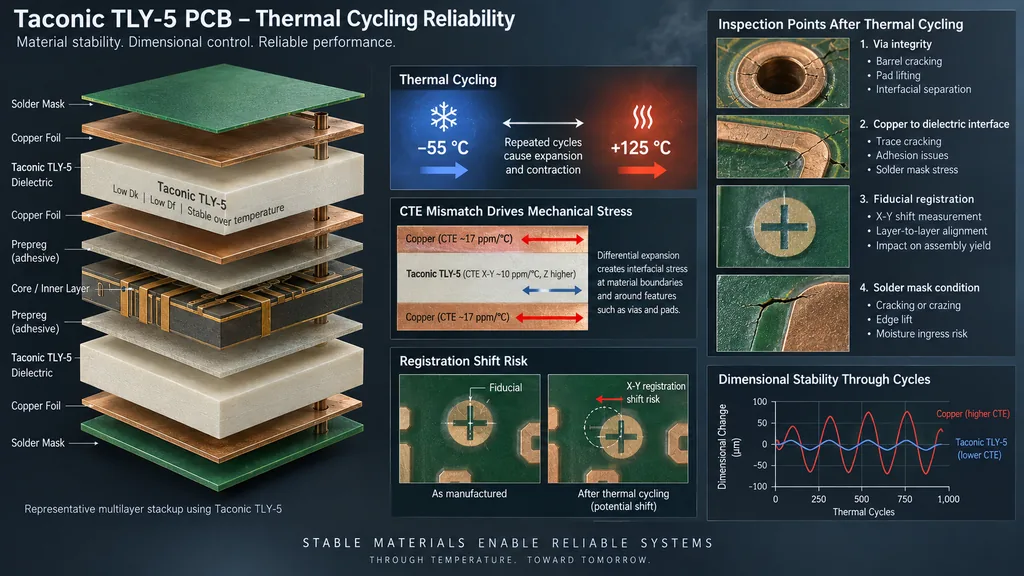
Registration tolerance accumulates through imaging, lamination, drilling, plating, and routing. Taconic TLY-5 PCB via and launch dimensions should be referenced to the same fiducial system used by assembly. The PCB manufacturing manufacturing package should carry panel orientation, press direction, drill class, and the inspection datum rather than a single board-edge number.
Use thermal exposure as a defined engineering window
Set conditioning temperature, dwell, cycle count, measurement timing, and acceptance criteria before the build. A calculated movement estimate is not a measured result. Taconic TLY-5 PCB thermal-cycling records should state the assumption. The RF PCB materials controlled-impedance PCB review can then compare registration, loss, and phase evidence without overstating correlation.
Inspect plated holes and soldered interfaces
Thermal movement can stress barrels, annular rings, connector pads, and exposed thermal joints. Inspect representative locations instead of relying only on a generic coupon. Taconic TLY-5 PCB drawings should identify critical holes and launches. The controlled-impedance PCB assembly record should include connector coplanarity, solder fillet, support tooling, and any rework before post-cycle RF checks.
Turn the result into a release decision
Freeze the construction, fiducial map, measurement plan, and disposition rule. Taconic TLY-5 PCB documentation should distinguish typical CTE, calculated movement, target registration, and measured evidence. The PCB assembly PCB manufacturing handoff can then adjust material, panelization, drill, or enclosure interface based on a traceable cause.
Use thermal cycling to learn where the released construction moves, not to invent a headline test result. Clear targets, fiducials, coupons, and revision control let the project team decide whether the remedy belongs in stackup, artwork, drill, assembly, or enclosure design.
Project evidence and handoff for Taconic TLY-5 PCB thermal cycling
For thermal-cycling work, capture construction, fiducial map, drill-to-copper checks, cycle profile, measurement timing, plated-hole evidence, connector condition, and post-cycle RF criteria. Calculated movement and measured registration must remain separate fields. The Taconic TLY-5 PCB drawing should make the critical datum visible to layout, fabrication, assembly, and test. If a number is calculated, retain the assumptions; if it is a supplier typical, keep it labeled as typical; if it is a measured acceptance value, keep the sample, method, and revision traceable.
| Release item | Engineering question | Evidence to retain |
|---|---|---|
| Stackup and material | Does the finished construction match the RF model? | Finished dielectric target, copper assumption, material lot, cross-section |
| Transition or critical path | Is the mechanical datum also the electrical datum? | Launch drawing, via or pad dimensions, mask and connector inspection |
| Process witness | Does the coupon represent the product feature? | Panel position, layer pair, finish, drill and impedance record |
| Assembly and test | Could placement, rework, or calibration move the result? | Placement tolerance, reflow or rework history, fixture and reference plane |
For program control, use a short disposition statement after each build: what passed, what moved, what is still a target, and which owner decides the next change. This keeps the Taconic TLY-5 PCB thermal cycling discussion focused on evidence and prevents a new material, finish, or layout change from being introduced without an updated model and acceptance plan.
Sources: Taconic and Rogers typical material data; IPC-TM-650 methods relevant to dielectric, copper, drilling, plating, registration, and impedance; RF application guidance from Qorvo, Analog Devices, and Würth Elektronik; KKPCB PCB design, materials, manufacturing, assembly, and high-frequency capability pages. Values are typical, target, or calculated references unless explicitly identified as measured.
