
Taconic TLY-5 PCB prototype release is where an RF evaluation board either becomes useful evidence or becomes an expensive collection of assumptions. The design may contain a capable laminate, but the team still needs a finished stackup, launch datum, representative coupon, assembly limits, calibration method, and a clear record of what is typical, calculated, targeted, or measured. This checklist is written for the handoff between engineering, purchasing, fabrication, assembly, and test.
Table of Contents
Gate one: freeze the engineering intent
Record band, application, connector, layer pair, impedance target, phase or loss budget, and environmental assumptions. Taconic TLY-5 PCB selection should be linked to finished construction rather than a material name alone. The RF PCB design RF PCB design package should identify the feature that is expected to be learned from the prototype.
Gate two: release stackup and launch geometry
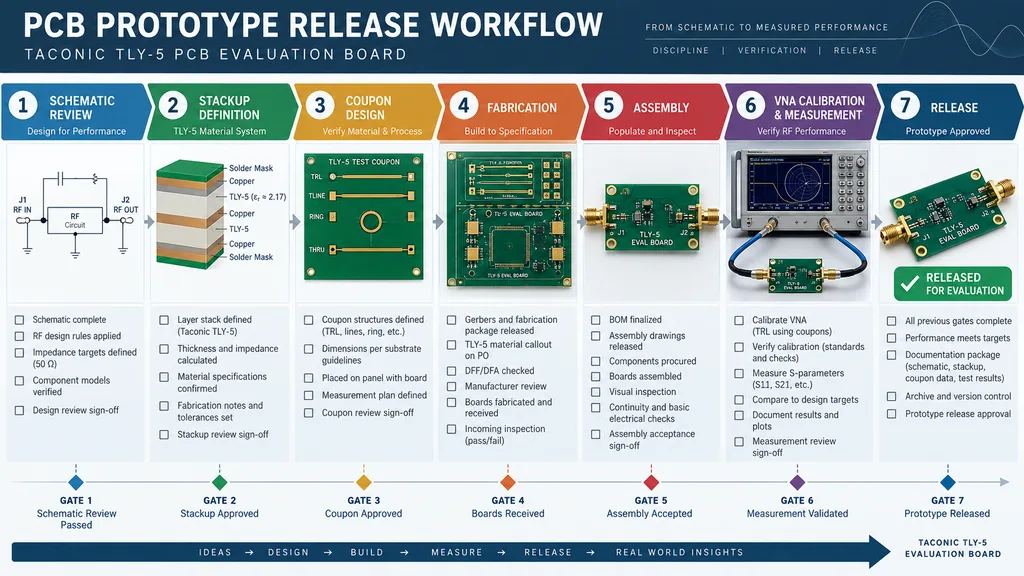
Approve finished dielectric targets, copper profile, mask strategy, via structure, anti-pad, ground fence, edge datum, and connector footprint. Taconic TLY-5 PCB drawings should use one coordinate system. The PCB manufacturing high-frequency PCB review can then check model assumptions against a build KKPCB can fabricate and inspect.
Gate three: create representative evidence
Add impedance, registration, drill, and launch witnesses that share panel, layer pair, finish, and copper density with the product. Taconic TLY-5 PCB coupon records should include panel location and revision. The RF PCB materials PCB manufacturing package should state which values are acceptance targets and which are process monitors.
Gate four: protect the evaluation during assembly
Freeze placement, reflow, connector torque, cleaning, inspection, shield attachment, and rework disposition. Taconic TLY-5 PCB phase-critical areas should be marked in the assembly drawing. The controlled-impedance PCB PCB assembly handoff should distinguish an untouched sample from a board repaired for diagnosis.
Gate five: define calibration and decision rules
Set reference plane, fixture, calibration standard, temperature, sweep, acceptance window, and disposition before measuring. Taconic TLY-5 PCB prototype release records should separate calculated expectations from measured response. The PCB assembly manufacturing and materials records should make the next ECO traceable to the actual evidence.
A prototype is valuable when the next decision is obvious. Use the gates to make the board teach the team something about the RF path, the manufacturing window, and the assembly process before the design is scaled or tuned.
Project evidence and handoff for Taconic TLY-5 PCB prototype release
For an RF prototype release, use explicit gates for intent, stackup, launch, coupon, assembly, calibration, and disposition. The project manager should be able to identify the next decision from the evidence package without reopening the entire layout. The Taconic TLY-5 PCB drawing should make the critical datum visible to layout, fabrication, assembly, and test. If a number is calculated, retain the assumptions; if it is a supplier typical, keep it labeled as typical; if it is a measured acceptance value, keep the sample, method, and revision traceable.
| Release item | Engineering question | Evidence to retain |
|---|---|---|
| Stackup and material | Does the finished construction match the RF model? | Finished dielectric target, copper assumption, material lot, cross-section |
| Transition or critical path | Is the mechanical datum also the electrical datum? | Launch drawing, via or pad dimensions, mask and connector inspection |
| Process witness | Does the coupon represent the product feature? | Panel position, layer pair, finish, drill and impedance record |
| Assembly and test | Could placement, rework, or calibration move the result? | Placement tolerance, reflow or rework history, fixture and reference plane |
For program control, use a short disposition statement after each build: what passed, what moved, what is still a target, and which owner decides the next change. This keeps the Taconic TLY-5 PCB prototype release discussion focused on evidence and prevents a new material, finish, or layout change from being introduced without an updated model and acceptance plan.
Sources: Taconic and Rogers typical material data; IPC-TM-650 methods relevant to dielectric, copper, drilling, plating, registration, and impedance; RF application guidance from Qorvo, Analog Devices, and Würth Elektronik; KKPCB PCB design, materials, manufacturing, assembly, and high-frequency capability pages. Values are typical, target, or calculated references unless explicitly identified as measured.
