
Taconic TLY-5 PCB solder mask decisions can change grounded coplanar waveguide more than a layout review suggests. A blanket coating adds dielectric material above the line, while an open region exposes copper to assembly, handling, and contamination concerns. The correct answer depends on frequency, geometry, finish, process capability, and how the connector or probe references the line.
Table of Contents
Model mask as part of the CPW cross-section
Do not switch between masked and open CPW after the line width is frozen. Taconic TLY-5 PCB geometry should include mask thickness, opening, copper profile, ground spacing, and finished dielectric. The RF PCB design high-frequency PCB review can then show whether the mask is electrical material, a mechanical keep-out, or both.
Use open copper selectively at launches and probes
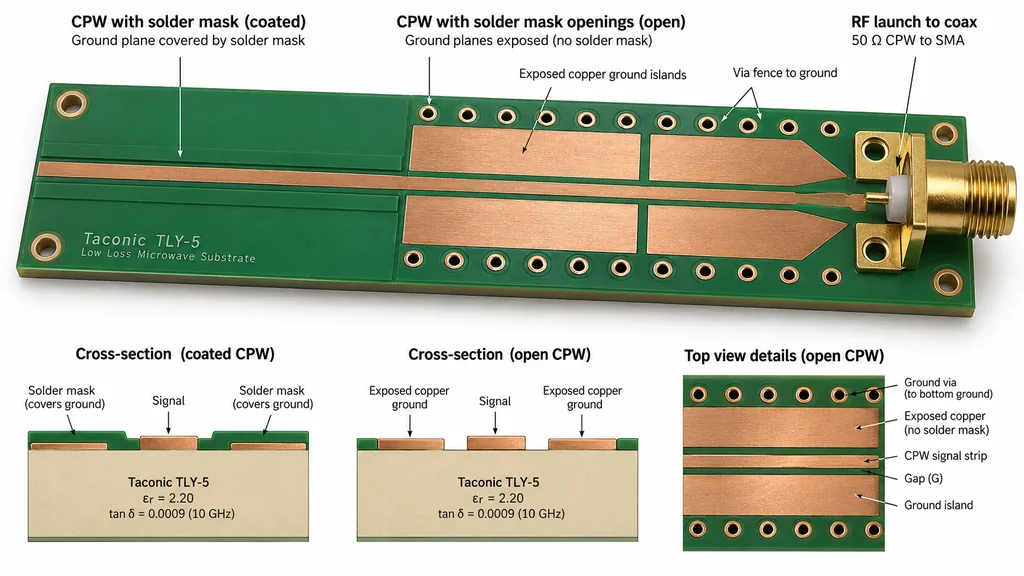
An open region may help connector or probe repeatability but increases handling and cleaning sensitivity. Define its length, edge, and keep-out from the launch datum. Taconic TLY-5 PCB RF PCB materials records should identify finish and exposed copper assumptions. The PCB manufacturing assembly handoff should control flux residue, protective film, cleaning, and operator contact.
Keep the via fence and mask opening aligned
A mask opening that drifts relative to the fence changes the local field and solder fillet. Check registration from mask artwork to copper and from copper to drill. Taconic TLY-5 PCB CPW documentation should include the finished opening and inspection method. The RF PCB materials manufacturing traveler should place this check beside the cross-section and registration witness.
Protect exposed copper through assembly
Use a defined connector installation, cleaning, and inspection sequence. A board can meet optical criteria while residue or a shifted fillet changes loss. Taconic TLY-5 PCB drawings should mark no-touch and no-rework areas. The controlled-impedance PCB PCB assembly record should separate an untouched open CPW from one that has been cleaned, probed, or repaired.
Release mask choice with correlation evidence
Freeze masked or open geometry, material assumptions, coupon, launch, and acceptance window. Taconic TLY-5 PCB targets should distinguish typical mask thickness from measured registration. The PCB assembly PCB manufacturing package can then decide whether a drift belongs to artwork, coating, plating, or assembly instead of retuning blindly.
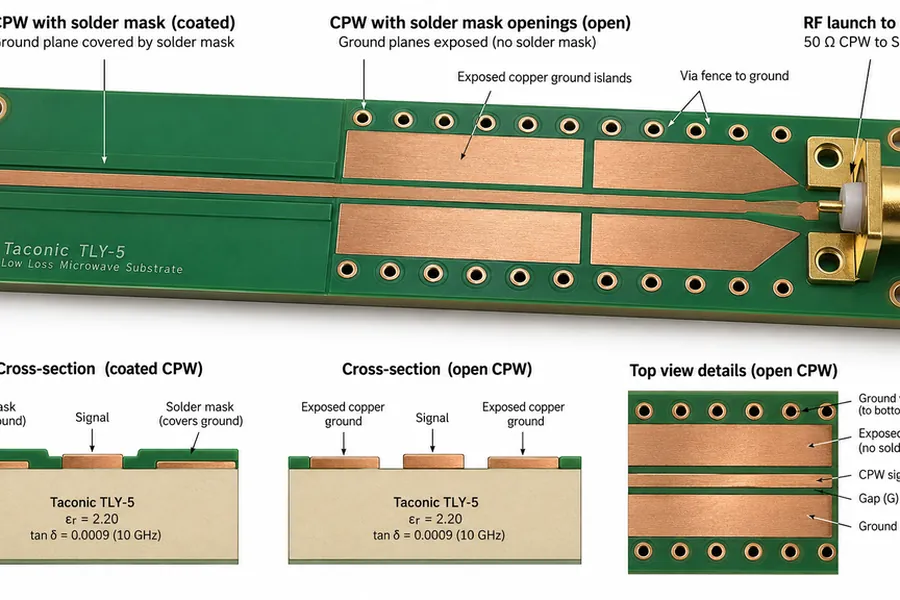
Use a mask strategy that is explicit in the model and in the fabrication drawing. That keeps the RF intent visible while giving manufacturing and assembly a practical way to protect the exposed region.
Project evidence and handoff for Taconic TLY-5 PCB solder mask CPW
For an open-CPW decision, retain mask opening, finish, exposed-copper handling, cleaning, probe or connector interface, via fence, and registration evidence. The electrical model and the assembly protection plan must describe the same opening. The Taconic TLY-5 PCB drawing should make the critical datum visible to layout, fabrication, assembly, and test. If a number is calculated, retain the assumptions; if it is a supplier typical, keep it labeled as typical; if it is a measured acceptance value, keep the sample, method, and revision traceable.
| Release item | Engineering question | Evidence to retain |
|---|---|---|
| Stackup and material | Does the finished construction match the RF model? | Finished dielectric target, copper assumption, material lot, cross-section |
| Transition or critical path | Is the mechanical datum also the electrical datum? | Launch drawing, via or pad dimensions, mask and connector inspection |
| Process witness | Does the coupon represent the product feature? | Panel position, layer pair, finish, drill and impedance record |
| Assembly and test | Could placement, rework, or calibration move the result? | Placement tolerance, reflow or rework history, fixture and reference plane |
For program control, use a short disposition statement after each build: what passed, what moved, what is still a target, and which owner decides the next change. This keeps the Taconic TLY-5 PCB solder mask CPW discussion focused on evidence and prevents a new material, finish, or layout change from being introduced without an updated model and acceptance plan.
Sources: Taconic and Rogers typical material data; IPC-TM-650 methods relevant to dielectric, copper, drilling, plating, registration, and impedance; RF application guidance from Qorvo, Analog Devices, and Würth Elektronik; KKPCB PCB design, materials, manufacturing, assembly, and high-frequency capability pages. Values are typical, target, or calculated references unless explicitly identified as measured.
