
Ceramic substrates are widely used in high-performance electronic applications due to their excellent thermal conductivity, electrical insulation properties, and mechanical stability. They are commonly found in power electronics, LED modules, automotive electronics, RF devices, semiconductor packaging, and other applications requiring efficient heat dissipation and reliable performance.
During ceramic substrate manufacturing, cutting is a critical process that directly affects dimensional accuracy, edge quality, material integrity, and final product reliability. Due to the inherent brittleness and hardness of ceramic materials, selecting an appropriate cutting technology is essential to minimize defects such as cracks, chipping, thermal damage, and mechanical stress.
Two commonly used ceramic substrate cutting methods are laser cutting and waterjet cutting. Each technology has unique advantages and limitations depending on material type, thickness, precision requirements, and production volume.
1. Ceramic Substrate Cutting Challenges
Unlike traditional PCB materials, ceramic substrates such as alumina (Al₂O₃), aluminum nitride (AlN), and silicon nitride (Si₃N₄) have high hardness and low fracture toughness, making them difficult to process.
Common challenges during ceramic substrate cutting include:
- Crack formation: Excessive mechanical stress can cause micro-cracks that may affect electrical reliability.
- Edge chipping: Poor cutting control can damage substrate edges and reduce assembly reliability.
- Dimensional accuracy requirements: Advanced applications often require tight tolerances for alignment and assembly.
- Thermal impact: Cutting heat may influence material properties or metallization layers.
- Surface quality control: Rough edges or contamination can affect subsequent processes such as brazing, bonding, and assembly.
Therefore, cutting technology selection must balance precision, processing efficiency, and material protection.
2. Laser Cutting Technology for Ceramic Substrates
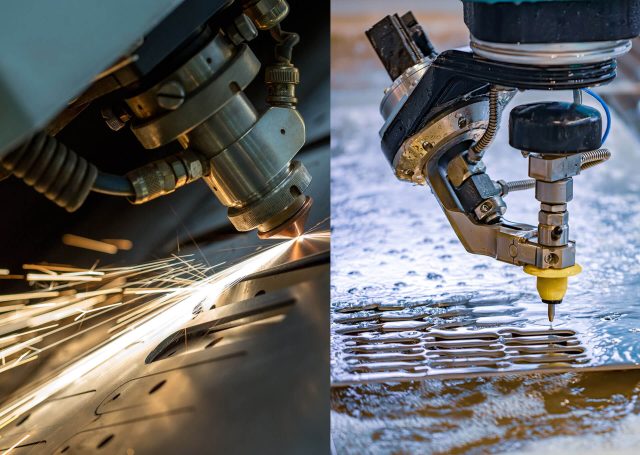
Laser cutting uses a focused high-energy laser beam to remove ceramic material through melting, vaporization, or ablation.
Common laser technologies used for ceramic processing include CO₂ lasers, fiber lasers, and UV lasers, depending on substrate characteristics and precision requirements.
Advantages of Laser Cutting
High Precision and Fine Feature Capability
Laser cutting provides excellent positioning accuracy and can achieve very small cutting widths. This makes it suitable for ceramic substrates with complex geometries, fine structures, and miniaturized electronic designs.
Low Mechanical Stress
Because laser cutting is a non-contact process, there is minimal mechanical force applied to the ceramic material. This helps reduce the risk of substrate deformation and mechanical cracking.
Suitable for Thin Ceramic Materials
For thin ceramic substrates used in semiconductor packages, sensors, and miniaturized electronic modules, laser cutting can achieve clean and precise separation.
High Processing Flexibility
Laser systems can easily handle different cutting patterns through software programming, making them suitable for prototype development and small-to-medium batch production.
Limitations of Laser Cutting
Despite its advantages, laser cutting also has some limitations:
Heat-Affected Zone (HAZ)
The high temperature generated during laser processing may create a heat-affected zone near the cutting area. In some applications, thermal stress or changes in material properties need to be carefully controlled.
Equipment Cost
High-precision laser cutting equipment requires significant investment, which may increase manufacturing costs for certain production requirements.
Material Thickness Limitations
For thicker ceramic substrates, laser cutting efficiency may decrease due to increased processing time and energy requirements.
3. Waterjet Cutting Technology for Ceramic Substrates
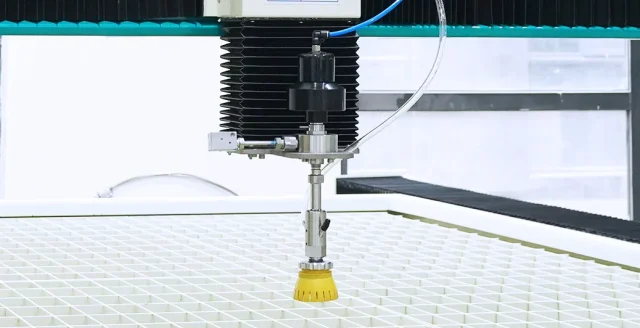
Waterjet cutting uses a high-pressure water stream, often mixed with abrasive particles, to mechanically cut ceramic materials without generating significant heat.
Abrasive waterjet technology is commonly used for processing hard and brittle materials such as ceramics, glass, and composites.
Advantages of Waterjet Cutting
No Thermal Damage
Since waterjet cutting is a cold-cutting process, it eliminates heat-affected zones and reduces the risk of thermal damage to ceramic materials and metallized layers.
Suitable for Thick Ceramic Substrates
Waterjet cutting is effective for thicker ceramic materials where laser processing may become inefficient.
Reduced Material Stress
The cutting process produces lower thermal stress, helping maintain substrate integrity and reducing the possibility of heat-related defects.
Capability for Large and Complex Shapes
Waterjet systems can process larger ceramic panels and complicated geometries while maintaining good dimensional stability.
Limitations of Waterjet Cutting
Lower Cutting Precision Compared with Laser
Although waterjet cutting provides good accuracy, it generally cannot achieve the same fine resolution as laser cutting for extremely small features.
Edge Quality Considerations
The cutting speed and abrasive parameters must be optimized to minimize edge roughness and chipping.
Higher Material Consumption
The cutting kerf of waterjet processing is typically wider than laser cutting, which may result in more material waste.
4. Laser Cutting vs. Waterjet Cutting: Key Comparison
| Comparison Factor | Laser Cutting | Waterjet Cutting |
|---|---|---|
| Cutting Method | Thermal ablation | High-pressure abrasive cutting |
| Mechanical Stress | Very low | Low |
| Heat Impact | Possible heat-affected zone | No thermal damage |
| Precision | Excellent | Good |
| Thin Ceramic Processing | Excellent | Moderate |
| Thick Ceramic Processing | Limited efficiency | Excellent |
| Edge Quality | Smooth with optimized parameters | Good but requires process control |
| Complex Small Features | Highly suitable | Less suitable |
| Production Flexibility | High | High |
| Equipment Investment | Higher | Moderate to high |
5. How to Select the Right Ceramic Cutting Technology?
The selection between laser cutting and waterjet cutting depends on several factors:
Material Type
Different ceramics have different hardness, thermal conductivity, and fracture characteristics. For example, AlN ceramic substrates used in high-power electronics may require different processing considerations compared with alumina substrates.
Substrate Thickness
- Thin ceramic substrates: Laser cutting is usually preferred due to higher precision.
- Thick ceramic substrates: Waterjet cutting may provide better efficiency and lower thermal impact.
Application Requirements
For semiconductor packaging, RF modules, and precision electronic components, dimensional accuracy and edge quality are critical. Laser cutting may provide better performance.
For power electronics and thermal management applications requiring thicker ceramic materials, waterjet cutting can be an effective solution.
Production Volume
Laser cutting is suitable for flexible production and precision manufacturing, while waterjet cutting can be advantageous for larger components and applications where thermal damage must be avoided.
6. Future Trends in Ceramic Substrate Cutting
With the increasing demand for high-power electronics, electric vehicles, and advanced semiconductor packaging, ceramic substrate processing continues to evolve.
Future cutting technologies are expected to focus on:
- Higher precision processing for miniaturized electronic components
- Improved crack and chipping control
- Faster processing speed for mass production
- Integration of automated inspection systems
- Advanced laser technologies with reduced thermal impact
The combination of advanced cutting processes and intelligent quality control will help improve ceramic substrate reliability and manufacturing efficiency.
Conclusion
Both laser cutting and waterjet cutting technologies offer unique advantages for ceramic substrate processing. Laser cutting provides excellent precision, flexibility, and suitability for miniaturized electronic applications, while waterjet cutting delivers strong performance for thicker ceramic materials with minimal thermal impact.
Choosing the right cutting method requires comprehensive consideration of ceramic material characteristics, substrate thickness, dimensional requirements, and application conditions. By selecting an appropriate cutting technology, manufacturers can improve ceramic substrate quality, reduce processing risks, and enhance the reliability of advanced electronic products.
