The Importance of High-Frequency PCB Materials
As wireless communication, radar systems, and high-speed electronic devices continue to evolve, PCB materials have become a critical factor in determining overall system performance.
At RF, microwave, and millimeter-wave frequencies, even minor variations in dielectric properties, thermal expansion, or copper surface characteristics can cause:
- Signal attenuation
- Phase instability
- Impedance variation
- Increased insertion loss
- Reduced system reliability
The Rogers CLTE™ Series high-frequency laminates are specifically engineered to address these challenges. With stable dielectric properties, low loss characteristics, and excellent thermal reliability, CLTE materials provide a reliable foundation for advanced RF, microwave, and mmWave PCB applications.
KKPCB specializes in manufacturing Rogers high-frequency PCBs, providing fabrication and assembly solutions that maximize the electrical performance and reliability of CLTE-based designs.
What Is the Rogers CLTE™ Series?
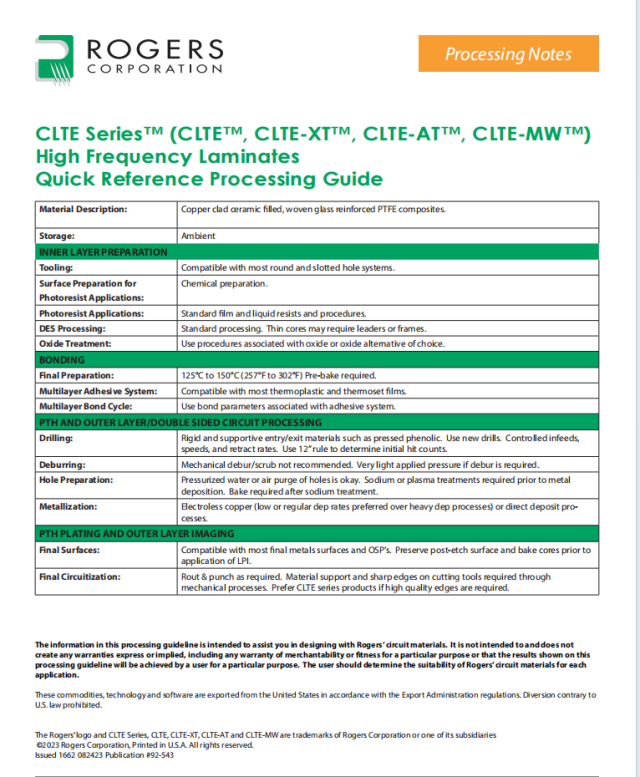
The Rogers CLTE™ Series is a family of PTFE-based high-frequency laminate materials reinforced with woven fiberglass.
Unlike conventional FR-4 materials, CLTE laminates are optimized for applications requiring:
- Stable dielectric performance
- Low signal loss
- Controlled impedance
- High-frequency reliability
- Excellent dimensional stability
The reinforced PTFE structure provides improved mechanical strength and manufacturing consistency, making CLTE suitable for demanding RF and microwave PCB applications.
Rogers CLTE™ Series Material Options
Different CLTE variants are designed to meet specific application requirements.
Rogers CLTE™
Provides a balance between electrical performance, mechanical stability, and manufacturability.
Typical applications:
- RF circuits
- Microwave modules
- Communication equipment
Rogers CLTE-XT™
Designed for applications requiring enhanced thermal stability and lower signal loss.
Key advantages:
- Improved temperature performance
- Stable electrical properties under thermal variation
- Reliable performance in demanding RF environments
Applications:
- Radar systems
- Wireless communication equipment
- High-temperature RF modules
Rogers CLTE-AT™
Optimized for advanced thermal reliability and dimensional control.
Advantages:
- Improved multilayer registration
- Stable mechanical performance
- Suitable for harsh operating environments
Applications:
- Aerospace electronics
- Defense communication systems
- High-reliability RF platforms
Rogers CLTE-MW™
Designed specifically for millimeter-wave applications.
Key characteristics:
- Stable dielectric performance at high frequencies
- Low transmission loss
- Suitable for frequencies up to approximately 110 GHz
Applications:
- Automotive radar
- mmWave communication
- Advanced antenna systems
Key Advantages of Rogers CLTE™ PCB Materials
1. Stable Dielectric Properties for Signal Integrity
High-frequency systems require predictable electrical performance.
Rogers CLTE materials provide:
- Controlled dielectric constant (Dk)
- Low dissipation factor (Df)
- Reduced signal attenuation
- Stable impedance characteristics
These properties help maintain:
- Signal phase accuracy
- Transmission efficiency
- Consistent RF performance
2. Low Insertion Loss for RF and Microwave Applications
At high frequencies, conductor and dielectric losses become significant design concerns.
CLTE laminates help reduce signal degradation through:
- Low-loss PTFE dielectric systems
- Controlled copper surface characteristics
- Optimized signal transmission paths
This makes them suitable for:
- RF front-end circuits
- Microwave filters
- High-speed transmission lines
3. Excellent Dimensional Stability
Multilayer RF PCBs require precise layer registration.
The woven fiberglass reinforcement in CLTE materials provides:
- Reduced thermal expansion
- Improved dimensional control
- Better multilayer alignment
This is especially important for:
- Hybrid stackups
- High-layer-count RF boards
- Fine-line PCB structures
4. Thermal and Mechanical Reliability
RF modules often operate under demanding environmental conditions.
Rogers CLTE materials provide:
- Good thermal stability
- Resistance to repeated thermal cycling
- Reliable performance during lead-free assembly
These characteristics support applications including:
- Automotive radar
- Aerospace electronics
- Industrial RF systems
5. Support for Fine-Line and High-Density PCB Manufacturing
Advanced RF designs often require:
- Fine traces
- Dense routing
- Controlled impedance structures
- HDI technology
CLTE laminates support precision PCB fabrication through:
- Stable dielectric thickness
- Reliable copper adhesion
- Consistent drilling and plating performance
Typical Applications of Rogers CLTE PCB
Rogers CLTE-based PCBs are widely used in:
Automotive Radar Systems
- 77 GHz radar sensors
- ADAS radar modules
- Collision avoidance systems
5G and Wireless Communication
- Base station RF modules
- Antenna systems
- High-frequency communication equipment
Aerospace and Defense Electronics
- Satellite communication
- Radar systems
- High-reliability RF modules
RF and Microwave Components
- Filters
- Power amplifiers
- Frequency converters
- RF front-end circuits
Test and Measurement Equipment
- High-frequency test fixtures
- RF validation platforms
- Microwave measurement systems
Manufacturing Challenges of Rogers CLTE PCB Fabrication
Although CLTE materials provide excellent RF performance, manufacturing requires specialized processes.
Key challenges include:
Precise Lamination Control
PTFE-based materials require optimized:
- Temperature control
- Pressure control
- Lamination cycles
to prevent:
- Delamination
- Resin movement
- Layer misalignment
Reliable Drilling and Plating
Proper process control is required to ensure:
- Smooth hole walls
- Reliable copper plating
- Stable via performance
Accurate Impedance Control
RF performance depends heavily on manufacturing consistency.
Important controls include:
- Trace width accuracy
- Dielectric thickness control
- Stackup verification
- TDR impedance testing
KKPCB Capabilities for Rogers CLTE PCB Manufacturing
KKPCB provides complete high-frequency PCB solutions based on Rogers CLTE materials.
Our capabilities include:
High-Frequency PCB Fabrication
- Rogers CLTE material processing
- PTFE PCB manufacturing
- Multilayer RF PCB fabrication
- Hybrid RF stackup solutions
RF Engineering Support
- Stackup optimization
- Signal integrity review
- DFM analysis
- Impedance simulation support
Manufacturing Control
- Controlled impedance verification
- TDR testing
- Precision drilling
- Fine-line etching
- Surface finish optimization
PCB Assembly Support
- RF component assembly
- Prototype production
- Small-batch manufacturing
- Volume production support
Conclusion: Rogers CLTE Enables Reliable High-Frequency PCB Performance
The Rogers CLTE™ Series provides an excellent material solution for advanced RF, microwave, and millimeter-wave PCB applications requiring low loss, stable dielectric performance, and long-term reliability.
From automotive radar and 5G communication systems to aerospace and RF test equipment, CLTE-based PCBs help engineers achieve consistent signal integrity and predictable system performance.
By combining Rogers high-frequency materials with advanced PCB fabrication expertise, KKPCB supports customers in developing reliable, high-performance RF and microwave electronic solutions.