
With the rapid development of advanced electronic technologies, high-frequency PCB boards have become a critical component in systems requiring fast signal transmission, stable electrical performance, and reliable operation under demanding conditions.
Unlike conventional PCBs, high-frequency PCBs are designed to handle signals operating at higher frequency ranges, where factors such as dielectric loss, signal attenuation, impedance variation, and electromagnetic interference (EMI) become increasingly important.
By using specialized low-loss materials, optimized stack-up structures, and precise manufacturing processes, high-frequency PCB boards provide the electrical performance required for industries including telecommunications, automotive electronics, aerospace, medical equipment, and advanced industrial systems.
1. Telecommunications and 5G Communication Systems
Telecommunication equipment is one of the most important application fields for high-frequency PCB boards.
With the continuous evolution from 4G to 5G and beyond, communication systems require higher operating frequencies, faster data transmission, and improved signal stability.
High-frequency PCBs are widely used in:
- 5G base stations
- RF modules
- Antenna systems
- Wireless communication equipment
- Microwave communication devices
In these applications, PCB performance directly affects:
- Signal transmission efficiency
- Data integrity
- Communication distance
- System reliability
Low-loss materials and controlled impedance design help minimize signal attenuation and maintain stable RF performance.
2. Automotive Radar and Intelligent Vehicle Systems
The development of autonomous driving and advanced driver assistance systems (ADAS) has significantly increased demand for high-frequency PCB technology.
Automotive radar systems commonly operate at high-frequency bands such as 24GHz and 77GHz, requiring excellent PCB performance.
High-frequency PCBs are applied in:
- Short-range radar systems
- Long-range radar modules
- Vehicle sensing systems
- Collision avoidance systems
- Autonomous driving electronics
Key PCB requirements include:
- Low dielectric loss
- Stable dielectric constant
- Precise impedance control
- High-temperature reliability
Because automotive electronics operate under vibration, temperature fluctuation, and harsh environmental conditions, PCB reliability is critical for long-term system performance.
3. Aerospace and Satellite Communication
Aerospace electronics require extremely reliable circuit solutions due to strict operating environments and high reliability requirements.
High-frequency PCBs are widely used in:
- Satellite communication systems
- Navigation equipment
- Radar systems
- Avionics electronics
- Space communication modules
These applications require PCB materials with:
- Excellent dimensional stability
- Low moisture absorption
- High thermal resistance
- Stable electrical performance
For aerospace applications, even small variations in signal performance may affect system accuracy and communication reliability.
4. Microwave and RF Equipment
Microwave circuits are highly dependent on PCB electrical characteristics.
High-frequency PCBs are commonly used in:
- RF amplifiers
- Microwave filters
- Transmitters and receivers
- Signal processing modules
- Frequency converters
At microwave frequencies, PCB traces behave as transmission lines rather than simple conductors.
Therefore, designers must carefully control:
- Trace geometry
- Impedance matching
- Signal routing
- Grounding structures
Specialized materials such as PTFE-based laminates and ceramic-filled materials are often selected to achieve stable RF performance.
5. Medical Electronics and Healthcare Equipment
Modern medical devices increasingly rely on compact, high-performance electronic systems.
High-frequency PCB applications in medical equipment include:
- Medical imaging systems
- Wireless monitoring devices
- Diagnostic equipment
- Portable medical sensors
These systems require:
- High signal accuracy
- Low interference
- Compact design
- Long-term reliability
High-frequency PCB technology helps improve signal quality while supporting miniaturized medical device designs.
6. Industrial Control and Automation Systems
Industrial automation equipment often operates in environments with electrical noise, temperature variation, and continuous operation requirements.
High-frequency PCBs are used in:
- Industrial communication modules
- Sensor systems
- Control equipment
- Machine vision systems
- Smart manufacturing devices
Advantages include:
- Improved signal integrity
- Better EMI control
- Reliable high-speed communication
As Industry 4.0 technologies continue developing, the demand for high-performance PCB solutions is increasing.
7. Defense and Security Electronics
Defense systems require advanced electronic solutions capable of operating under complex conditions.
High-frequency PCBs are applied in:
- Radar systems
- Electronic communication equipment
- Detection systems
- Secure communication devices
These applications demand:
- High reliability
- Precise signal transmission
- Excellent environmental resistance
- Stable RF performance
PCB design and manufacturing accuracy play an important role in ensuring system effectiveness.
8. Consumer Electronics and Smart Devices
Although consumer electronics focus heavily on miniaturization and cost efficiency, many advanced products increasingly require high-frequency PCB technology.
Applications include:
- Smartphones
- Wireless devices
- Wearable electronics
- Smart home equipment
High-frequency PCB solutions help support:
- High-speed wireless communication
- Compact product designs
- Improved signal performance
Key Factors Affecting High Frequency PCB Applications
Regardless of industry, successful high-frequency PCB applications depend on several critical factors:
Material Selection
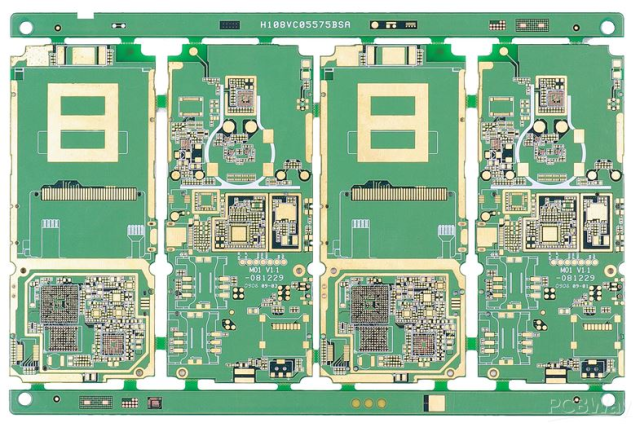
Low-loss PCB materials help reduce signal attenuation and maintain stable electrical characteristics.
Common materials include:
- PTFE laminates
- Rogers high-frequency materials
- Ceramic-filled substrates
Impedance Control
Accurate impedance control ensures reliable signal transmission and minimizes reflection and signal loss.
Important parameters include:
- Trace width
- Dielectric thickness
- Copper thickness
- Stack-up structure
Manufacturing Capability
High-frequency PCB fabrication requires strict control of:
- Layer alignment
- Material processing
- Copper thickness
- Surface treatment
- Electrical testing
Manufacturing accuracy directly influences final RF performance.
Conclusion
High-frequency PCB boards have become an essential technology supporting the development of modern electronic systems.
From 5G communication and automotive radar to aerospace, medical, industrial automation, and RF applications, high-frequency PCBs enable faster signal transmission, improved reliability, and enhanced system performance.
As electronic products continue moving toward higher frequencies, greater integration, and more demanding environments, the importance of advanced high-frequency PCB design and manufacturing capabilities will continue to grow.
By combining suitable materials, optimized design strategies, and precise manufacturing processes, high-frequency PCB solutions provide a strong foundation for next-generation electronic applications.
