
IoT Testing Challenges
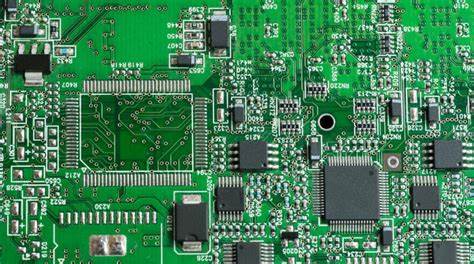
Testing IoT integrated circuits introduces a unique combination of challenges. Unlike purely digital or RF chips, IoT devices integrate:
- Wireless communication (Wi-Fi, BLE, LoRa, NB-IoT)
- Low-power operation modes
- Mixed-signal functionality (analog + digital + RF)
An IoT IC Test PCB must support all these domains simultaneously while maintaining accuracy, repeatability, and efficiency.
Key challenges include:
- Ensuring stable RF signal measurement
- Accurately capturing ultra-low power consumption
- Managing interference between RF and digital circuits
- Supporting high-throughput production testing
This makes IoT test PCBs highly application-specific and system-driven.
Test Architecture for IoT ICs
The architecture of an IoT IC test PCB must be designed around both functional testing and performance validation.
Typical architecture includes:
- RF Signal Paths:
Dedicated transmission lines connecting the DUT to RF connectors or test instruments - Power Measurement Blocks:
High-precision circuits for measuring current in active and sleep modes - Digital Interface Routing:
Support for communication protocols such as SPI, UART, I2C, or GPIO - Test Socket or Module Interface:
Accommodates packaged ICs or IoT modules for repeatable insertion - Shielding & Isolation:
Prevents interference between RF, power, and digital sections
A well-designed architecture ensures that each subsystem can be tested independently and accurately.
RF Performance & Power Accuracy
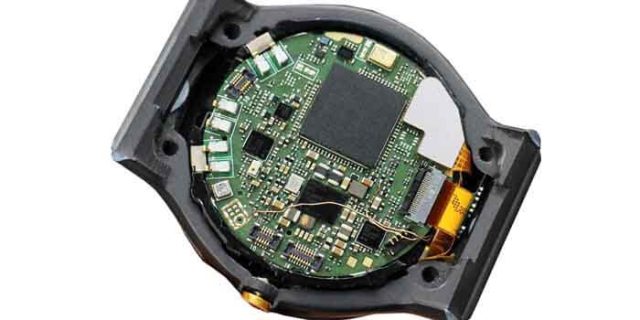
IoT IC testing must balance two critical performance areas:
RF Performance
- Controlled impedance routing ensures stable signal transmission
- Short RF paths reduce insertion loss
- Proper grounding minimizes EMI and coupling
- Antenna matching and RF connectors must be optimized
Power Accuracy
- Low-current measurement circuits are required for sleep mode validation
- Noise in power lines must be minimized
- Stable power delivery ensures consistent DUT behavior
- Transient response must be captured accurately
Even small inaccuracies in these areas can result in misleading performance data or failed certifications.
Design Optimization Strategies
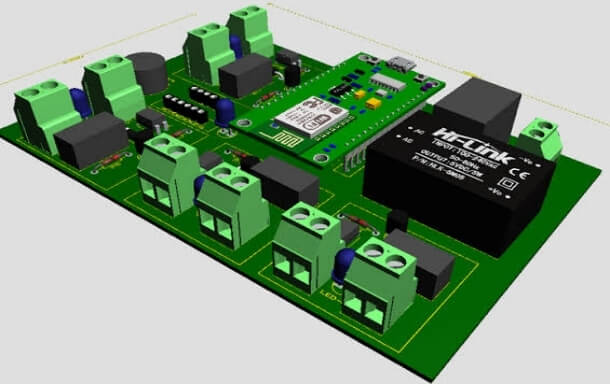
To ensure reliable IoT testing, several design strategies are applied:
- Partitioned Layout:
Separate RF, power, and digital sections to reduce interference - Low-Loss Materials for RF Paths:
Improve wireless signal accuracy, especially at higher frequencies - Fine Routing for Compact Designs:
Support small IoT packages and modules - Via & Transition Optimization:
Reduce signal degradation in RF paths - Grounding & Shielding Techniques:
Via stitching and ground planes enhance signal stability - Hybrid Stack-Ups:
Combine RF materials with standard substrates for cost efficiency
These strategies ensure the PCB supports both performance validation and practical manufacturability.
Production Testing Considerations
For IoT devices, testing is not only about accuracy—it is also about scalability.
- High Throughput:
Test boards must support rapid testing cycles for mass production - Repeatability:
Consistent performance across thousands of test cycles is critical - Durability:
Frequent socket insertions require robust surface finishes such as ENIG or hard gold - Automation Compatibility:
Design must integrate with automated test systems and fixtures - Cost Efficiency:
Balance between high-performance materials and production cost
A well-designed IoT IC test PCB ensures reliable validation without slowing down production.
Final Thoughts
IoT IC Test PCBs are essential platforms for validating the connectivity, efficiency, and reliability of modern connected devices.
They must simultaneously handle:
- RF signal integrity
- Ultra-low power measurement
- Mixed-signal testing environments
- High-volume production requirements
By combining RF design expertise, precise power measurement, and scalable manufacturing, KKPCB delivers IoT IC Test PCBs that enable accurate validation and efficient production of next-generation IoT devices.
