
Engineering Context
Modern aerospace and defense radar systems require PCB technologies capable of maintaining stable RF performance under extreme electrical, thermal, and mechanical conditions. Radar modules used in airborne platforms, unmanned aerial vehicles (UAV), missile guidance systems, and surveillance equipment often operate at X-band, Ku-band, and higher microwave frequencies where even minor material variations can affect detection accuracy and signal reliability.
A Duroid 5880 PCB is widely adopted in high-frequency radar applications due to its exceptionally low dielectric loss, stable dielectric constant, and excellent phase consistency. Manufactured by Rogers, the RT/duroid 5880 material provides a low-loss PTFE-based substrate designed for demanding microwave and millimeter-wave circuits.
However, aerospace and defense radar modules introduce additional engineering challenges beyond RF performance. High-power RF amplifiers, continuous transmission cycles, thermal gradients, and harsh environmental conditions require advanced PCB thermal management strategies. Excessive heat can cause dielectric expansion, impedance variation, copper fatigue, and long-term reliability degradation.
For radar system engineers and procurement teams, selecting the right high-frequency PCB manufacturer requires evaluating not only material capability but also stackup engineering, copper processing, thermal design, RF simulation, and reliability validation.
KKCPB develops Duroid 5880 PCB solutions with optimized RF stackups, controlled impedance manufacturing, thermal management strategies, and aerospace-level reliability testing to support advanced radar and defense electronics platforms.
Core Engineering Challenges
| Engineering Challenge | Root Cause | Engineering Impact |
|---|---|---|
| High thermal stress during radar transmission | High RF power density and continuous operation | Material expansion, impedance drift |
| RF insertion loss at microwave frequencies | Dielectric loss and copper roughness | Reduced radar range and sensitivity |
| Phase instability under temperature variation | Dk variation and CTE mismatch | Beamforming errors |
| Heat accumulation near power amplifiers | Limited thermal pathways | Component lifetime reduction |
| Mechanical stress during operation | Vibration and shock environments | Via fatigue and solder cracking |
| EMI coupling in compact radar modules | Dense RF routing | Signal distortion and interference |
These challenges are especially critical in Defense Radar PCB, Aerospace PCB, and Microwave Module PCB applications where reliability directly affects mission performance.
Material Science & Dielectric Performance of Duroid 5880 PCB
Duroid 5880 is engineered specifically for high-frequency and microwave applications requiring minimal signal attenuation and excellent electrical stability.
Duroid 5880 Material Characteristics
| Parameter | Typical Value | Engineering Benefit |
|---|---|---|
| Dielectric Constant (Dk) | 2.20 ±0.02 | Stable impedance and phase control |
| Dissipation Factor (Df) | 0.0009 @10 GHz | Extremely low insertion loss |
| Thermal Conductivity | 0.20 W/m·K | Requires optimized thermal design |
| CTE X/Y | -25 ppm/°C | Stable dimensional performance |
| Moisture Absorption | <0.02% | Reliable dielectric properties |
| Glass Transition | PTFE-based system | Excellent microwave stability |
Compared with conventional FR-4 materials, provides significantly lower dielectric loss and improved phase stability, making it suitable for radar antenna arrays, RF front-end modules, and satellite communication systems.
However, because PTFE-based materials have lower thermal conductivity compared with ceramic or metal-core solutions, thermal management must be carefully engineered through copper structures, heat spreading layers, and mechanical integration.
KKCPB Case Study — Aerospace Defense Radar Module PCB Using Duroid 5880
Client & Application Context
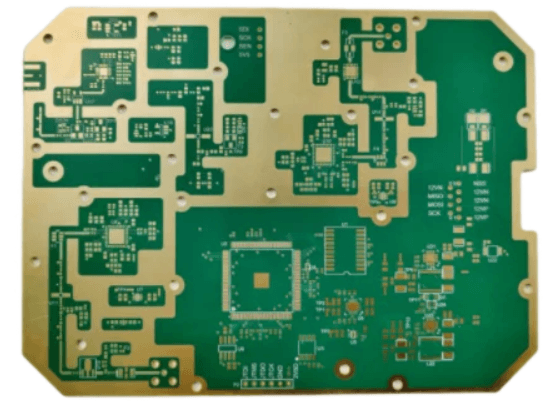
A defense electronics manufacturer required a high-frequency PCB solution for an airborne radar module operating in the X-band frequency range.
The radar system was designed for:
- Airborne surveillance applications
- Long-range target detection
- High-power RF transmission
- Phased-array antenna control
- Continuous operation under extreme temperature environments
The customer required a PCB platform capable of maintaining stable RF performance while handling elevated thermal loads generated by high-power amplifier circuits.
Engineering Problem
The customer’s previous RF PCB design experienced several challenges:
- Increased insertion loss during high-temperature operation
- Phase deviation between antenna channels
- Localized thermal hotspots near RF power amplifier sections
- Impedance drift after thermal cycling
- Copper fatigue caused by repeated temperature changes
Measured problems included:
- Impedance variation exceeding ±5%
- Phase deviation above 1.5°
- RF efficiency reduction after extended operation
- Increased calibration requirements during radar testing
The customer required a more reliable PCB solution without sacrificing microwave performance.
KKCPB Engineering Solution
KKCPB developed a radar-grade Duroid 5880 PCB solution using a thermal-aware RF design approach.
The engineering improvements included:
- Duroid 5880 material selection for critical RF transmission layers
- Optimized copper thickness for power handling capability
- Low-profile copper foil to reduce conductor loss
- Thermal via arrays beneath high-power components
- Hybrid stackup integrating mechanical support materials
- Improved ground plane structure for heat spreading
- Controlled impedance routing with ±2% tolerance
- RF simulation optimization before fabrication
KKCPB also implemented:
- HFSS electromagnetic simulation
- ADS RF circuit modeling
- Thermal FEM analysis
- TDR impedance verification
- Vector Network Analyzer (VNA) measurement
to ensure correlation between simulation and production performance.
Measured Results
| Parameter | Target Requirement | KKCPB Result |
|---|---|---|
| Impedance Variation | ±5% | ±1.5% |
| Insertion Loss @10 GHz | <0.25 dB/in | 0.18 dB/in |
| Phase Deviation | <1° | 0.42° |
| Return Loss (S11) | < -15 dB | -19.5 dB |
| Thermal Hotspot Reduction | — | 8°C improvement |
| RF Efficiency Stability | Long operation | Maintained |
| Layer Registration | ±30 μm | ±15 μm |
Project Outcome
The optimized Duroid 5880 PCB significantly improved radar module reliability during high-power operation.
The customer achieved:
- More stable RF transmission performance
- Improved phase consistency across antenna channels
- Reduced thermal drift
- Lower calibration requirements
- Extended operational lifetime
- Improved production consistency
The solution successfully passed aerospace-level environmental verification and was approved for integration into the next-generation radar platform.
Stackup Design & RF Implementation
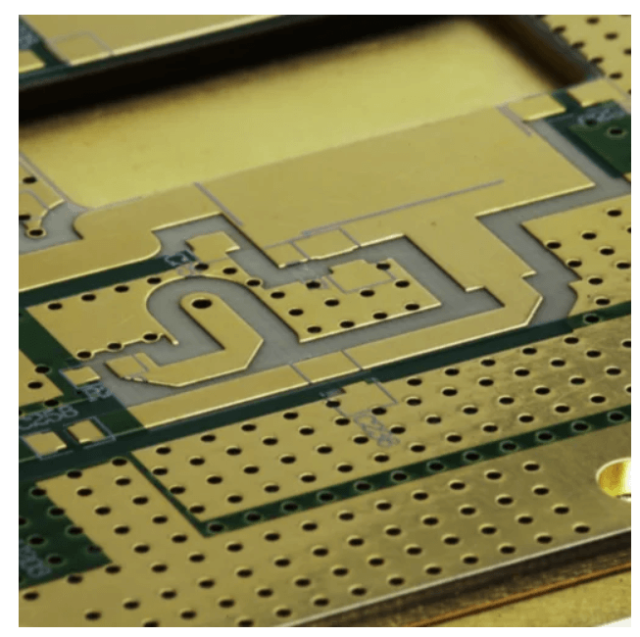
Representative 8-Layer Aerospace Radar PCB Stackup
| Layer | Function | Material |
|---|---|---|
| L1 | RF Antenna Feed Layer | Duroid 5880 PCB |
| L2 | Ground Reference | Copper |
| L3 | RF Transmission Layer | Duroid 5880 PCB |
| L4 | Thermal Spreading Layer | Heavy Copper |
| L5 | Control Signal Layer | High Reliability Material |
| L6 | Power Distribution | High Current Copper |
| L7 | RF Interface Layer | Duroid 5880 PCB |
| L8 | Mechanical Support Layer | Aerospace Grade Material |
Simulation & RF Validation
HFSS Electromagnetic Simulation
Used for:
- RF field distribution analysis
- Antenna feed optimization
- Radiation performance evaluation
- EMI coupling prediction
ADS Circuit Simulation
Used for:
- S-parameter optimization
- Phase matching analysis
- Power amplifier integration
TDR Measurement
Used for:
- Controlled impedance verification
- Transmission line consistency
- Manufacturing tolerance analysis
Thermal FEM Simulation
Used for:
- RF amplifier heat distribution
- Thermal stress prediction
- Material expansion analysis
- Thermal management optimization
The simulation results were validated through production testing using VNA measurements and thermal chamber testing.
Environmental & Reliability Validation
| Test | Condition | Result |
|---|---|---|
| Thermal Cycling | -55°C ↔ +125°C, 1000 cycles | No delamination |
| High Temperature Operation | 150°C continuous operation | Stable RF performance |
| Humidity Test | 85°C / 85% RH | No dielectric degradation |
| Vibration Test | Aerospace vibration profile | No via failure |
| Mechanical Shock | High acceleration impact | Structural integrity maintained |
| Solder Reflow | 260°C ×3 cycles | No warpage |
| RF Power Stress Test | Continuous high-power transmission | Stable insertion loss |
These reliability evaluations confirm that Duroid 5880 PCB technology can support demanding aerospace and defense radar applications requiring long-term electrical and thermal stability.
Engineering Summary & Contact
High-frequency radar systems demand PCB solutions that combine low-loss RF transmission, thermal reliability, and mechanical durability. Duroid 5880 PCB provides outstanding dielectric stability and minimal signal attenuation, making it an ideal material for aerospace radar, defense electronics, satellite communication, and microwave systems.
However, achieving reliable performance requires more than selecting a high-performance laminate. Advanced stackup design, thermal management, controlled impedance fabrication, and comprehensive validation are essential for successful deployment.
KKCPB provides professional Duroid 5880 PCB manufacturing services, supporting engineers and procurement teams with:
- RF material selection
- Microwave stackup optimization
- High-frequency PCB fabrication
- Thermal management design
- HFSS and ADS simulation support
- Prototype and volume production
For aerospace radar modules, defense RF systems, and high-power microwave applications, KKCPB delivers reliable low-loss PCB solutions engineered for demanding mission environments.
