
Precision mmWave routing networks—operating from 26 GHz to beyond 90 GHz—demand exceptional electromagnetic uniformity, controlled impedance, and stable mode behavior to maintain system linearity. RT/duroid 5880 PCB materials have become a foundational high-frequency laminate for mmWave architectures because their ultra-low dielectric constant (Dk ≈ 2.20), extremely low dissipation factor (Df ≈ 0.0009), and isotropic PTFE composite enable uniform field distribution and robust suppression of parasitic modes in dense RF layouts.
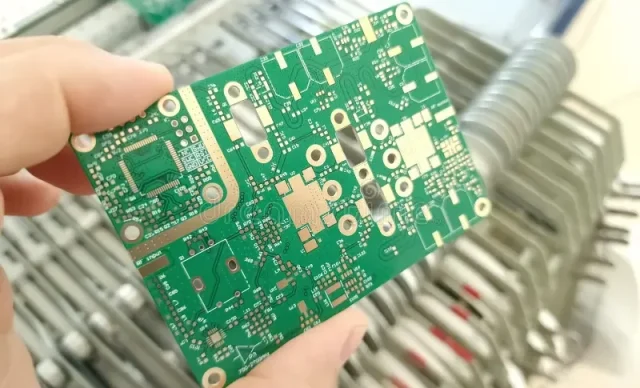
In mmWave transmission lines such as microstrip, grounded coplanar waveguide (GCPW), substrate-integrated waveguide (SIW), and hybrid stripline geometries, RT/duroid 5880 PCB stackups ensure electromagnetic consistency by minimizing dielectric dispersion and eliminating field asymmetry. The material’s near-uniform Dk allows electric-field propagation to remain balanced across the stackup, reducing the risk of unintended higher-order modes—such as TE/TM resonances—that degrade phase stability and increase insertion loss in mmWave networks.
Mode-suppression performance becomes especially critical in precision mmWave routing networks used in radar front-ends, satellite phased arrays, point-to-point microwave links, and 5G/6G mmWave modules. RT/duroid 5880 PCB materials support these requirements by offering exceptionally tight dielectric tolerance and ultra-low loss tangent, which together maintain coherent wave propagation even at high-frequency harmonics. This results in improved isolation, minimized cross-coupling, and stable phase performance across wideband operational ranges.
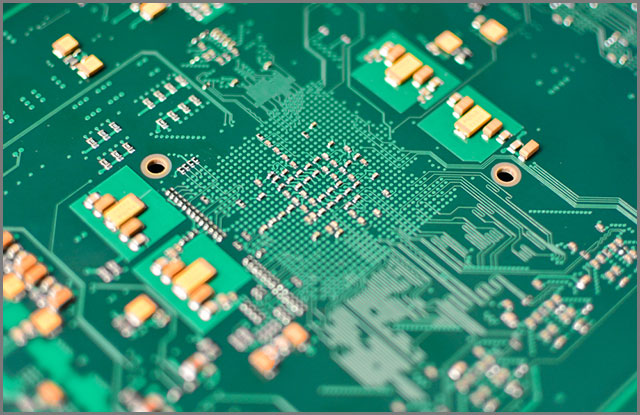
Thermal stability further strengthens the performance of RT/duroid 5880 PCB stackups. The laminate’s low thermal coefficient of dielectric constant (TCDk) prevents phase drift during temperature cycling, allowing mmWave beamforming networks, LO distribution lines, and high-frequency feed structures to sustain consistent propagation characteristics. This stability is essential for systems such as airborne radar arrays, LEO satellite payloads, and high-density telecom base stations, where operational temperatures fluctuate significantly.
When used in multilayer RF stackups, RT/duroid 5880 PCB substrates also reduce discontinuities at via transitions and ensure tight impedance matching across complex interconnect paths. The material’s well-controlled mechanical properties support precise copper-to-dielectric alignment, enabling uniform electromagnetic boundary conditions throughout the routing network. This enhances mode control, reduces dielectric anisotropy, and improves high-frequency reliability in mmWave module assemblies.
In summary, RT/duroid 5880 PCB stackups provide three critical advantages for precision mmWave routing networks:
• Electromagnetic uniformity, preventing waveform distortion and beam misalignment.
• Effective mode-suppression, eliminating parasitic resonances and higher-order mode excitation.
• Consistent wideband propagation, ensuring low-loss, stable, and coherent signal transmission.
For next-generation mmWave communication systems, radar sensing platforms, satellite transceivers, and multi-gigabit wireless modules, RT/duroid 5880 PCB technology remains one of the most reliable materials for achieving high-fidelity signal routing with exceptional precision and stability.
