
The Evolution of ADAS PCB Design
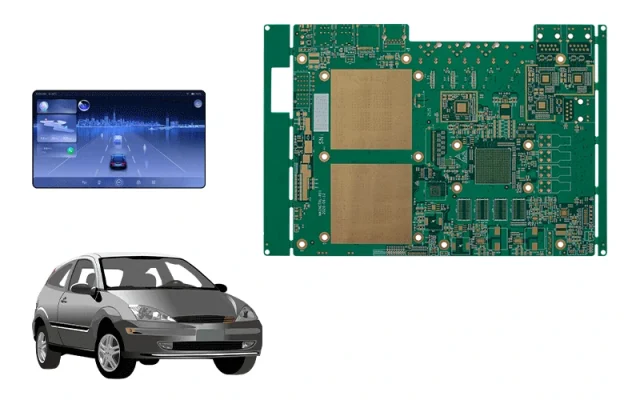
As vehicles transition from basic assistance features to semi-autonomous driving, ADAS electronics are evolving from distributed modules to centralized domain controllers.
An ADAS PCB today is no longer just a radar board or camera board — it is often part of a high-performance computing platform that integrates:
-
Sensor fusion processors
-
AI acceleration chips
-
High-speed memory
-
Automotive Ethernet networks
-
Power management modules
This evolution significantly increases PCB design complexity and performance requirements.
Domain Controller Architecture and PCB Challenges
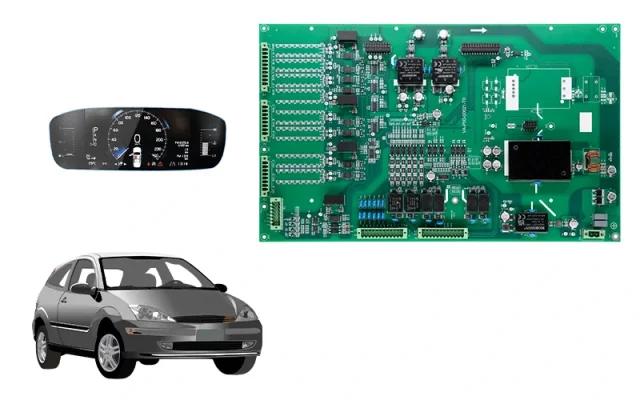
Modern ADAS systems consolidate multiple functions into a single electronic control unit (ECU). This domain-based architecture requires PCB designs that support:
High-Speed Data Aggregation
Sensor data from radar, cameras, and LiDAR must be transmitted through:
-
Automotive Ethernet (1000BASE-T1 / 10G)
-
PCIe interfaces
-
High-speed serializer/deserializer (SerDes) links
PCB layout must ensure:
-
Tight impedance control
-
Length matching for differential pairs
-
Low insertion loss
-
Clean reference planes
Even minor layout inconsistencies can impact real-time processing accuracy.
Functional Safety Compliance
ADAS PCBs must support systems designed under automotive functional safety standards (such as ISO 26262 principles).
This influences PCB design in several ways:
-
Redundant power paths
-
Isolated safety-critical circuits
-
Fault detection routing
-
Segmented grounding strategy
Reliability is not optional — it directly affects passenger safety.
Mixed Signal and Hybrid Stack-Up Design
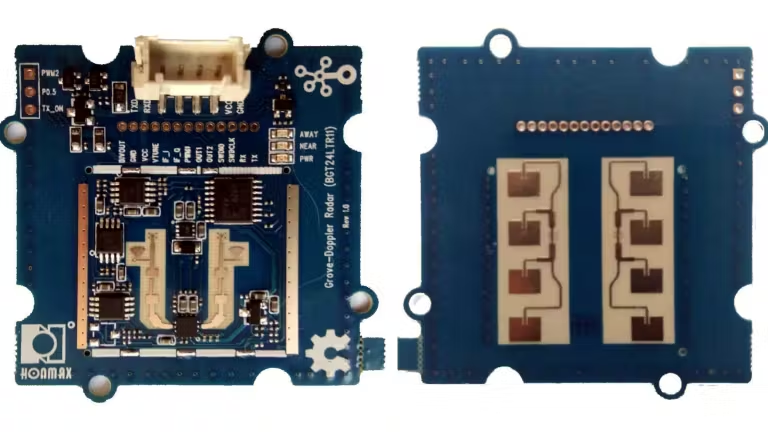
One of the biggest challenges in ADAS PCB development is integrating:
-
High-frequency radar circuits
-
High-speed digital processors
-
Low-voltage control logic
-
High-current power circuits
To address this, engineers often adopt hybrid stack-up structures combining standard high-TG FR4 with low-loss RF laminates from suppliers such as Rogers Corporation.
This hybrid approach balances:
-
Cost efficiency
-
Signal performance
-
Thermal stability
Automotive Communication and EMC Considerations
ADAS PCBs operate in an electrically noisy automotive environment. Therefore, electromagnetic compatibility (EMC) design becomes critical.
Design strategies include:
-
Solid multi-layer grounding
-
Shielded high-speed routing
-
Controlled return paths
-
Proper separation between analog, RF, and digital domains
Effective EMC design prevents signal interference that could compromise sensor accuracy.
Thermal and Power Integrity Strategy
Advanced ADAS processors generate significant heat due to AI-based computation.
Thermal design techniques include:
-
High copper thickness in power layers
-
Thermal via arrays under BGA packages
-
Dedicated heat-spreading planes
-
Mechanical integration with metal enclosures
Power distribution networks must also maintain low impedance to avoid voltage fluctuation during peak processing loads.
Applications in Modern Vehicles
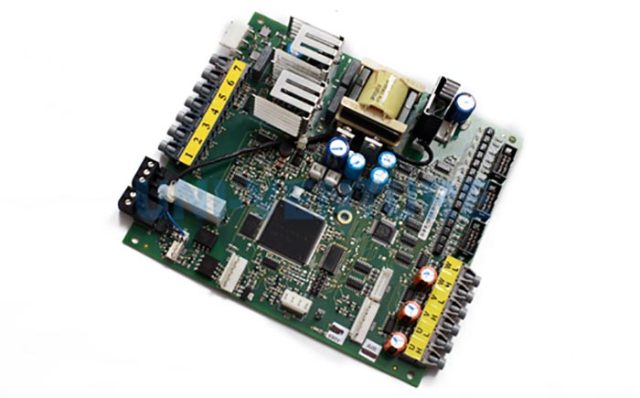
ADAS PCBs are used in:
-
Forward collision avoidance systems
-
Adaptive cruise control units
-
Lane-keeping assist modules
-
Automated parking systems
-
Centralized ADAS domain controllers
As vehicles move toward higher levels of automation, PCB density and complexity continue to increase.
Why ADAS PCB Design Matters
In automotive safety systems, PCB performance directly influences:
-
Sensor accuracy
-
Real-time processing capability
-
System stability
-
Long-term durability
A well-engineered ADAS PCB ensures reliable operation across extreme temperature, vibration, and electrical conditions.
Conclusion
The modern ADAS PCB serves as the backbone of intelligent vehicle safety systems.
From domain controller integration to high-speed automotive networking, PCB design plays a critical role in enabling accurate sensor fusion and dependable vehicle performance.
As automotive technology advances toward autonomous driving, high-density, high-reliability ADAS PCBs will remain central to system safety and innovation.
