
1. What Is Shengyi S1000-2?
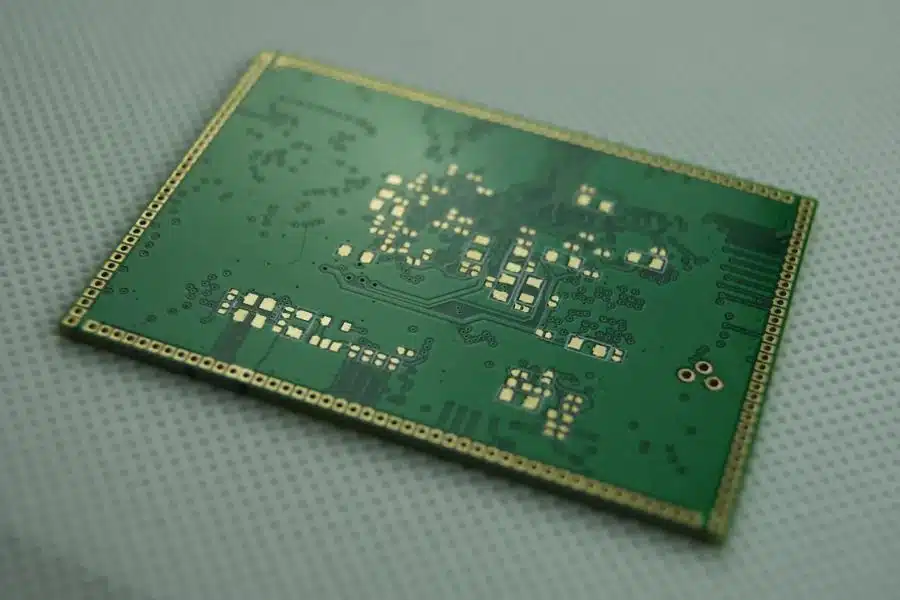
S1000-2 is a glass-reinforced epoxy laminate classified as UL ANSI FR-4.0. Shengyi positions it as a “High Tg, Low CTE” material, and the datasheet references IPC-4101/126 as the applicable specification sheet. In practical terms, S1000-2 sits between mid-Tg lead-free materials such as S1000 and S1000H and the heavier-duty S1000-2M.
The features Shengyi lists for S1000-2 are:
- Anti-CAF capability – resistance to conductive anodic filament growth between closely spaced holes.
- Lead-free compatibility – suitable for lead-free reflow and lead-free HASL.
- Excellent thermal reliability – T260 above 60 minutes and T288 of 20 minutes.
- Excellent through-hole reliability – Z-axis expansion of 2.8% from 50 °C to 260 °C.
The datasheet names routers, computers, communication equipment and precision instruments as typical applications.
2. Shengyi S1000-2 Key Specifications
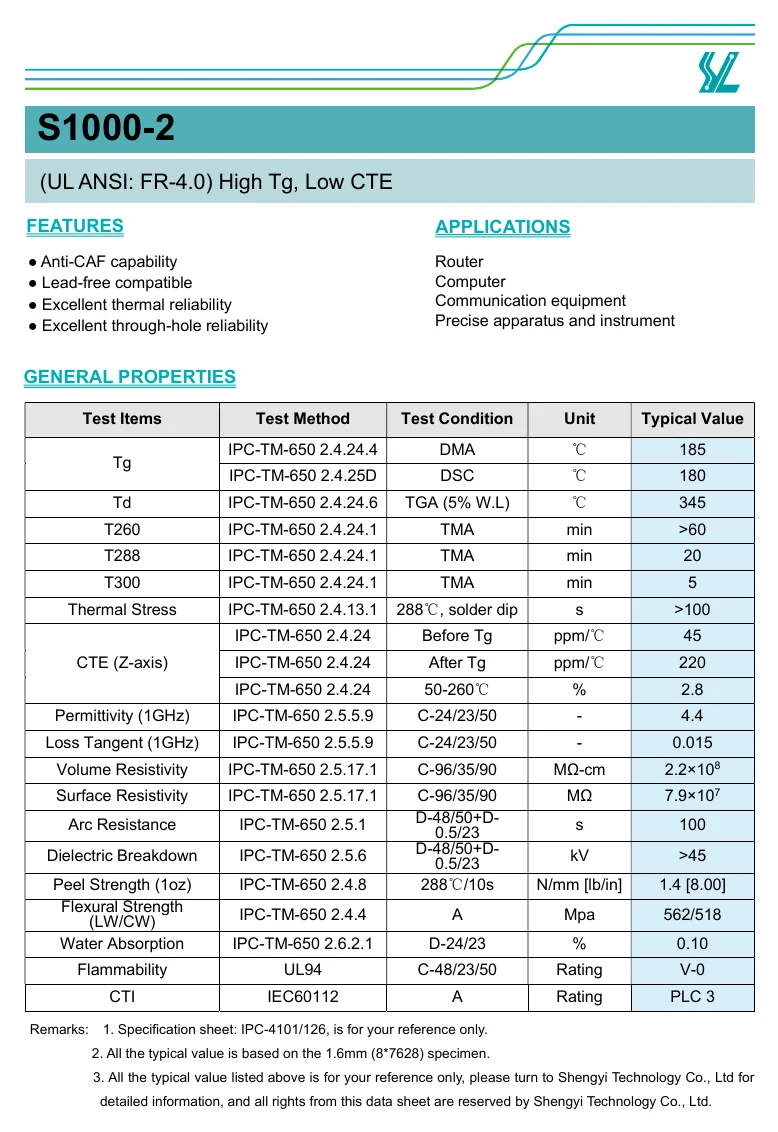
The table below lists the key Shengyi S1000-2 laminate properties exactly as published by Shengyi. All typical values are based on a 1.6 mm (8×7628) specimen.
| Property | Test method | Condition | Typical value |
|---|---|---|---|
| Tg | IPC-TM-650 2.4.25D / 2.4.24.4 | DSC / DMA | 180 °C / 185 °C |
| Td (5% weight loss) | IPC-TM-650 2.4.24.6 | TGA | 345 °C |
| T260 / T288 / T300 | IPC-TM-650 2.4.24.1 | TMA | >60 / 20 / 5 min |
| Thermal stress | IPC-TM-650 2.4.13.1 | 288 °C solder dip | >100 s |
| Z-axis CTE | IPC-TM-650 2.4.24 | Before Tg / after Tg | 45 / 220 ppm/°C |
| Z-axis expansion | IPC-TM-650 2.4.24 | 50–260 °C | 2.8% |
| Permittivity (Dk) | IPC-TM-650 2.5.5.9 | 1 GHz, C-24/23/50 | 4.4 |
| Loss tangent (Df) | IPC-TM-650 2.5.5.9 | 1 GHz, C-24/23/50 | 0.015 |
| Volume resistivity | IPC-TM-650 2.5.17.1 | C-96/35/90 | 2.2×10⁸ MΩ·cm |
| Surface resistivity | IPC-TM-650 2.5.17.1 | C-96/35/90 | 7.9×10⁷ MΩ |
| Arc resistance | IPC-TM-650 2.5.1 | D-48/50+D-0.5/23 | 100 s |
| Dielectric breakdown | IPC-TM-650 2.5.6 | D-48/50+D-0.5/23 | >45 kV |
| Peel strength (1 oz) | IPC-TM-650 2.4.8 | 288 °C / 10 s | 1.4 N/mm (8.0 lb/in) |
| Flexural strength (LW/CW) | IPC-TM-650 2.4.4 | A | 562 / 518 MPa |
| Water absorption | IPC-TM-650 2.6.2.1 | D-24/23 | 0.10% |
| Flammability | UL94 | C-48/23/50 | V-0 |
| CTI | IEC 60112 | A | PLC 3 |
These are typical values for reference, not guaranteed specification limits. For incoming inspection and qualification, the IPC-4101/126 slash sheet defines the requirements.
How to read the Shengyi S1000-2 thermal data
- Tg 180 °C (DSC): the resin stays in its glassy state through most operating and many assembly conditions, which reduces resin softening during assembly and rework.
- Td 345 °C: the temperature at which the resin loses 5% of its weight. It gives margin above peak lead-free reflow temperatures.
- 2.8% Z-axis expansion (50–260 °C): lower expansion means less stress on plated through-hole barrels during repeated reflow, which matters most in thick, high-layer-count boards.
- T288 of 20 minutes: the time to delamination at 288 °C. It is a useful indicator for boards that will see several reflow and rework cycles.
3. S1000-2B Prepreg and Laminate Constructions
S1000-2 cores are bonded with S1000-2B prepreg. According to the datasheet, S1000-2 laminate is available from 0.05 mm to 3.2 mm with copper foil from 12 µm to 105 µm, in 40″×48″, 36″×48″ and 42″×48″ sheets. The standard S1000-2B prepreg range is shown below.
| Glass style | Resin content (%) | Cured thickness (mm) | Standard roll size |
|---|---|---|---|
| 106/1037 | 70 / 73 / 76 / 78 | 0.046 / 0.052 / 0.060 / 0.065 | 1.260 m × 150 m |
| 1080/1078 | 62 / 65 / 68 | 0.070 / 0.077 / 0.086 | 1.260 m × 300 m |
| 2313 | 54 / 57 | 0.094 / 0.102 | 1.260 m × 300 m |
| 2116 | 53 / 56 / 58 | 0.117 / 0.127 / 0.134 | 1.260 m × 250 m |
| 1506 | 44 / 49 | 0.150 / 0.170 | 1.260 m × 150 m |
| 7628 | 43 / 45 / 48 / 50 | 0.187 / 0.196 / 0.210 / 0.222 | 1.260 m × 150 m |
Shengyi recommends a cure of more than 60 minutes at 185–195 °C. Prepreg storage life is 3 months below 23 °C and 50% RH, or 6 months below 5 °C, with at least 4 hours of normalisation at room temperature before use.
Dk and Df by construction
The 4.4 / 0.015 figures in the main table are measured at one resin content. For impedance calculations, the S1000-2 line-up data is more useful because Dk falls as resin content rises. Shengyi’s line-up (SPDR method) shows, for example, a 1×7628 core at 45% resin with Dk 4.59 at 1 GHz and 4.49 at 10 GHz, while a 2×10⁶ core at 70% resin measures 3.97 at 1 GHz and 3.78 at 10 GHz.
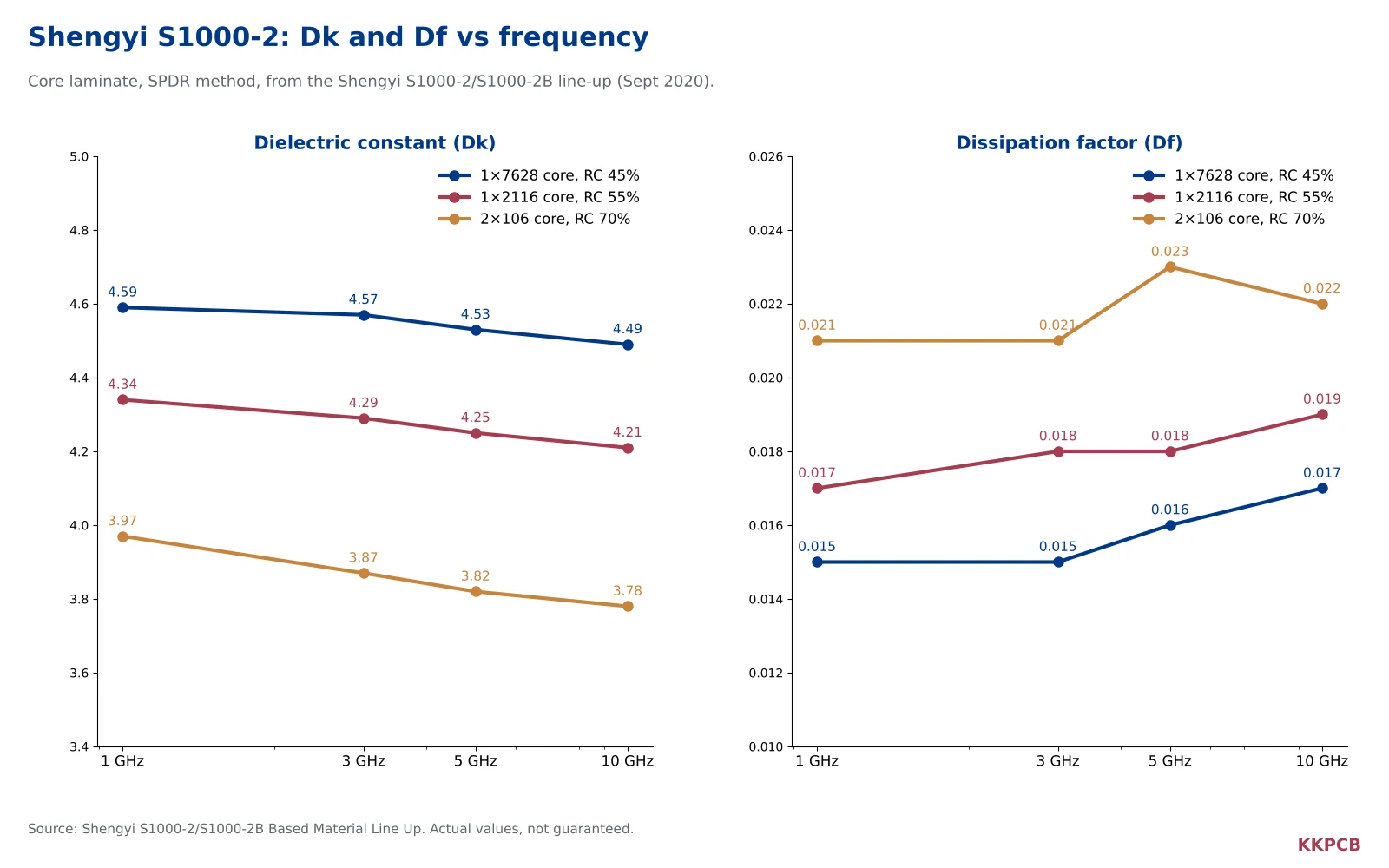
This spread is why KKPCB calculates controlled-impedance stack-ups with the Dk of the actual glass style and resin content rather than a single datasheet number.
4. Shengyi S1000-2 vs Other S1000 Grades
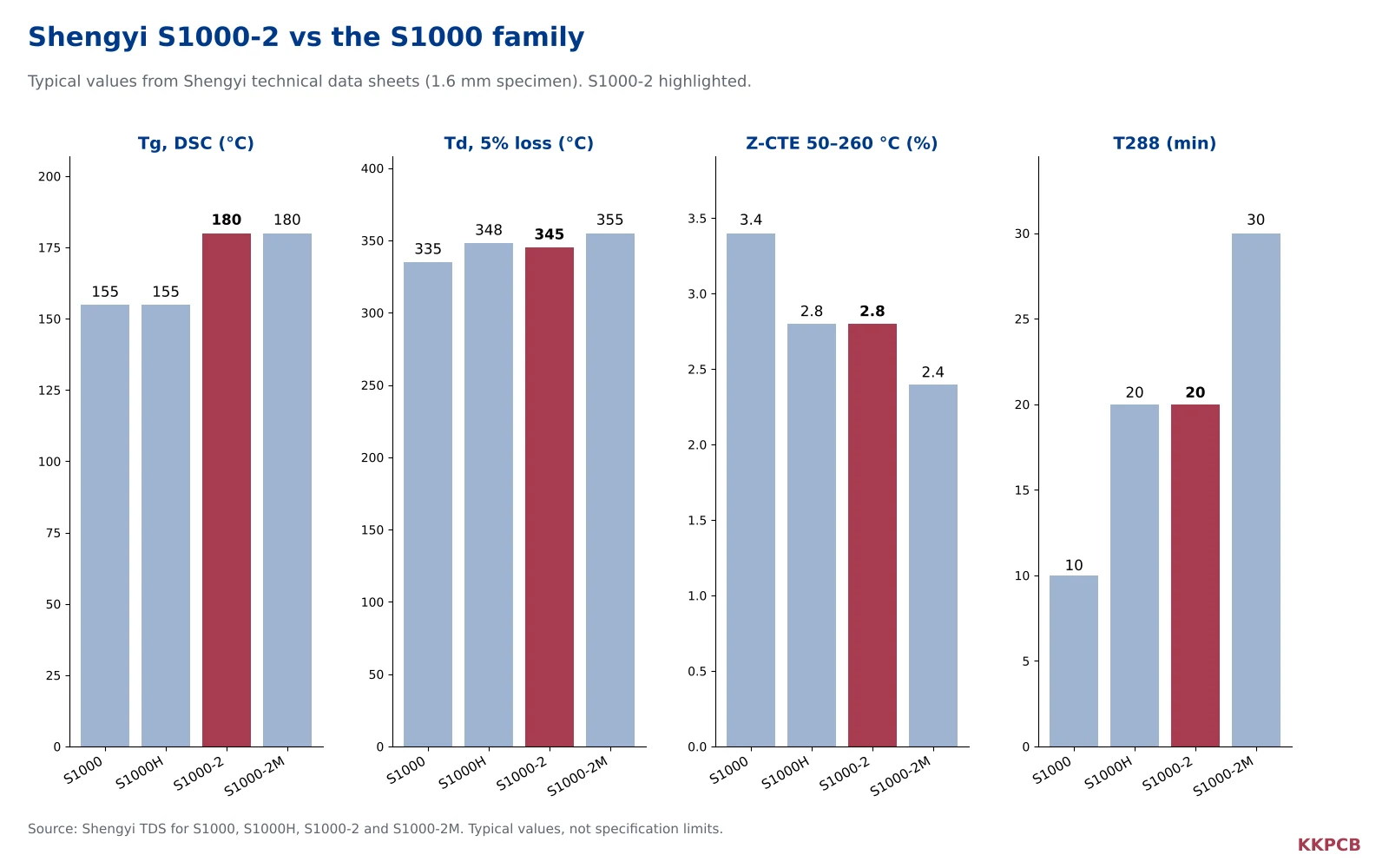
Shengyi offers several closely related lead-free FR-4 grades. The table compares them using the values in each grade’s own Shengyi datasheet.
| Property | S1000 | S1000H | S1000-2 | S1000-2M |
|---|---|---|---|---|
| Positioning | Mid-Tg, low CTE | High performance, mid-Tg | High Tg, low CTE | High Tg, high performance, low CTE |
| Tg, DSC (°C) | 155 | 155 | 180 | 180 |
| Td (°C) | 335 | 348 | 345 | 355 |
| T288 (min) | 10 | 20 | 20 | 30 |
| Z-expansion 50–260 °C | 3.4% | 2.8% | 2.8% | 2.4% |
| Dk / Df @ 1 GHz | 4.7 / 0.009 | 4.6 / 0.011 | 4.4 / 0.015 | 4.6 / 0.018 |
| IPC-4101 slash sheet | /99 | /99 | /126 | /126 |
How to choose:
- S1000 or S1000H for cost-sensitive lead-free boards where a 150 °C class Tg is enough.
- S1000-2 when you need a 170 °C class Tg (IPC-4101/126) for high-layer-count boards, thicker boards or several reflow cycles.
- S1000-2M when you want even lower Z-expansion (2.4%) and a longer T288. Shengyi lists it as suitable for high multilayer PCBs.
Dk and Df in the comparison come from different specimens, so use them to compare trends, not as design values. For lower loss at multi-gigabit speeds, a dedicated low-loss material is a better choice than any of these FR-4 grades.
5. Processing Shengyi S1000-2: Key Points from the Shengyi Guide
Shengyi publishes a processing guide for S1000-2/S1000-2B. The points that most affect PCB yield are:
- Lamination: heat rate of 1.0–2.5 °C/min between 80 °C and 140 °C material temperature, 300–420 psi (hydraulic press), and a cure of more than 60 minutes at 185–195 °C.
- Core baking: 150 °C for 4–8 hours where baking is used.
- Drilling: the material is relatively hard, so Shengyi suggests reducing feed by 10–20% compared with standard FR-4 and lowering hit counts to protect hole-wall quality.
- Desmear: the resin contains inorganic filler, so desmear needs to be strengthened and ultrasonic rinsing is recommended.
- Routing: the filler increases router-bit wear, so feed speed should be reduced. Punching is not recommended.
- Before packing and assembly: baking at 125 °C for 4–8 hours to remove moisture.
6. Building Shengyi S1000-2 PCBs at KKPCB
S1000-2 is one of the FR-4 systems listed on the KKPCB PCB manufacturing capabilities page, together with S1141, IT-158 and IT-180A. When you specify S1000-2, KKPCB engineers:
- Build the stack-up from S1000-2 cores and S1000-2B prepreg and model impedance with line-up Dk values. Our standard controlled-impedance tolerance is ±5 Ω below 50 Ω and ±10% at or above 50 Ω.
- Apply the Shengyi lamination profile and adjust drilling and desmear for the filled resin system.
- Review thick, high-aspect-ratio designs against our limits (25:1 prototype through-hole aspect ratio, finished thickness 0.10–8.00 mm for prototypes).
- Propose an equivalent grade only with your written approval, if S1000-2 is not specified or not available for a build.
Typical KKPCB products on S1000-2 include multilayer PCBs, HDI PCBs that need several lamination cycles and boards for industrial electronics. You can compare other base materials on our PCB materials page.
7. Typical Applications of S1000-2
- Routers, switches and other communication equipment.
- Computer and server motherboards and backplanes.
- Precision instruments and industrial control boards.
- Multilayer and HDI boards that see several lead-free reflow or rework cycles.
8. Download the Shengyi S1000-2 Datasheet (PDF)
The official Shengyi S1000-2 / S1000-2B technical data sheet (document CN-TDS-1911-02, 2 pages) is shown below. It includes the full laminate property table, S1000-2B prepreg parameters, the hot-pressing cycle, storage conditions and purchasing information.
Download the Shengyi S1000-2 datasheet (PDF)
The official Shengyi S1000-2/S1000-2B line-up (3 pages, English) lists Dk and Df at 1, 3, 5 and 10 GHz for every core and prepreg construction (SPDR method).
Download the Shengyi S1000-2 line-up (PDF)
Source: Shengyi Technology Co., Ltd., S1000-2 / S1000-2B technical data sheet and line-up. All rights to the data sheet belong to Shengyi Technology Co., Ltd.; values are typical and for reference only.
Frequently Asked Questions
What is the Tg of Shengyi S1000-2?
Is S1000-2 a high-Tg FR-4?
What is S1000-2B?
What is the difference between S1000-2 and S1000-2M?
Can KKPCB build boards on Shengyi S1000-2?
Quote Your Shengyi S1000-2 PCB with KKPCB
Send your Gerber files, stack-up and impedance targets to KKPCB, and our engineers will review the Shengyi S1000-2 build before production. Contact KKPCB for a quote or a material recommendation.