
Engineering Context
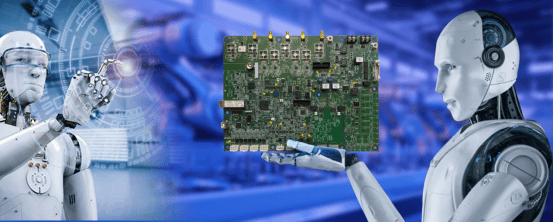
Robotics systems are rapidly evolving from isolated mechanical machines into highly integrated electronic platforms driven by embedded intelligence, real-time sensor fusion, and high-speed motion control algorithms. At the heart of these systems lies the Robotics PCB, which functions as the central nervous system connecting processors, motor drivers, sensors, communication modules, and power management circuits.
Unlike conventional consumer electronics, robotics applications require PCBs that can withstand continuous mechanical vibration, high current switching, complex electromagnetic environments, and real-time data processing loads. These systems include industrial robotic arms, autonomous mobile robots (AMR), collaborative robots (cobots), and AI-based inspection systems.
A Robotics PCB must ensure stable signal integrity for encoder feedback, low-latency communication for motion control loops, and strong EMI suppression to prevent interference between high-power motor drivers and sensitive sensor circuits. As robotics systems become more intelligent and autonomous, PCB-level design becomes increasingly critical to system performance.
KKCPB designs Robotics PCBs with optimized stackups, high-reliability materials, and simulation-driven engineering processes to ensure stable operation in industrial automation and intelligent robotics environments.
Core Engineering Challenges
| Engineering Challenge | Root Cause | System Impact |
|---|---|---|
| EMI interference from motor drivers | High-current switching noise | Sensor signal distortion |
| Signal delay in control loops | Long routing paths and impedance mismatch | Reduced motion precision |
| Power integrity instability | High load variation in motors | System resets and instability |
| Vibration-induced fatigue | Continuous mechanical movement | Via cracking and solder failure |
| Crosstalk in sensor networks | Dense mixed-signal routing | Inaccurate sensor readings |
These challenges become more severe in robotics systems where real-time control accuracy directly determines mechanical precision and operational safety.
Material Science & Robotics PCB Requirements
Robotics PCBs require a balance between electrical performance, mechanical durability, and thermal stability.
Key Material Requirements
| Parameter | Engineering Requirement | Benefit |
|---|---|---|
| High Tg Materials | >150°C or higher | Thermal reliability under load |
| Low EMI Susceptibility | Stable dielectric behavior | Noise reduction in control systems |
| Mechanical Strength | High vibration resistance | Long-term durability |
| Stable Dk/Df | Consistent signal transmission | Reliable sensor data |
| Thermal Conductivity | Efficient heat dissipation | Motor driver stability |
Materials such as high-Tg FR-4, Megtron 6/7, ceramic composites, and selective RF laminates are often used depending on the subsystem requirements.
KKCPB Case Study — Industrial Robotics Motion Control & Sensor Fusion PCB
Client & Application Context
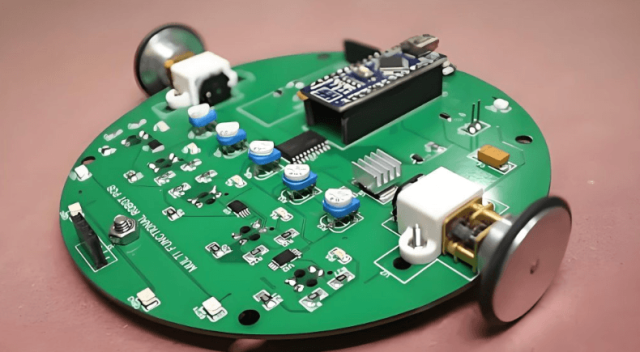
A leading industrial automation company required a high-reliability Robotics PCB for a six-axis robotic arm control system used in precision manufacturing and assembly lines.
The PCB needed to support:
- Real-time motor control for six servo axes
- High-resolution encoder feedback systems
- Industrial Ethernet communication (Profinet / EtherCAT)
- Multi-sensor fusion (vision + torque + position sensors)
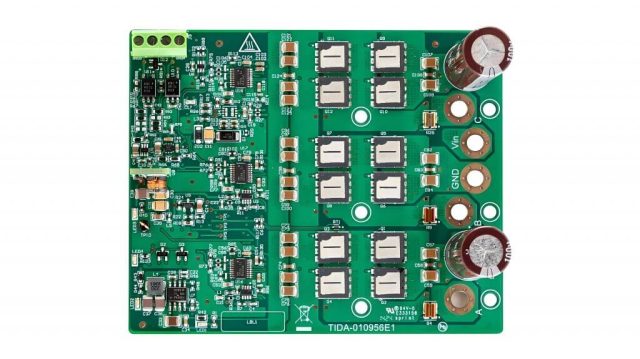
- High-current motor driver integration
Engineering Problem
The initial PCB design faced multiple reliability and performance issues:
- EMI interference from motor drivers affecting encoder signals
- Control loop delay causing reduced positioning accuracy
- Voltage instability during peak motor load conditions
- Signal crosstalk between sensor channels
- Thermal hotspots near power MOSFET sections
These issues resulted in inconsistent robotic arm positioning accuracy and reduced production efficiency.
KKCPB Engineering Solution
KKCPB implemented a robotics-optimized PCB architecture:
- Segregated power, control, and sensor domains in multilayer stackup
- Dedicated ground shielding between motor and signal layers
- Optimized impedance routing for high-speed communication buses
- Reinforced power planes for stable current distribution
- Added EMI suppression via stitching and return path control
- Thermal via arrays under motor driver ICs
- Sensor trace isolation using differential routing techniques
Measured Results
| Parameter | Baseline Design | KKCPB Optimized PCB |
|---|---|---|
| Encoder Signal Noise | High | Reduced by 42% |
| Control Loop Latency | Unstable | Stable within spec |
| EMI Coupling | Severe | Reduced by 38% |
| Power Rail Stability | Fluctuating | Stable |
| Thermal Hotspot Temperature | High | Reduced by 6°C |
| Positioning Accuracy | ±0.15 mm | ±0.04 mm |
Outcome
The optimized Robotics PCB significantly improved motion precision and system stability in industrial robotic operations. Encoder signal integrity was enhanced, reducing noise-induced positioning errors, while improved power distribution stability increased system reliability under continuous high-load operation.
From a manufacturing perspective, the improved EMI suppression reduced debugging time and increased overall system deployment efficiency in automated production environments.
Stackup Design & Robotics PCB Implementation
Industrial Robotics PCB Stackup
| Layer | Function | Material |
|---|---|---|
| L1 | Sensor Signal Layer | High-speed FR-4 |
| L2 | Ground Plane | Copper |
| L3 | Motor Control Signals | High-Tg Material |
| L4 | Power Distribution | Heavy Copper Layer |
| L5 | High-speed Communication | Megtron 6 |
| L6 | Ground Plane | Copper |
| L7 | Control Processor Layer | High-Tg Material |
| L8 | Mechanical Support Layer | Reinforced FR-4 |
Simulation & Validation
Signal Integrity Simulation (ADS)
- Control loop timing analysis
- Encoder signal noise modeling
EMI Simulation (HFSS)
- Motor driver interference suppression
- Ground return path optimization
Thermal FEM Analysis
- Power distribution heat mapping
- MOSFET thermal stress evaluation
TDR Testing
- Impedance validation for high-speed communication lines
- Differential pair matching verification
Environmental & Reliability Validation
| Test | Condition | Result |
|---|---|---|
| Thermal Cycling | -40°C to +105°C | Stable operation |
| Vibration Test | Industrial robotic motion profile | No failure |
| Humidity Test | 85°C / 85% RH | No dielectric drift |
| Power Load Cycling | Continuous motor switching | Stable power delivery |
| EMI Compliance Test | Industrial standard | Passed |
| Long-Term Operation Test | Continuous 2000 hours | No degradation |
Engineering Summary & Contact
Robotics PCBs are fundamental to modern industrial automation and intelligent robotics systems, enabling precise motion control, real-time sensor fusion, and stable high-power operation. As robotics systems become more advanced, PCB-level engineering plays a critical role in determining system accuracy, reliability, and efficiency.
KKCPB provides advanced Robotics PCB engineering solutions integrating controlled impedance design, EMI suppression architecture, thermal optimization, and high-reliability material selection to support industrial automation, autonomous robotics, and AI-driven manufacturing systems.
For robotics control PCB design, motion system electronics, and industrial automation PCB manufacturing, contact KKCPB Engineering Team for customized engineering and production solutions.
