
Medical PCB change control becomes fragile when a revision is treated as only a new Gerber archive. A production-ready release is a controlled set of connected information: schematic references, layout data, fabrication drawing, stackup, drill information, material assumptions, assembly outputs, test requirements, approved deviations, and the revision record that explains what changed. If those items are not linked, a manufacturer can build a board that is technically from the latest folder but operationally from a mixed revision.
The goal is not paperwork for its own sake. The goal is to make the manufacturing effect of a change visible before release. A moved connector may alter a routing constraint. A substitute laminate may affect impedance or thickness. A revised solder mask opening may change assembly yield. The change record should identify the affected deliverables and the reviewers who need to see them.
Define the release as a controlled data package
Give the released package a unique revision, date, owner, and contents list. Store fabrication outputs, assembly outputs, drawings, stackup, notes, and BOM references under that controlled revision. Avoid copying a file from an older build into a new folder without checking whether it is still valid. A simple manifest can list each deliverable, its source revision, its format, and its approval status.
Make manufacturing notes explicit. If a board needs a particular finished thickness, copper construction, impedance target, controlled spacing, special material, route depth, or inspection condition, place that requirement in a controlled document that travels with the fabrication data. Do not rely on an informal email thread or on the supplier remembering the prior build.

Make the impact review proportional and visible
Every revision does not carry the same risk, but every revision should be classified before release. A spelling change in a silkscreen note differs from a layer change, material substitution, via modification, component footprint update, or test-method change. Record what changed, why it changed, which interfaces may be affected, and what confirmation is required. This prevents a minor-looking file update from bypassing a necessary electrical, mechanical, fabrication, or assembly review.
Where suppliers provide manufacturing feedback, capture the disposition in the same controlled record. A DFM observation that changes a pad, drill, route, or material choice should lead to a new revision or an approved deviation, not an invisible production adjustment. The released data must remain the source of truth for the build.
Connect lots and processes to the released revision
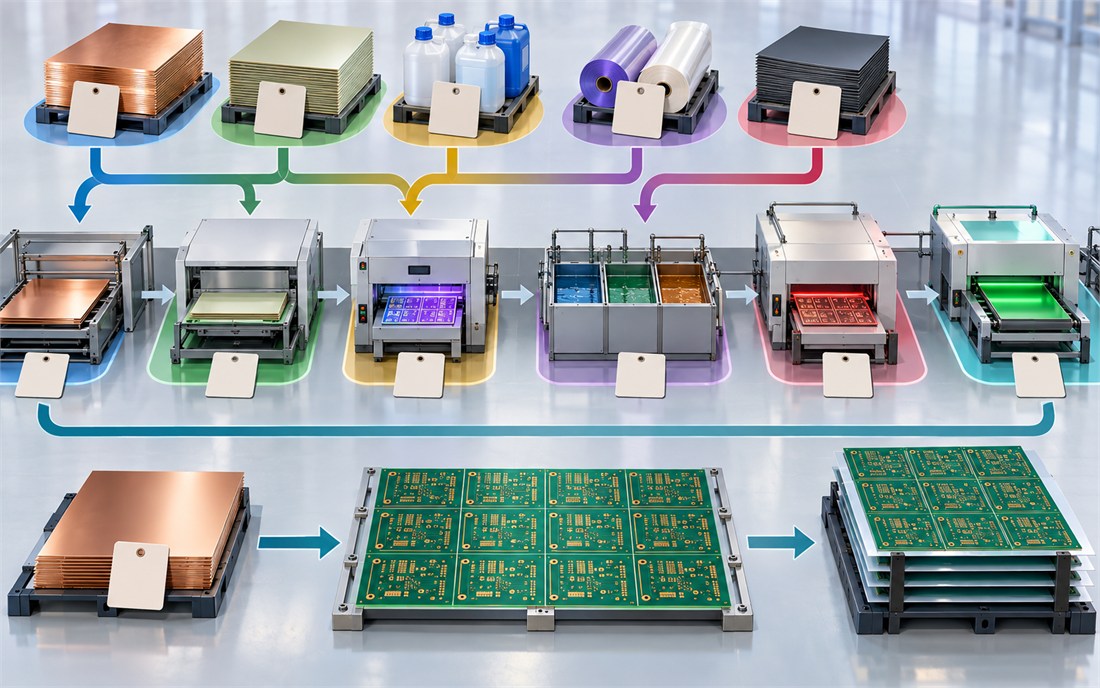
Traceability is stronger when the production records can answer a basic question: which controlled data package, material lots, and major process records relate to this delivered board or panel? The exact record set depends on the product and commercial agreement, but the relationships should be designed before volume production. Panel identifiers, traveler records, material certificates where required, inspection evidence, and nonconformance dispositions are useful only if they point back to the right revision.
Do not confuse change control with a compliance claim
Documented change control supports disciplined manufacturing, but it does not by itself certify a device or establish regulatory compliance. The U.S. FDA Quality Management System Regulation became effective on February 2, 2026 and incorporates ISO 13485:2016 by reference for the regulated finished-device context. Device manufacturers remain responsible for determining the obligations that apply to their products, suppliers, and markets. A board supplier should provide accurate build information and agreed records without making unsupported product-level claims.
Before release, check the revision ID, data-package manifest, fabrication notes, assembly outputs, material requirements, inspection instructions, test inputs, and approved deviations together. That final comparison turns change control into a practical handoff rather than a label applied after files have already diverged.
Five change-control checks before release
- Give the fabrication and assembly package a unique controlled revision.
- List every released deliverable and the source revision it represents.
- Classify the manufacturing impact before approving a change.
- Record supplier feedback as an approved revision or deviation.
- Connect lots, travelers, and inspection records to the exact released data package.
Source note: Regulatory and quality-system responsibilities depend on the product, jurisdiction, contractual roles, and documented quality plan. This article is not legal or regulatory advice.
Related KKPCB capabilities
- Medical PCB planning for sensor, power, and mechanical interfaces.
- Medical PCB manufacturing review before a released data package.
- Medical PCB build discussions with fabrication and assembly inputs aligned.
- Medical PCB DFM communication for controlled production changes.
- Medical PCB projects that need documented handoff decisions.
- PCB Manufacturing options for stackup, materials, and fabrication data review.
- High Frequency PCB know-how when signal behavior must be considered early.
- HDI PCB approaches for dense interconnect and constrained routing.
- Multilayer PCB construction support for planned reference planes and routing layers.
- PCB Prototype builds for checking the released design before a larger run.
- Rigid-Flex PCB coordination where mechanical motion shapes the circuit.
- PCB Assembly review for process-sensitive component and cleaning choices.
- PCB Prototype Assembly support for early build learning.
- BGA PCB Assembly considerations for fine-pitch component placement and inspection planning.
- SMT PCB Assembly process input for repeatable component placement and reflow.
