
1. Introduction to Rogers High-Frequency PCB Materials
In RF, microwave, and high-speed communication applications, PCB material selection plays a decisive role in signal integrity, loss control, thermal stability, and long-term reliability.
Rogers Corporation is a globally recognized supplier of high-frequency PCB laminates, widely used in:
-
RF and microwave circuits
-
Automotive radar
-
5G and millimeter-wave systems
-
Aerospace and satellite communication
Among its product lines, RO3003 and RO4003 are two of the most commonly compared materials. Although they are both Rogers laminates, they are not interchangeable.
At KKPCB, we help customers select and manufacture the right Rogers material based on frequency, cost, and production requirements.
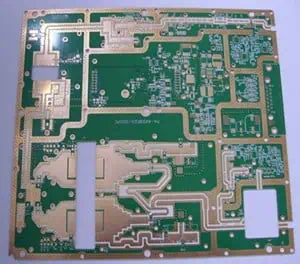
2. What Is Rogers RO3003?
Rogers RO3003 is a ceramic-filled PTFE composite laminate, belonging to the RO3000 series, specifically designed for microwave and RF applications.
2.1 Key Electrical Properties
| Parameter | RO3003 |
|---|---|
| Dielectric Constant (Dk) | 3.00 |
| Loss Factor (Df) | 0.0013 @ 10 GHz |
| Frequency Capability | Up to 77 GHz |
| Thermal Conductivity | ~0.50 W/m·K |
| Z-axis CTE | ~24 ppm/°C |
RO3003 exhibits excellent dielectric constant stability across temperature and frequency, avoiding the Dk drift commonly seen in PTFE-glass materials.
2.2 Mechanical & Manufacturing Advantages
-
Uniform mechanical properties across dielectric constants
-
Excellent multilayer reliability
-
Compatible with lead-free assembly processes
-
CTE closely matched to copper → reliable plated through holes
RO3003 is ideal for hybrid PCB designs, combining RF layers with standard FR-4 multilayers.
2.3 Typical Applications of RO3003
-
Automotive radar (77 GHz)
-
GPS antennas
-
RF couplers
-
Bandpass filters
-
Microstrip and patch antennas
-
Voltage-controlled oscillators (VCOs)
-
Cost-sensitive aerospace RF systems
3. What Is Rogers RO4003?
Rogers RO4003C is a glass-reinforced hydrocarbon ceramic laminate, not PTFE-based, designed to combine high-frequency performance with FR-4–like manufacturability.
3.1 Key Electrical Properties
| Parameter | RO4003C |
|---|---|
| Dielectric Constant (Dk) | ~3.38 |
| Loss Factor (Df) | ~0.0027 @ 10 GHz |
| Thermal Conductivity | ~0.71 W/m·K |
| Processing | FR-4 compatible |
3.2 Manufacturing Advantages
-
Can be processed using standard FR-4 PCB fabrication lines
-
No special PTFE drilling or surface treatment required
-
Lower fabrication risk and higher yield
-
Suitable for high-volume production
RO4003 is widely favored where manufacturing simplicity and cost control are critical.
3.3 Typical Applications of RO4003
-
Cellular base station antennas
-
Power amplifiers
-
Low-noise amplifiers (LNA)
-
RFID systems
-
Automotive sensors
-
Satellite communication modules
4. RO3003 vs RO4003: Key Differences
4.1 Material Composition
| Aspect | RO3003 | RO4003 |
|---|---|---|
| Base Material | Ceramic-filled PTFE | Hydrocarbon ceramic + glass |
| PTFE Content | Yes | No |
| Manufacturing Complexity | Higher | Lower |
4.2 Electrical Performance
| Aspect | RO3003 | RO4003 |
|---|---|---|
| Loss @ 10 GHz | 0.0013 | 0.0027 |
| Max Frequency | Up to 77 GHz | Typically < 20–30 GHz |
| Dk Stability | Excellent | Very good |
RO3003 is superior for millimeter-wave and ultra-low-loss designs.
4.3 Cost & Production
| Aspect | RO3003 | RO4003 |
|---|---|---|
| Raw Material Cost | Higher | Lower |
| Fabrication Cost | Higher (PTFE process) | Lower (FR-4 compatible) |
| Volume Production | Medium | High |
5. How to Choose Between RO3003 and RO4003?
Choose RO3003 if:
-
Operating frequency > 30 GHz
-
Ultra-low loss is critical
-
Automotive radar or mmWave systems
-
RF performance outweighs cost
Choose RO4003 if:
-
Frequency ≤ 20 GHz
-
High-volume production required
-
Cost and yield are priorities
-
FR-4–compatible manufacturing preferred
6. KKPCB Rogers PCB Manufacturing Capabilities
At KKPCB, we provide:
-
Rogers RO3003 / RO4003 PCB fabrication
-
Hybrid Rogers + FR-4 multilayer PCBs
-
Controlled impedance RF PCB manufacturing
-
Prototype and volume production support
-
DFM and RF stack-up optimization
We ensure:
-
Tight Dk tolerance
-
Reliable PTH quality
-
Consistent RF performance
-
Competitive pricing
7. FAQ
Q1: Can RO3003 and RO4003 be used on the same PCB?
Yes. Hybrid stack-ups are common, especially combining RO3003 RF layers with FR-4 digital layers.
Q2: Are Rogers PCBs suitable for long-term use?
Yes. When properly designed and manufactured, Rogers PCBs offer excellent lifespan and environmental stability.
Q3: Are Rogers materials only for aerospace and military?
No. Today they are widely used in 5G, automotive radar, IoT, satellite communication, and industrial RF systems.
Both Rogers RO3003 and RO4003 are excellent high-frequency PCB materials—but they serve different design priorities.
-
RO3003 → Maximum RF performance, ultra-low loss, mmWave applications
-
RO4003 → Balanced RF performance, easier manufacturing, lower cost
Selecting the right material is critical to performance, reliability, and cost control.
Contact KKPCB today for expert support and competitive quotes on Rogers RO3003 / RO4003 PCBs.
