
Rogers RT/duroid 5880 is one of the most widely used microwave and millimeter-wave PCB substrates, known for its ultra-low dielectric loss and stable electrical performance. It is extensively applied in radar systems, satellite communications, 5G infrastructure, automotive radar, aerospace, and high-speed digital circuits.
In this article, KKPCB provides a comprehensive technical overview of RT/duroid 5880, covering:
-
Material composition
-
Electrical, mechanical, and thermal properties
-
Available laminate formats
-
Typical applications
-
Comparison with other RF substrates
-
Practical PCB design and manufacturing guidelines
-
Frequently asked questions
1. What Is Rogers RT/duroid 5880?
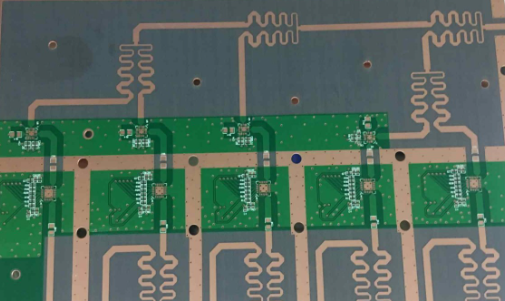
Rogers RT/duroid 5880 is a ceramic-filled PTFE (polytetrafluoroethylene) composite laminate, specifically engineered for high-frequency RF and microwave PCB applications.
Material Composition
The substrate consists of:
-
PTFE polymer matrix – provides excellent electrical insulation and thermal stability
-
Proprietary inorganic ceramic filler – tailors dielectric properties while preserving PTFE advantages
This composite formulation delivers:
-
Exceptionally stable dielectric constant across frequency and temperature
-
Ultra-low dielectric loss
-
Low Z-axis coefficient of thermal expansion (CTE)
-
Good mechanical rigidity suitable for double-sided and multilayer PCBs
2. Dielectric Properties of RT/duroid 5880
Dielectric performance is the most critical parameter for RF PCB materials. RT/duroid 5880 excels in this area.
Key Dielectric Parameters
-
Dielectric Constant (Dk): 2.20 ± 0.02
-
Loss Tangent (Df) @ 10 GHz: 0.0009
Unlike many substrates whose Dk varies significantly with frequency, RT/duroid 5880 maintains consistent performance from microwave to millimeter-wave bands.
Electrical Advantages
-
Easier impedance control
-
Higher Q-factor circuit designs
-
Lower insertion loss
-
Improved signal integrity at high frequencies
This makes RT/duroid 5880 ideal for high-Q resonators, antennas, filters, and low-noise RF front-end circuits.
3. Electrical, Mechanical & Thermal Properties
Electrical Properties
-
Volume Resistivity: 1 × 10¹⁴ ohm·cm
-
Surface Resistivity: 5 × 10¹⁴ ohms
-
Dielectric Strength: 3.0 × 10⁶ V/m
Mechanical Properties
-
Flexural Strength: 20,000 psi (138 MPa)
-
Tensile Strength: 10,000 psi (69 MPa)
-
Compressive Strength: 30,000 psi (207 MPa)
-
Density: 2.2 g/cm³
Thermal Properties
-
Thermal Conductivity: 0.71 W/m·K
-
Coefficient of Thermal Expansion (CTE): 17 ppm/°C
-
Max Continuous Operating Temperature: 170°C
-
Decomposition Temperature: >280°C
-
Water Absorption: <0.02%
These characteristics ensure excellent dimensional stability, thermal reliability, and environmental resistance.
4. Available Forms & Thickness Options
Sheet Laminates
Standard Sheet Sizes
-
12 × 18 in
-
18 × 24 in
-
24 × 36 in
Standard Thicknesses
-
0.005″, 0.010″, 0.015″, 0.020″
-
0.025″, 0.030″, 0.060″, 0.125″
(Custom thicknesses available upon request)
Roll Laminates
-
Widths: 12″, 24″, 48″
-
Standard Length: 250 ft (76 m)
-
Thickness Range: 0.005″ – 0.062″
This flexibility supports antenna arrays, large panels, and volume RF production.
5. Bonding & Multilayer PCB Options
Fusion Bonding (PTFE-to-PTFE)
-
No adhesive required
-
Bond strength > 2000 psi
-
Void-free interfaces
-
Superior electrical and mechanical integrity
-
Thinner, lighter multilayer boards
Recommended for high-performance RF and aerospace designs.
Adhesive Bonding
Compatible bonding materials include:
-
Rogers RO3000 / RO4000 series prepregs
-
Thermoset polyimide films
-
Epoxy-based bonding layers (e.g., FR-4 hybrid stacks)
Used for:
-
Mixed dielectric stack-ups
-
Metal-backed or heat-sink PCBs
-
Complex multilayer structures
KKPCB supports both bonding methods depending on performance and cost requirements.
6. Typical Applications of RT/duroid 5880 PCBs
-
Radar Systems – antennas, phased arrays, RF modules
-
Aerospace & Defense – satellites, avionics, flight systems
-
5G & Wireless Infrastructure – base stations, test equipment
-
Automotive Radar – ADAS, collision avoidance systems
-
High-Speed Digital (20+ Gbps) – SERDES, backplanes
-
Medical RF Devices – MRI coils, RF ablation systems
7. RT/duroid 5880 vs Other RF PCB Materials
| Material | Dk | Loss Tangent | Key Features |
|---|---|---|---|
| RT/duroid 5880 | 2.20 | 0.0009 | Ultra-low loss, best RF performance |
| RT/duroid 6002 | 2.94 | 0.0012 | Higher Dk, compact RF designs |
| Rogers RO3003 | 3.00 | 0.0013 | Balanced RF performance |
| Rogers RO4003C | 3.38 | 0.0027 | Cost-performance tradeoff |
| Nelco 4000-13SI | 3.66 | 0.0021 | Lower cost, mid-level RF |
| Taconic RF-60A | 6.15 | 0.0028 | High Dk applications |
| Rogers TMM10i | 9.80 | 0.0020 | Very high Dk designs |
RT/duroid 5880 remains the gold standard for ultra-low-loss RF circuits.
8. Design Guidelines for RT/duroid 5880 PCBs
Stack-Up Design
-
Use symmetrical layer structures
-
Balance copper distribution to minimize warpage
-
Follow Rogers lamination guidelines
Trace Width & Spacing
-
Minimum spacing ≥ 3× dielectric thickness
-
Wider traces for higher current and reduced loss
Impedance Control
-
Expect ±8% manufacturing tolerance
-
Use field solvers with Rogers material models
Signal & Power Integrity
-
Isolate RF from noisy digital circuits
-
Use solid reference planes and proper decoupling
Thermal Management
-
Use thermal vias under power devices
-
Ensure airflow and copper heat spreading
Manufacturing Considerations
-
Clearly define drilling, milling, and lamination cycles
-
Use Rogers-qualified PCB manufacturers like KKPCB
9. Rogers RT/duroid 5880 – FAQ
Q1: Can RT/duroid 5880 be used for multilayer PCBs?
Yes. Both fusion bonding and adhesive bonding are supported, depending on performance requirements.
Q2: Is RT/duroid 5880 an RF material?
Yes. It is specifically designed for RF, microwave, and millimeter-wave applications.
Q3: Is RT/duroid 5880 suitable for flexible PCBs?
No. It is rigid. For RF flex PCBs, Rogers FlexWave materials are recommended.
Q4: Is RT/duroid 5880 suitable for aerospace use?
Yes. It meets aerospace-grade requirements including low outgassing and thermal stability.
Q5: RT/duroid 5880 vs FR-4?
Pros:
-
Much lower loss
-
Stable impedance
-
Better thermal and moisture resistance
Cons:
-
Significantly higher cost
-
Specialized processing required
Rogers RT/duroid 5880 delivers unmatched electrical stability and ultra-low loss for mission-critical RF and microwave PCBs. While more expensive than FR-4, it is the preferred choice for applications where performance, reliability, and signal integrity cannot be compromised.
KKPCB specializes in Rogers PCB fabrication, offering:
-
RT/duroid 5880 prototypes & mass production
-
Hybrid Rogers + FR-4 stack-ups
-
Controlled impedance RF PCBs
-
Aerospace & automotive-grade manufacturing
