
For standard SMT PCBs, surface finish is often selected for solderability, storage life and cost.
But for RF, microwave, high-speed PCB, HDI, fine-pitch, radar, satellite communication, 5G RF and defense communication PCBs, surface finish can become part of the electrical performance discussion.
The key question is not simply:
Which gold finish is better?
The better question is:
When does the nickel layer become a design concern?
1. Structure Difference
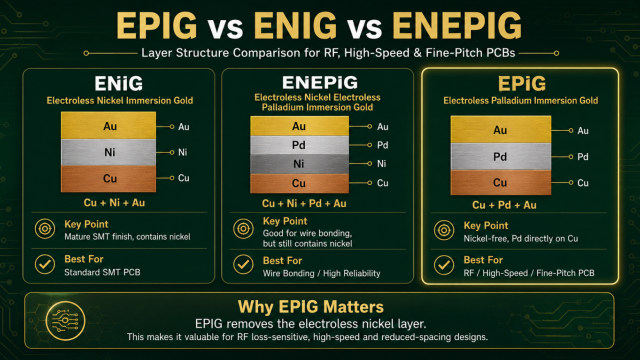
The core value of EPIG is not only palladium.
The real value is that EPIG removes the electroless nickel layer.
In EPIG, palladium is deposited directly onto copper, followed by immersion gold. This nickel-free structure is why EPIG is worth evaluating for high-frequency, fine-pitch and special reliability applications.
2. High-Frequency Signal Loss
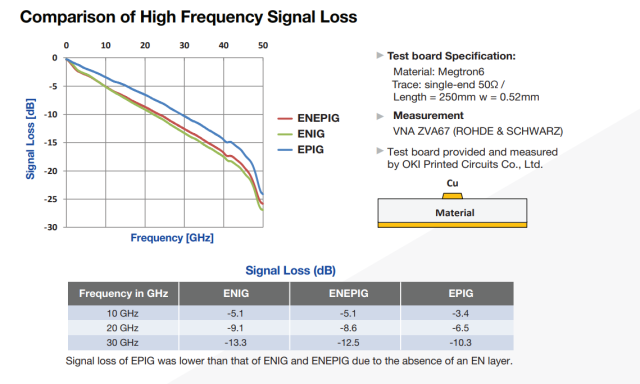
At high frequencies, current tends to concentrate near the conductor surface due to skin effect.
This means copper roughness, plating structure and surface finish can influence insertion loss.
In EPIG process evaluation, one important comparison is signal loss under RF transmission conditions.
3. Fine-Pitch and HDI Value
As PCB spacing becomes smaller, surface finish thickness becomes a manufacturing variable.
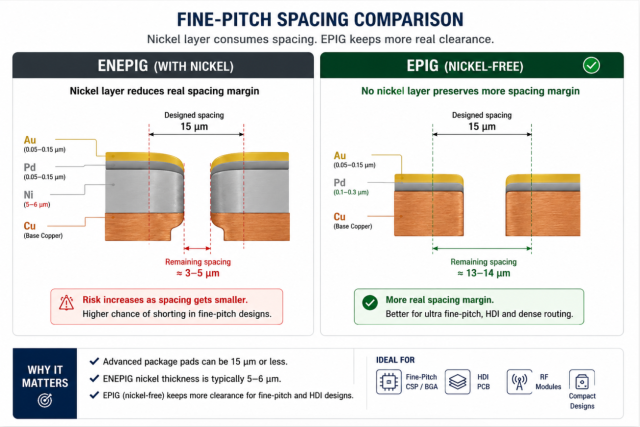
ENIG and ENEPIG both include an electroless nickel layer. In fine-pitch CSP, BGA, HDI PCB and compact RF module designs, this nickel layer can reduce the real spacing margin between pads or traces.
In some advanced package designs, spacing may reach 15 μm or less. If the nickel layer is 5–6 μm, the remaining clearance becomes very limited.
EPIG removes the electroless nickel layer and helps preserve more spacing margin.
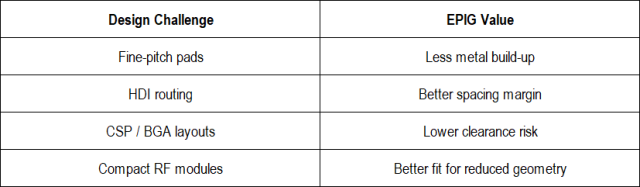
When spacing becomes smaller, every micron matters.
4. Soldering and Wire Bonding
EPIG is not only about signal loss.
It is also solderable and gold wire bondable.
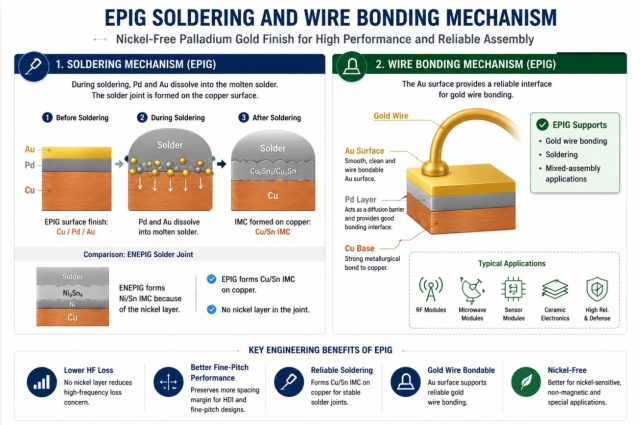
During soldering, palladium and gold dissolve into the molten solder, and the solder joint forms on the copper surface. The resulting intermetallic compound is Cu/Sn.
This is different from ENEPIG, where the solder joint normally forms Ni/Sn because of the nickel layer.
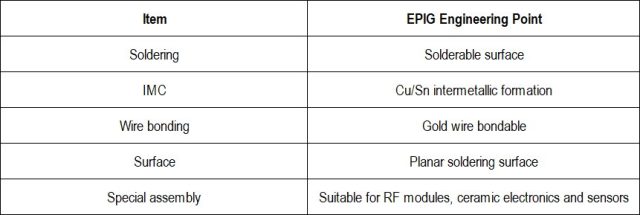
This makes EPIG useful when the PCB requires both solderability and wire bonding compatibility.
5. Where EPIG Fits Best
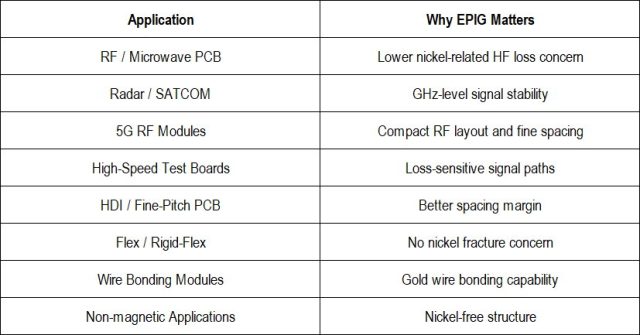
EPIG is not required for every PCB.
It becomes valuable when the design involves RF loss sensitivity, fine spacing, HDI density, flex bending, wire bonding or nickel-free requirements.
Final Takeaway
ENIG is still suitable for many standard SMT PCBs.
ENEPIG remains strong for high-reliability and wire bonding applications.
EPIG is worth evaluating when the project involves RF loss sensitivity, high-speed signal paths, fine-pitch geometry, HDI structures, flex reliability, wire bonding or nickel-free requirements.
The most important difference is not gold.
It is not even palladium.
The key difference is nickel.
EPIG removes the electroless nickel layer.
That is why it matters for advanced RF, high-speed and fine-pitch PCB manufacturing.
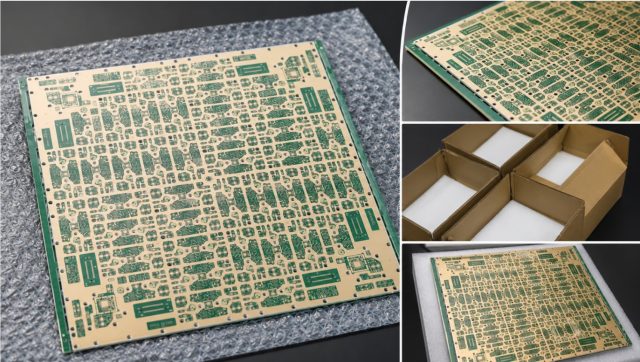
At KKPCB, we have moved EPIG from process evaluation to stable batch manufacturing, supporting high-speed, RF and high-reliability PCB projects with controlled nickel-free palladium gold surface finish.

